
Big Business Plan Template
-
 ShopifyPut your brand on Shopify. Launch your online store with tools designed for growth and success. Ready to turn your idea into profit? Start building your e-commerce business today.
 -
 SquarespaceShowcase your brand with Squarespace’s sleek designs. Build a professional online presence with ease. Start with a template that already looks finished.
 -
 WixBring your ideas to life with Wix. Customize every aspect of your site with unmatched flexibility. Start creating your unique online space and let your creativity shine.
 -
 ElementorCraft captivating websites effortlessly with Elementor. Enjoy complete creative control without coding. Make your site stand out to your audience. Start turning your vision into reality now.
- Executive Summary
- Business Info
- SWOT Analysis
- Big Business Name Ideas
- Website
- Marketing Details
- Industry Trends
- Competitor Information
- Financial Information
- Legal and Compliance
- Operational Plan
- Contingency Planning
- Build a Big Business Plan That Works
- Cover All the Business Models
- Keep Evolving Your Business Plan
- Practical Applications of Your Plan
- Your Future is Bright
A "Big" business plan template covers the operating model for a venture aiming for scale: multi-location, multi-product, or a national customer base. The structure is similar to a small-business plan, but the financials, hiring plan, and supply chain need more depth. Your plan should describe the customer segments, the long-term revenue streams, and the milestones that justify the larger fixed costs. Without those specifics, "big" is just an ambition, not a strategy.
Building a Big business plan takes focused work, not vague optimism. Lay out the funding stages, the management team's responsibilities, the unit economics per channel, and the exit horizon if you are pursuing one. For adjacent templates, see our corporate business plan template and startup business plan template. Use the structure below as a working baseline and adjust each section to match your specific industry.
Executive Summary
Our mission is to provide exceptional products and services that meet the diverse needs of our target market while promoting sustainable practices and community engagement. Our vision is to become a leader in our industry, known for quality, innovation, and customer satisfaction.
We will differentiate ourselves through our value proposition of delivering high-quality products with exceptional customer service. Our financial goals aim for a steady growth rate of 15% annually, allowing us to expand our operations and product offerings effectively.
Business Info
We will offer a range of innovative products aimed at modern consumers who value quality and sustainability. Our target market includes environmentally conscious individuals aged 18 to 45, who are looking for products that align with their values. We will operate under a direct-to-consumer model, allowing us to maintain competitive pricing and a personalized shopping experience.
SWOT Analysis
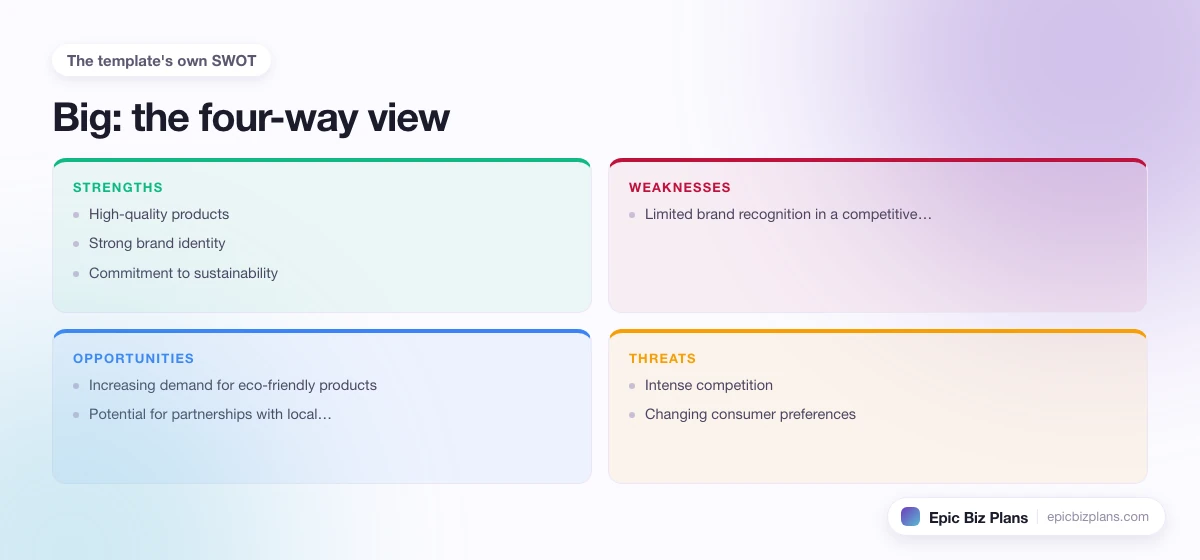
- Strengths: High-quality products, strong brand identity, commitment to sustainability.
- Weaknesses: Limited brand recognition in a competitive market.
- Opportunities: Increasing demand for eco-friendly products, potential for partnerships with local organizations.
- Threats: Intense competition, changing consumer preferences.
Big Business Name Ideas
Website
We will build our website using Shopify, as it provides the necessary tools for an effective eCommerce platform. Shopify allows for smooth transactions and has excellent customization options, ideal for showcasing our products. Alternatively, we may consider Squarespace to create a visually appealing site that resonates with our brand aesthetic.
Marketing Details
Our marketing strategy will combine digital marketing and social media initiatives. We will use Semrush for SEO management to improve our online visibility. HubSpot will be key in managing our email campaigns, ensuring we engage directly with our consumers.
To reach younger demographics, we will run targeted TikTok ads, showing our products and values in real use to build brand awareness and drive sales.
Industry Trends
The market trend toward sustainability continues to grow as more consumers seek eco-conscious options. Technological advancements in eCommerce, including AI-driven analytics and personalized shopping experiences, will shape how we engage with our audience.
Advancements in production methods that reduce waste will also become increasingly relevant to our business operations. Our sustainable business plan template covers eco-focused operating models in more depth.
Competitor Information
Our main competitors are established brands specializing in eco-friendly products. We will differentiate ourselves through our strong commitment to community engagement, unique product offerings, and personalized customer service. Indirect competitors include conventional brands that do not focus on sustainability.
Financial Information
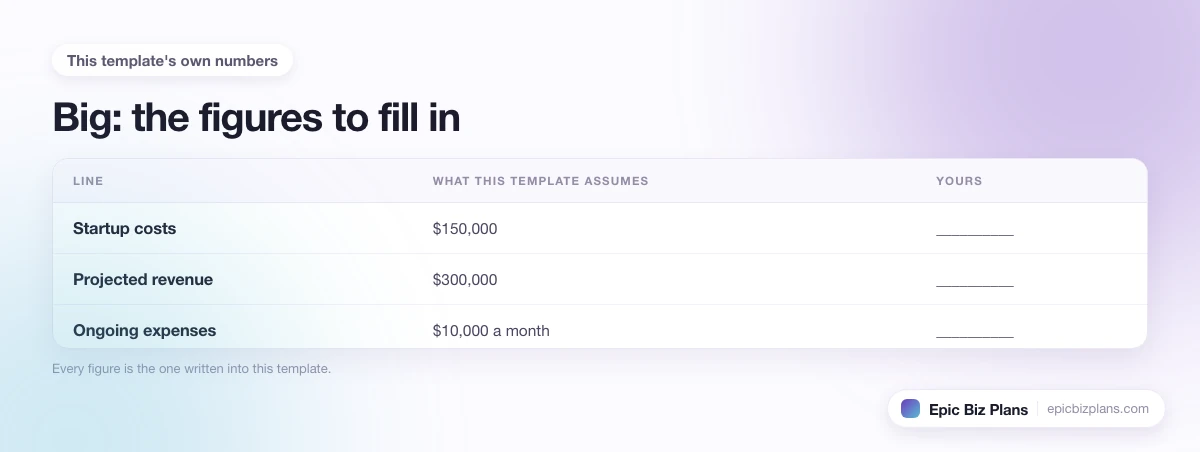
We estimate our startup costs at approximately $150,000, covering inventory, marketing, and operational expenses. Our projected revenue in the first year is $300,000, with ongoing monthly expenses around $10,000.
We expect to maintain a healthy cash flow and will closely monitor our P&L statements to ensure financial stability and profitability over time.
Legal and Compliance
We will comply with all legal requirements necessary for operating our business, including registration and obtaining relevant permits. Protecting our intellectual property will be vital, so we will explore trademarking our brand name and logo.
Operational Plan
Our operations will focus on creating an efficient supply chain, working with local suppliers whenever possible to maintain both quality and sustainability. Logistics will be handled efficiently to provide timely deliveries to our customers.
-
 SemrushSemrush is a platform with literally any online tool you will need to promote your business. Spy on your competitors, get search traffic, keyword research, social info, ad copies and much more. Used by most of the top online companies in the world. Besides all its tools, Semrush also has many available integrations possible with many other tools that will make your work even better.
 -
 Surfer SEOSurfer SEO is an incredibly smart AI tool that will give you exact explanations what to do in order to make your website rank better. They use hundreds of parameters, check your competitors and decide on the best course of action. Whether it be inner links, bold text, paragraphs, headers, images and much more. Surfer is a must-have in 2026.
Contingency Planning
We recognize various risks, including supply chain disruptions and fluctuating consumer demand. Our mitigation strategies will include securing multiple suppliers and maintaining a flexible inventory system to adapt to changes effectively.
We will also keep monitoring industry trends and consumer preferences to stay ahead of potential market shifts.
Build a Big Business Plan That Works
Starting a business at scale is a different exercise from a side project. A brick-and-mortar chain, a national eCommerce brand, or a multi-location service company each need real plans for hiring, finance, and operations. The Big business plan keeps those moving parts aligned. For a wider lens on building a venture from the ground up, see our entrepreneur business plan template.
Cover All the Business Models
A Big business plan can support many models, from tech ventures to a chain of cafés, from subscription boxes to handmade goods at scale. Each model has its own working capital requirements and customer acquisition math. Pick the model that matches your starting capital, then build the plan to support that path. For a smaller-scale comparison, the small business plan template shows the typical structure used by independent operators.
Keep Evolving Your Business Plan
As you grow, update your Big business plan to reflect new audiences, pricing changes, new products, or new regions. The document is most useful when it matches the real state of the business and the next 12 months of decisions. Set a quarterly review so revisions happen on a cadence. The discipline keeps the plan trustworthy for investors and partners.
Practical Applications of Your Plan
Treat your Big business plan as a toolkit. Use it when presenting to potential partners, planning a launch, applying for funding, or aligning your team on strategy. Each version sharpens your focus on what is working and what is not. The plan is also the document lenders and landlords will ask to see before they commit.
Your Future is Bright
Your big business plan is 100% free, with unlimited edits, unlimited downloads, and unlimited chances to get it right. Replace the placeholder numbers with quotes from your real suppliers, lease terms from your real city, and salary figures from your real hiring plan. The earlier you anchor it in real numbers, the more useful the document becomes.
