
Belt Business Plan Template
-
 ShopifyPut your brand on Shopify. Launch your online store with tools designed for growth and success. Ready to turn your idea into profit? Start building your e-commerce business today.
 -
 SquarespaceShowcase your brand with Squarespace’s sleek designs. Build a professional online presence with ease. Start with a template that already looks finished.
 -
 WixBring your ideas to life with Wix. Customize every aspect of your site with unmatched flexibility. Start creating your unique online space and let your creativity shine.
 -
 ElementorCraft captivating websites effortlessly with Elementor. Enjoy complete creative control without coding. Make your site stand out to your audience. Start turning your vision into reality now.
- Executive Summary
- Business Info
- SWOT Analysis
- Business Name Ideas
- Website
- Marketing Details
- Industry Trends
- Competitor Information
- Financial Information
- Legal and Compliance
- Operational Plan
- Contingency Planning
- Putting Your Belt Business Plan to Work
- Explore Your Options
- Adapt as You Grow
- Practical Uses for Your Plan
Your Belt business plan is the foundation for a brand that competes on both style and durability. Belts sit at the intersection of fashion and function, so a clear plan helps you decide where your product fits, who you sell to, and how you stand out. This template walks through every section you need, from your executive summary to your operational plan. Treat it as a working document you refine as your product line and customer base grow.
Every part of your plan should reflect what your brand stands for and what your buyers actually want. Strong designs, considered materials, and a focused marketing approach matter more than broad claims about being the best. Fill in each section with specifics about your belts, your pricing, and your channels. The more concrete your plan, the easier it is to act on and to share with partners or lenders.
Executive Summary
Our mission is to provide high-quality and stylish belts that cater to diverse consumer needs. Makers working in leather more broadly can review the leather craft business plan template. We envision becoming a leading brand in the accessories market, known for our commitment to quality, design, and affordability. Our value proposition lies in offering a blend of function and fashion, so customers look good and feel confident. Financially, we aim to reach break-even within the first year and build steady revenue growth after that.
Business Info
We will offer a variety of belts, including casual, formal, leather, and vegan options. Our target market includes fashion-forward individuals aged 18-35 who value both style and sustainability. If you plan a wider product range, the accessories business plan template covers complementary lines like bags and small leather goods. Our business model will focus on direct-to-consumer sales through an e-commerce platform, supplemented by occasional pop-up events.
SWOT Analysis
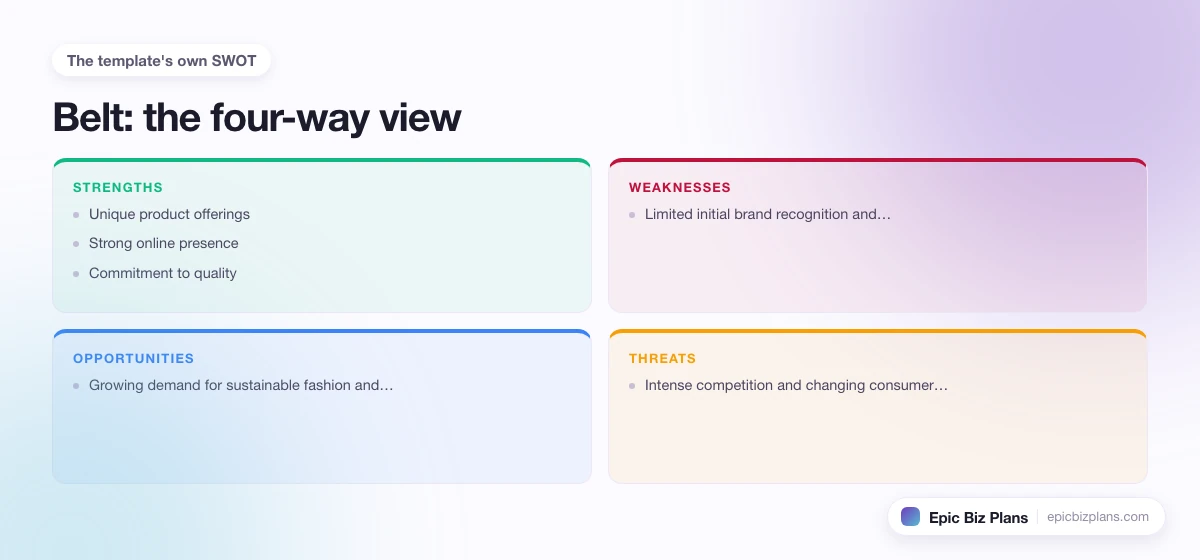
- Strengths: Unique product offerings, strong online presence, and commitment to quality.
- Weaknesses: Limited initial brand recognition and reliance on online sales.
- Opportunities: Growing demand for sustainable fashion and the potential to expand internationally.
- Threats: Intense competition and changing consumer preferences.
Business Name Ideas
Website
We will build our e-commerce website using Shopify, as it offers a user-friendly interface and strong features for online sales. This will help easy product listings, inventory management, and secure payment processing. Shopify will allow us to create a visually appealing storefront that aligns with our brand identity. We will also consider Squarespace if we want more artistic layout options in the future.
Marketing Details
Our marketing strategy will cover both digital marketing and social media efforts. We will use Semrush for SEO to improve our visibility in search results.
Additionally, we will use HubSpot for email campaigns aimed at nurturing customer relationships and promoting special offers. To reach a younger demographic, we will run advertising through TikTok ads, using trending content to draw attention to our products. A focus on sustainable materials also gives us a story to tell, much like the angle covered in the sustainable fashion business plan template.
Industry Trends
The fashion accessories industry is seeing significant technological advancements, especially in e-commerce and personalized shopping experiences. Virtual fitting rooms and AI-driven recommendations are becoming more common, giving customers a more tailored shopping experience. There is also a growing move toward sustainability, with shoppers favoring brands that prioritize eco-friendly practices in production.
Competitor Information
We will analyze both direct competitors, such as established belt brands, and indirect competitors like general accessory retailers. Our strategy to set ourselves apart will include a strong emphasis on eco-friendly materials, distinct designs, and excellent customer service. Brands that also sell wallets or small leather pieces can compare notes with the wallet business plan template. By building a loyal community around our brand, we encourage customer retention and word-of-mouth referrals.
Financial Information
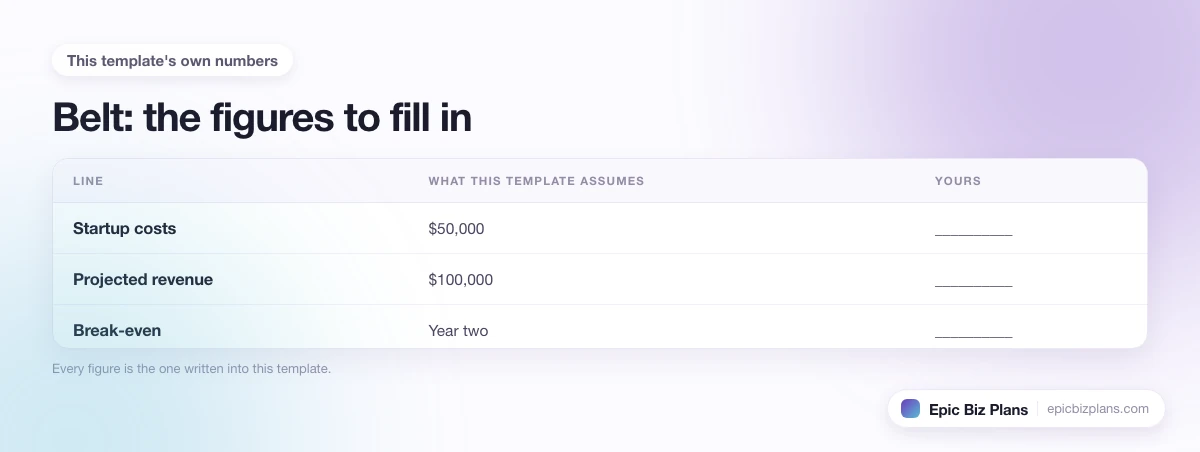
Our initial startup costs are estimated to include material sourcing, website development, marketing, and operational costs, totaling approximately $50,000. We project our revenue to reach $100,000 in the first year as we establish our brand and customer base, with ongoing expenses primarily arising from inventory, marketing, and operational overheads. Cash flow will be closely monitored to maintain positive liquidity throughout operations, ensuring profitability is achievable by year two.
Legal and Compliance
We will ensure compliance with all legal requirements, including business registration, tax obligations, and intellectual property protection for our brand and product designs. This will include registering trademarks for our brand name and logos.
Operational Plan
Key operations will involve sourcing materials responsibly and establishing relationships with manufacturers for high-quality production. Our supply chain will focus on minimizing delays and ensuring consistent product availability. Logistics will be managed through partnerships with reliable shipping carriers to offer our customers efficient delivery options.
Contingency Planning
Potential risks include supply chain disruptions, changing consumer preferences, and increased competition. To reduce these risks, we will diversify our supplier base to avoid dependence on any single source, continuously monitor market trends, and keep a flexible marketing strategy to adapt quickly to changes.
Putting Your Belt Business Plan to Work
Starting a belt business is about more than fashion; it ties into identity, lifestyle, and the way people present themselves. It is your chance to combine design with commerce, turning your belt ideas into products that people choose and recommend. Whether you picture an online shop, a local artisan brand, or a line of accessories tied to a specific culture or subculture, your plan is the step that moves it forward.
Explore Your Options
In the belt market, the range of niches is wide. From high-end leather collections to colorful belts aimed at kids, your focus can be broad or narrow, local or international. Consider selling through online marketplaces, your own storefront, or brick-and-mortar stores. Each path has distinct advantages worth weighing before you commit.
-
 SemrushSemrush is a platform with literally any online tool you will need to promote your business. Spy on your competitors, get search traffic, keyword research, social info, ad copies and much more. Used by most of the top online companies in the world. Besides all its tools, Semrush also has many available integrations possible with many other tools that will make your work even better.
 -
 Surfer SEOSurfer SEO is an incredibly smart AI tool that will give you exact explanations what to do in order to make your website rank better. They use hundreds of parameters, check your competitors and decide on the best course of action. Whether it be inner links, bold text, paragraphs, headers, images and much more. Surfer is a must-have in 2026.
Adapt as You Grow
As you build this venture, remember that your Belt business plan should change alongside your business. Updating it for different audiences, pricing models, and sales channels is essential for growth. Every edit gives you fresh insight that keeps your strategy aligned with your goals and the market.
Practical Uses for Your Plan
Your plan can serve several roles: a pitch to potential partners, a blueprint for your launch, or a guide for securing funding. Clarity in strategy points you in the right direction and gives confidence to the people who join you.
Your Belt business plan is 100% free, with unlimited edits, unlimited downloads, and unlimited chances to get it right. Let's turn your vision into a real product.
