
Accessories Business Plan Template
-
 ShopifyPut your brand on Shopify. Launch your online store with tools designed for growth and success. Ready to turn your idea into profit? Start building your e-commerce business today.
 -
 SquarespaceShowcase your brand with Squarespace’s sleek designs. Build a professional online presence with ease. Start with a template that already looks finished.
 -
 WixBring your ideas to life with Wix. Customize every aspect of your site with unmatched flexibility. Start creating your unique online space and let your creativity shine.
 -
 ElementorCraft captivating websites effortlessly with Elementor. Enjoy complete creative control without coding. Make your site stand out to your audience. Start turning your vision into reality now.
- Executive Summary
- Business Info
- SWOT Analysis
- Accessories Business Name Ideas
- Website
- Marketing Details
- Industry Trends
- Competitor Information
- Financial Information
- Legal and Compliance
- Operational Plan
- Contingency Planning
- Build a Brand Around Your Creativity
- Explore Diverse Business Opportunities
- Adapt and Grow with Your Business
- Seize Your Opportunity
An accessories business plan covers product sourcing, brand positioning, and the sales channels that get bags, jewelry, hats, or belts in front of buyers. Margins in accessories tend to be strong, but inventory turnover and trend forecasting are what separate profitable brands from clearance bins. Your plan should be specific about which categories you sell, your sourcing partners, and how you balance evergreen items with seasonal drops.
When building your plan, get specific about positioning. Bold statement pieces, minimalist staples, and category-specific lines like handbag business plan or handmade jewelry business plan all require different sourcing and marketing strategies. Document target customer demographics, average order value, and the channels (Shopify, Etsy, wholesale, in-person markets) you'll use to reach them. Brands building a wallet line as part of a wider accessories range should also review the wallet business plan template for category-specific operational detail.
Executive Summary
We will focus on providing high-quality accessories that appeal to a diverse range of consumers. Sellers building a wider lifestyle range around accessories can reference a Willie B Livy business plan that spans decor, fashion, and personal care. Our mission is to enhance personal style and individual expression through our curated selection of fashionable items, including identity-driven lines like those featured in a Pride business plan. Our vision is to become a household name in the accessories industry, known for our commitment to quality, design, and customer satisfaction. Our unique value proposition lies in our ability to blend trendy designs with affordability, ensuring our products are accessible to all.
Financially, we aim to achieve profitability within the first 18 months of operation, with projected revenue growth of 25% annually. For a related approach, see the jewel business plan template.
Business Info
We will offer a variety of accessories including jewelry, bags, belts, hats, and scarves, and shoppers drawn to durable leather pieces can also explore our leather goods business plan template. Our target market will consist of trendy young adults aged 18-35, who are fashion-forward and enjoy expressing their unique styles through accessories. Our business model will be primarily e-commerce based, allowing us to reach a wider audience without geographical constraints See our sure business plan for related planning.
SWOT Analysis
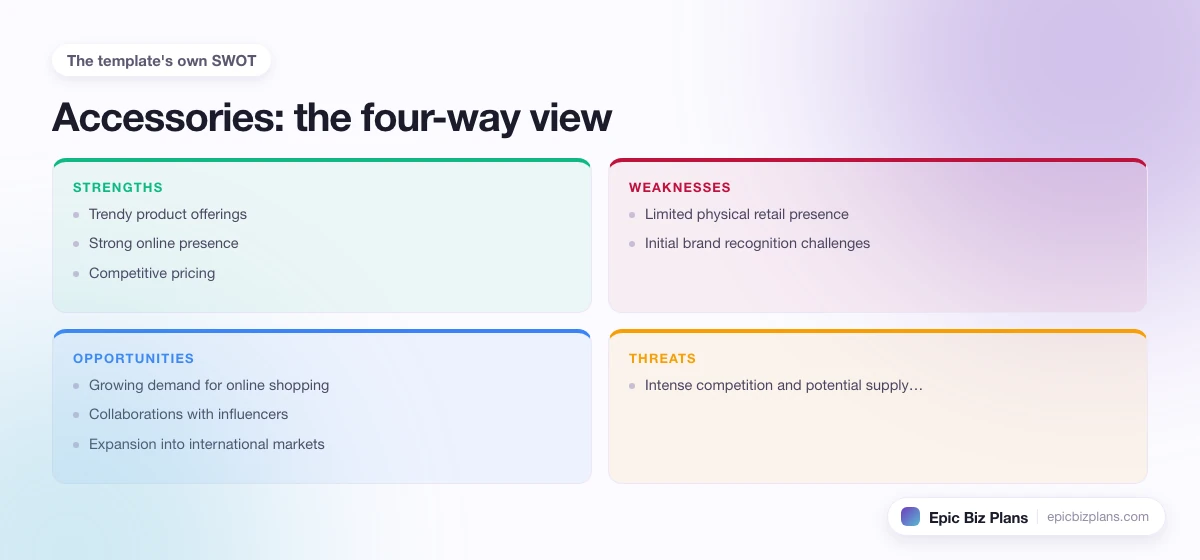
- Strengths: Trendy product offerings, strong online presence, and competitive pricing.
- Weaknesses: Limited physical retail presence, initial brand recognition challenges.
- Opportunities: Growing demand for online shopping, collaborations with influencers, and expansion into international markets.
- Threats: Intense competition and potential supply chain disruptions.
Accessories Business Name Ideas
Website
We will build our e-commerce website using Shopify for its strong features, which are well-suited for online sales. This platform will enable us to manage our inventory efficiently, process payments securely, and provide an excellent shopping experience for our customers. We may also consider Squarespace, which offers beautiful design templates, should we look for a more visually-oriented site.
Marketing Details
Our marketing strategy will encompass a detailed digital marketing approach. We will employ Semrush for search engine optimization to enhance our online visibility and attract potential customers. For email marketing campaigns, we will use HubSpot to build engagement and retain existing customers.
Additionally, we will use TikTok ads to reach younger demographics effectively, showcasing our products in creative and entertaining ways that resonate with our target audience.
Industry Trends
The accessories industry is witnessing a shift towards sustainable products as consumers increasingly prefer eco-friendly options. Additionally, technological advancements such as augmented reality for virtual try-ons and personalized shopping experiences are reshaping how consumers engage with product offerings. We will stay abreast of these trends and incorporate them into our strategy to enhance customer experience.
Entrepreneurs building a general DTC lifestyle or accessories brand should also review the Sri business plan template, which covers the core DTC eCommerce planning framework, brand positioning strategy, and financial model for a quality-focused product brand.
Competitor Information
Our main competitors will include established accessory brands as well as emerging online boutiques. We will analyze their pricing strategies, product offerings, and customer engagement techniques. To differentiate ourselves, we will focus on unique designs not readily available in the market, exceptional customer service, and a strong online community through social media engagement.
Financial Information
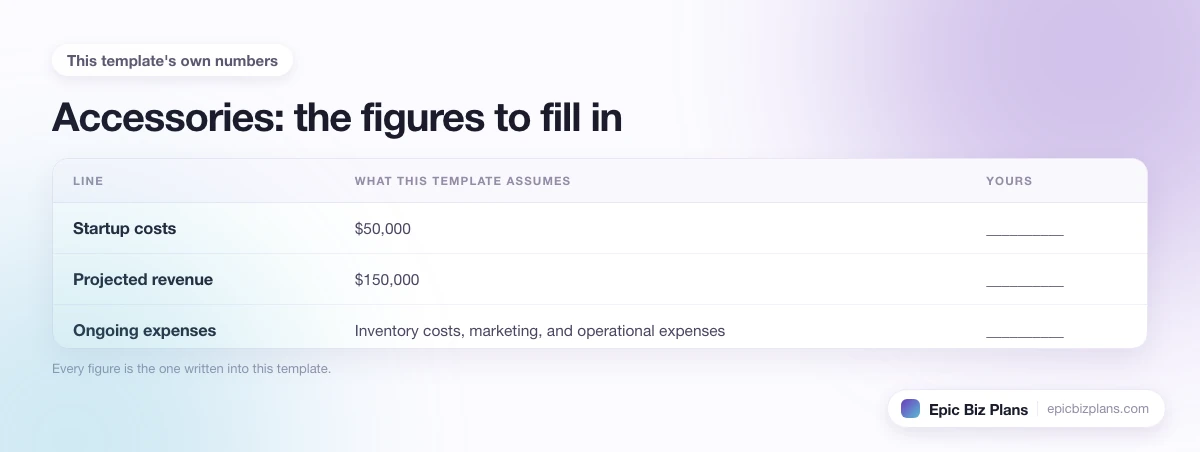
We anticipate startup costs to be approximately $50,000, covering product sourcing, website development, and initial marketing expenses. Our projected revenue for the first year is expected to be around $150,000, with a steady increase as brand recognition grows. Ongoing expenses will include inventory costs, marketing, and operational expenses, which we will monitor closely to maintain healthy cash flow.
Legal and Compliance
We will ensure compliance with local and federal regulations by registering our business, obtaining necessary licenses, and securing intellectual property rights for our unique designs. It is crucial to protect our brand through trademarks and adhere to industry standards for product safety and quality. For another angle, see our K-pop merch business plan.
Operational Plan
Our key operations will center around e-commerce logistics, including inventory management, order fulfillment, and customer service. We will establish relationships with reliable suppliers and logistics companies to ensure timely delivery and quality control. Inventory will be managed efficiently to reduce overhead costs while meeting customer demand.
Contingency Planning
We recognize the potential risks associated with starting a new business, including market fluctuation and supply chain issues. To mitigate these risks, we will develop strong relationships with multiple suppliers to ensure continuity of product availability, and we will maintain an emergency fund to cover unexpected expenses. Regular market analysis will also help us adapt our strategies in response to changes in consumer behavior.
-
 SemrushSemrush is a platform with literally any online tool you will need to promote your business. Spy on your competitors, get search traffic, keyword research, social info, ad copies and much more. Used by most of the top online companies in the world. Besides all its tools, Semrush also has many available integrations possible with many other tools that will make your work even better.
 -
 Surfer SEOSurfer SEO is an incredibly smart AI tool that will give you exact explanations what to do in order to make your website rank better. They use hundreds of parameters, check your competitors and decide on the best course of action. Whether it be inner links, bold text, paragraphs, headers, images and much more. Surfer is a must-have in 2026.
Build a Brand Around Your Creativity
Starting an accessories business turns a feel for style into a real product line. Your plan covers what you'll make or source, how you'll price it, and where you'll sell it. An accessories business plan helps you find your category position and connect with the customer you're actually trying to win.
Explore Diverse Business Opportunities
The accessories market spans small-scale artisans making one-of-a-kind pieces to eCommerce platforms moving high volumes of trend-driven product. You might run a local boutique that features regional makers or build an online store focused on eco-friendly materials. Each category, whether jewelry, bags, or hats, has its own sourcing and margin profile worth working through in the plan.
Adapt and Grow with Your Business
Your accessories business plan is a working document. Update it as your audience, pricing tiers, product range, or sales channels shift. A current plan also speeds up partner conversations, launch planning, and funding applications. Makers of themed, mythology-inspired accessories can also review our Greek god business plan template.
Seize Your Opportunity
This is your moment to step into your passion and create something impactful. Your accessories business plan is 100% free, with unlimited edits, unlimited downloads, and unlimited chances to get it right. Embrace the process ahead.
