
Bread Business Plan Template
-
 ShopifyPut your brand on Shopify. Launch your online store with tools designed for growth and success. Ready to turn your idea into profit? Start building your e-commerce business today.
 -
 SquarespaceShowcase your brand with Squarespace’s sleek designs. Build a professional online presence with ease. Start with a template that already looks finished.
 -
 WixBring your ideas to life with Wix. Customize every aspect of your site with unmatched flexibility. Start creating your unique online space and let your creativity shine.
 -
 ElementorCraft captivating websites effortlessly with Elementor. Enjoy complete creative control without coding. Make your site stand out to your audience. Start turning your vision into reality now.
- Executive Summary
- Business Info
- SWOT Analysis
- Bread Business Name Ideas
- Website
- Marketing Details
- Industry Trends
- Competitor Information
- Financial Information
- Legal and Compliance
- Operational Plan
- Contingency Planning
- Every Slice Counts
- Exploring Opportunities
- Grow with Your Plan
- Practical Use Cases
- Take the Next Step
A bread business plan is your starting point for entering an industry built on daily habit and repeat customers. Demand for artisan loaves, sourdough, and specialty breads keeps climbing, and a clear plan helps you turn that demand into a working business. This is about more than mixing dough. It covers who you sell to, how you price your loaves, and what makes your bakery worth a second visit.
Your plan should reflect your brand, the story behind your recipes, and what your customers actually want. Look for ways to stand out by matching real trends, gluten-free options, local sourcing, or seasonal flavors, to what buyers in your area are asking for. A good plan guides your daily operations and keeps your goals in front of you as you grow. Build steadily, test your recipes, and let demand tell you where to expand next. For a related model, see the pastries business plan.
Executive Summary
Our mission is to provide high-quality, artisan bread that fits a range of tastes and dietary needs. Over the next five years we want to become a recognized name in the local bakery market, known for freshness, flavor, and sustainable practices. Our value proposition rests on organic ingredients, tested recipes, and traditional baking methods applied across a wide range of breads. Financially, we aim to break even within the first year and hold a 20% margin on every product sold. For related angles, our pretzel walk-through goes deeper, and the patisserie business plan template is worth a look too.
Business Info
Our offerings will include a variety of breads such as sourdough, whole grain, gluten-free, and special seasonal flavors. Bakeries that buy direct from a local mill can source heritage grains through partners running a focused mill business plan, or work with producers following a milling business plan for custom flour blends. Bakers leaning into long-fermentation loaves can follow the sourdough rustic business plan for a deeper look at sourcing and production. We will target health-conscious consumers, food enthusiasts, and shoppers looking for fresh local products. Our business model will focus on direct-to-consumer sales through our bakery, local farmers' markets, and online orders for delivery or pickup.
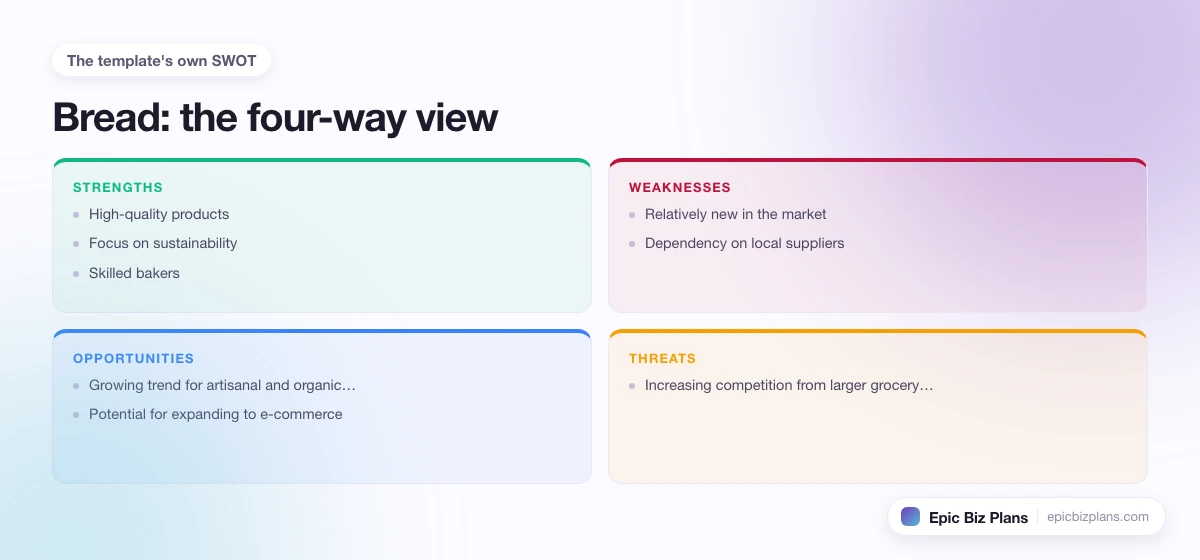
SWOT Analysis
- Strengths: High-quality products, focus on sustainability, skilled bakers.
- Weaknesses: Relatively new in the market, dependency on local suppliers.
- Opportunities: Growing trend for artisanal and organic products, potential for expanding to e-commerce.
- Threats: Increasing competition from larger grocery chains and other local bakeries.
Bread Business Name Ideas
Website
We will build our website on Shopify to support e-commerce, which lets us reach a wider customer base and handle online orders efficiently. Shopify's built-in tools help manage the sales process, track inventory, and give customers an easy checkout. If we decide to lean more toward showcasing our products visually, we will also consider Squarespace.
Marketing Details
Our marketing strategy will combine digital marketing and social media outreach. We will use Semrush for search engine optimization to improve our online visibility. To engage our audience effectively, we will run email campaigns through HubSpot, reaching both new and returning customers with promotions and updates on new products.
On social media, we will use TikTok ads to reach a younger demographic, showing our baking process and unique bread offerings. Awareness campaigns will focus on the freshness, quality, and character of our products, helping to build a strong brand presence.
Industry Trends
The bakery industry keeps shifting toward health-conscious products, with steady demand for gluten-free, organic, and artisan breads. Better baking equipment and e-commerce platforms both improve product quality and make it easier for customers to buy. Bakers adding flavored or value-added lines can look at a garlic bread business plan template for ideas on extending a core bread menu. Our bakery will track these shifts to stay competitive and relevant.
Bread makers who also produce other baked goods for sale should review a home baking business plan to understand how to structure a multi-product operation from a residential kitchen. For founders working on closely related concepts, the wheat business plan covers a parallel framework worth reviewing. Bakers planning a health-focused product line can also review the artisanal bakery business plan template.
Competitor Information
We will analyze both direct competitors (local bakeries and artisan bread shops) and indirect competitors (supermarkets offering premade bread). To set ourselves apart, we will focus on our own recipes, organic ingredients, and strong customer service. Offering tastings and samples at local events will also help build our brand presence and attract new customers. Bakers building a wider menu around bread, pastries, and cakes can plan that range with a Crust business plan.
Financial Information
Startup costs will include equipment, ingredients, marketing, and location leasing. We estimate initial costs to be around $50,000. Projected revenue in the first year is expected to reach approximately $100,000, with ongoing expenses, including rent and salaries, consuming around $60,000 annually. We will monitor our cash flow and aim for consistent profitability through careful financial management and sales tracking.
Legal and Compliance
We will handle legal compliance by registering the business in our state, obtaining the necessary food handling permits, and meeting all health and safety standards. We will also look into intellectual property protection for our recipes and branding.
Operational Plan
Key operations will include daily baking, inventory management, marketing efforts, and customer service. We will build a reliable supply chain by partnering with local organic farmers for ingredients and using efficient logistics for product distribution. Our production process will emphasize quality control to keep our standards high.
Contingency Planning
To prepare for risks such as fluctuating ingredient costs or unexpected equipment failures, we will keep an emergency fund of at least three months of operating expenses. Building relationships with several suppliers will help offset supply chain disruptions, so we can keep operating even in difficult stretches.
Every Slice Counts
Why start a bread business? It comes down to more than dough and an oven. It is about the kind of work you want to do, the recipes you want to build, and the freedom to run things your way. The plan you write becomes the roadmap, whether you picture a neighborhood bakery full of regulars or an online store shipping artisan loaves across the country.
-
 SemrushSemrush is a platform with literally any online tool you will need to promote your business. Spy on your competitors, get search traffic, keyword research, social info, ad copies and much more. Used by most of the top online companies in the world. Besides all its tools, Semrush also has many available integrations possible with many other tools that will make your work even better.
 -
 Surfer SEOSurfer SEO is an incredibly smart AI tool that will give you exact explanations what to do in order to make your website rank better. They use hundreds of parameters, check your competitors and decide on the best course of action. Whether it be inner links, bold text, paragraphs, headers, images and much more. Surfer is a must-have in 2026.
Exploring Opportunities
From a small neighborhood bakery to an online bread subscription service, there is real room to build. You can focus on gluten-free, organic, or traditional loaves, or offer a mix of all three. Partnerships help too, from local farmers who supply your grain to creators who help market your loaves online.
Grow with Your Plan
Your bread business plan is not a static document; it should change as you do. Update it for different audiences or sales channels, from local farmers' markets to regional wholesale. Consider adding new pricing models and products as your brand grows to meet customer demand.
Practical Use Cases
This plan is a versatile tool. Use it to present to partners, outline a launch strategy, secure funding, or clarify your overall approach. Whatever your next step, your bread business plan will help you stay well-prepared.
Take the Next Step
Your bread business plan is 100% free, with unlimited edits, unlimited downloads, and unlimited chances to get it right. Start shaping your business today and watch every slice of your work turn into a real venture.
