
Baby And Kids Business Plan Template
-
 ShopifyPut your brand on Shopify. Launch your online store with tools designed for growth and success. Ready to turn your idea into profit? Start building your e-commerce business today.
 -
 SquarespaceShowcase your brand with Squarespace’s sleek designs. Build a professional online presence with ease. Start with a template that already looks finished.
 -
 WixBring your ideas to life with Wix. Customize every aspect of your site with unmatched flexibility. Start creating your unique online space and let your creativity shine.
 -
 ElementorCraft captivating websites effortlessly with Elementor. Enjoy complete creative control without coding. Make your site stand out to your audience. Start turning your vision into reality now.
- Executive Summary
- Business Info
- Business Model Overview
- SWOT Analysis
- Business Name Ideas
- Website
- Marketing Details
- Industry Trends
- Competitor Information
- Startup Cost Breakdown
- Financial Information
- Legal and Compliance
- Operational Plan
- Key Metrics to Track
- Contingency Planning
- Build a Baby and Kids Brand Parents Trust
- Keep Your Plan Updated
- Practical Applications
- Get Started
The baby and kids product market is built on trust. Parents research purchases thoroughly, prioritize safety above all else, and tend to stay loyal to brands that consistently deliver on their promises. This business plan template walks you through every component of launching a baby and kids business - from defining your product range and target customer to mapping out your financials and operational workflow. Use it as a practical guide, not just a funding document. Brands serving busy mothers can also reference a Mom Life business plan for community-driven positioning.
Whether you are building an eco-friendly baby clothing brand, a curated toy subscription box, or an online store for educational materials, the framework below applies. The specifics you fill in will make it your own. Focus on accuracy in every section - a plan grounded in real market research and honest financial projections is more useful than an optimistic one. Safety-minded founders can also review a dedicated children safety business plan. Importers of children’s products should read our kids stuff business plan for the testing, certificate and customs filing requirements now in force.
Executive Summary
We will build a baby and kids product business focused on eco-friendly, safety-certified products for children aged 0 to 10. Brands that want to specialize in apparel for older kids can review a girl clothes business plan. Our mission is to give parents access to high-quality, sustainably produced alternatives to conventional baby and kids products - without the premium pricing that currently limits access to this category.
First-year revenue target is ,000, achieved through online direct-to-consumer sales supplemented by partnerships with local boutiques. We project breakeven within 18 months, with a gross margin target of 55% or higher across the core product range.
Business Info
Our product range covers organic clothing, educational toys, and developmental play materials for children from newborn through age 10, including items that pair well with a kids fun business plan focused on play experiences. The eco-friendly positioning targets parents who are already making sustainable purchasing decisions in other categories and are actively looking for equivalent options in the baby and kids space.
We will launch with a focused SKU count - eight to twelve products - to keep inventory costs manageable and quality control straightforward while we validate product-market fit. Expanding the range prematurely is one of the most common mistakes in product businesses at this stage.
Business Model Overview
Revenue comes from direct-to-consumer online sales through our Shopify store, supplemented by wholesale partnerships with boutique children's retailers and potential subscription box offerings for recurring revenue. The direct channel provides the best margins and the most customer data - both valuable early in the business.
Subscription bundles for age-appropriate developmental toys delivered monthly are a natural extension of the core product range and align well with how parents actually shop for their growing children. A toys business plan provides a detailed framework for the product development and safety certification side of a kids product business.
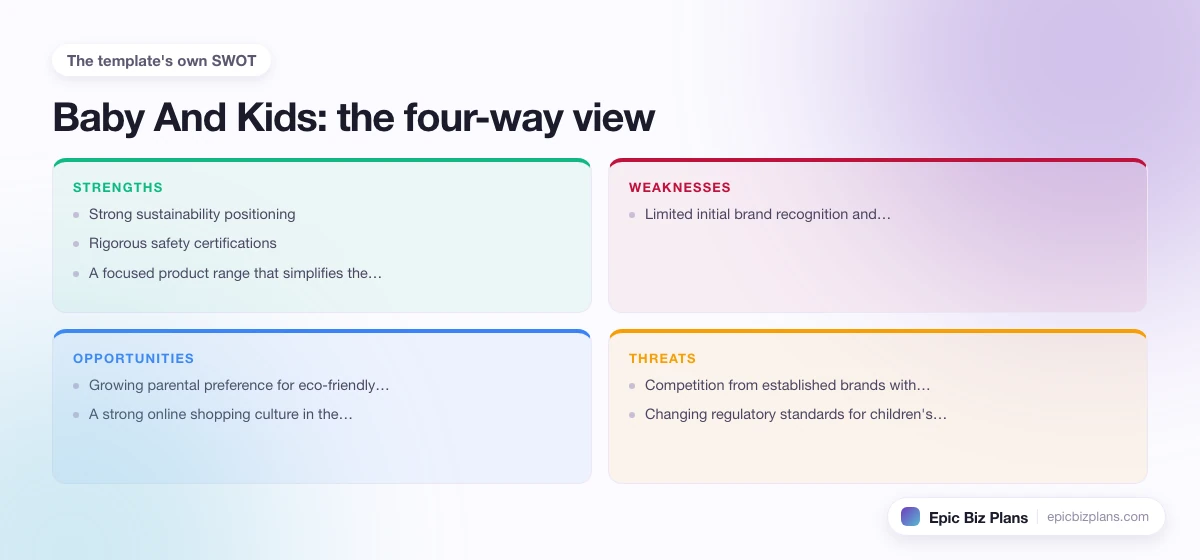
SWOT Analysis
- Strengths: Strong sustainability positioning, rigorous safety certifications, and a focused product range that simplifies the buying decision for parents.
- Weaknesses: Limited initial brand recognition and reliance on online sales during the awareness-building phase.
- Opportunities: Growing parental preference for eco-friendly and developmental products, and a strong online shopping culture in the parent demographic.
- Threats: Competition from established brands with larger marketing budgets, and changing regulatory standards for children's product safety.
Business Name Ideas
Website
We will build on Shopify, using a clean, family-friendly design that communicates safety credentials and sustainability certifications clearly on every product page. Product photography featuring children in real-use settings builds authenticity. Customer reviews and age-appropriate product filtering are essential features for a baby and kids ecommerce store - parents shop by age range and developmental stage, not general category.
Marketing Details
Our primary acquisition channels are content marketing and social media, specifically Instagram and Pinterest, where parent audiences are highly active and product discovery is common. We will produce SEO-optimized content targeting parent research queries - such as "safest organic baby clothes" or "best developmental toys for 18-month-olds" - to drive organic traffic from parents already in buying mode.
Email marketing through HubSpot will convert first-time buyers into repeat customers through age-based product recommendations and milestone-triggered campaigns. TikTok ads targeting new parents will amplify product launches. Partnering with parenting influencers who have authentic followings is more effective in this category than broad-reach advertising, because trust is the primary purchase driver. For businesses targeting related developmental education markets, this STEM kids business plan covers educational product positioning in depth.
Industry Trends
Three trends are defining the baby and kids product market right now: growing demand for certified organic and non-toxic materials, increased parental focus on screen-free developmental play, and the shift toward purpose-built online shopping destinations rather than general marketplaces for baby products.
Safety certification standards are also tightening in key markets. Products that meet or exceed ASTM, CPSC, and OEKO-TEX standards are increasingly preferred by retail partners and directly referenced in parental purchasing decisions. Building compliance into your product development process from the start is cheaper than retrofitting it later.
Competitor Information
Direct competitors in the eco-friendly baby products space include brands like Burt's Bees Baby, Finn + Emma, and various boutique Etsy sellers. Larger mainstream brands - Carter's, Skip Hop, and Amazon private label - are indirect competitors competing primarily on price and convenience. Readers building a parent-focused brand can also review the Mum business plan template.
Our differentiation comes from genuine sustainability credentials (not just marketing language), rigorous safety testing documentation shared openly with customers, and a curated product selection that makes decisions easier for overwhelmed parents. Brands that build reputations in physical retail alongside their online presence often outperform online-only competitors in trust metrics - for that angle, a kids clothing business plan covers retail channel strategy in detail.
-
 SemrushSemrush is a platform with literally any online tool you will need to promote your business. Spy on your competitors, get search traffic, keyword research, social info, ad copies and much more. Used by most of the top online companies in the world. Besides all its tools, Semrush also has many available integrations possible with many other tools that will make your work even better.
 -
 Surfer SEOSurfer SEO is an incredibly smart AI tool that will give you exact explanations what to do in order to make your website rank better. They use hundreds of parameters, check your competitors and decide on the best course of action. Whether it be inner links, bold text, paragraphs, headers, images and much more. Surfer is a must-have in 2026.
Startup Cost Breakdown
Estimated startup costs are ,000, allocated across: product development, sampling, and safety certification testing (,000); initial inventory for launch SKUs (,000); website development and photography (,000); marketing and launch campaigns (,000); and business registration, insurance, and legal setup (,000).
Safety certification is the non-negotiable line item. Children's products sold in the US must meet CPSC standards; those sold as organic require certification from an accredited body. Budget for this testing before you finalize your initial inventory order - selling products that fail compliance testing is a business-ending risk, not just a financial one.
Financial Information
We project first-year revenue of ,000 with a gross margin of 55%, yielding approximately ,000 in gross profit. After marketing, operations, and administrative costs of ,000, we project a first-year operating profit of approximately ,000 - assuming the ,000 startup cost is funded separately from operations.
Cash flow management is critical for a product business. Inventory must be purchased before revenue arrives, and production lead times for eco-certified materials are longer than conventional alternatives. We will maintain a 90-day cash reserve and review cash flow weekly in the first year.
Legal and Compliance
Children's products are among the most regulated consumer goods categories. We will comply with CPSC regulations, California Proposition 65 requirements, and applicable ASTM standards for each product category. All products will carry required safety labeling. Organic textile claims must be certified through GOTS or an equivalent accredited certification body.
The business will be registered as an LLC. We will trademark the brand name and logo in the US and key export markets before launch. Product liability insurance is mandatory - carrying a minimum of million per occurrence is standard for children's product businesses.
Operational Plan
Operations center on product sourcing, quality control, inventory management, order fulfillment, and customer service. We will use a third-party logistics provider for fulfillment to keep overhead lean and accommodate seasonal volume spikes. Supplier agreements will include material certification requirements and audit rights so that our sustainability claims remain verifiable.
Customer service response time will be a defined standard - 24 hours or less on all channels - because parents shopping for baby products often have time-sensitive questions. Businesses offering in-person experiences alongside products may also find this kids play area business plan a useful complement for community-building strategy.
Key Metrics to Track
The most important metrics for a baby and kids product business are: customer acquisition cost by channel, repeat purchase rate (critical in this category - parents who find a brand they trust come back repeatedly), average order value, product return rate, and safety incident rate (which should be zero). A repeat purchase rate below 20% after 12 months signals a product quality or customer experience problem that needs immediate investigation.
Contingency Planning
The two most significant risks are a product safety incident and supply chain disruption. For safety, we will maintain clear recall procedures, product traceability documentation, and a crisis communication plan before we need it. For supply chain resilience, we will qualify backup suppliers for our highest-volume products and maintain 60-day safety stock on core SKUs.
-
ShopifyPut your brand on Shopify. Launch your online store with tools designed for growth and success. Ready to turn your idea into profit? Start building your e-commerce business today.
-
SquarespaceShowcase your brand with Squarespace’s sleek designs. Build a professional online presence with ease. Start with a template that already looks finished.
-
WixBring your ideas to life with Wix. Customize every aspect of your site with unmatched flexibility. Start creating your unique online space and let your creativity shine.
-
ElementorCraft captivating websites effortlessly with Elementor. Enjoy complete creative control without coding. Make your site stand out to your audience. Start turning your vision into reality now.
Market trend shifts in the baby and kids space can move quickly - particularly in the toy category. We will monitor customer feedback and competitor product launches monthly to identify category shifts early enough to respond before they affect revenue materially.
Build a Baby and Kids Brand Parents Trust
In the baby and kids market, trust is the most valuable asset you can build. Parents who trust your brand become your most effective marketing channel - they recommend products to other parents with the kind of genuine enthusiasm that no ad campaign can replicate. Everything in this plan - from safety certification to customer service standards - is designed to build that trust systematically.
Keep Your Plan Updated
This plan should be reviewed every quarter and updated as your product range evolves, your customer data accumulates, and your market understanding deepens. The assumptions you make at launch will change - the question is whether you catch and incorporate those changes before or after they affect your results.
Practical Applications
Use this plan to secure funding, structure your launch campaign, present to boutique retail partners, or set clear targets for your first hire. Every section you sharpen reflects directly in the clarity of your business decisions. For businesses exploring the broader children's services market, this children's business plan covers adjacent service and product models.
Get Started
This baby and kids business plan template is free to use, edit, and download. Start building your version today - focus on accuracy over ambition in every section, and use the finished plan as your operational guide from day one.
For more guidance, see our related guides on soft play hire business plan.
