
Children Business Plan Template
-
 ShopifyPut your brand on Shopify. Launch your online store with tools designed for growth and success. Ready to turn your idea into profit? Start building your e-commerce business today.
 -
 SquarespaceShowcase your brand with Squarespace’s sleek designs. Build a professional online presence with ease. Start with a template that already looks finished.
 -
 WixBring your ideas to life with Wix. Customize every aspect of your site with unmatched flexibility. Start creating your unique online space and let your creativity shine.
 -
 ElementorCraft captivating websites effortlessly with Elementor. Enjoy complete creative control without coding. Make your site stand out to your audience. Start turning your vision into reality now.
- Executive Summary
- Business Info
- Products and Services
- Target Market
- Business Model Overview
- SWOT Analysis
- Children Business Name Ideas
- Website
- Marketing Details
- Industry Trends
- Competitor Information
- Financial Information
- Legal and Compliance
- Operational Plan
- Contingency Planning
- Startup Cost Breakdown
- Why Start a Children Business?
- Exploring Business Opportunities
- Embrace Growth and Adaptability
- Ready to Take Action
The children's product and services market is one of the most demanding to build a business in - and one of the most rewarding when you get it right. Parents make purchasing decisions based on safety, educational value, and quality, and they are not price-insensitive when it comes to their children's development. The businesses that succeed here earn parental trust first and sales second.
Your business plan for a children's brand needs to treat safety and compliance as core operational requirements, not afterthoughts. Whether you are building a toy brand, an educational program, or a children's apparel line, the regulatory landscape is specific and non-negotiable. Getting this right from the start protects your brand and your customers equally. For a related roadmap, see a focused children safety business plan.
Executive Summary
Our mission is to create high-quality educational products and experiences that support child development across the 0–12 age range. We aim to become a trusted brand in the children's industry, recognized by parents and educators for the safety, quality, and genuine educational value of our products. Our core value proposition is that we produce developmentally appropriate products backed by evidence - not marketing claims. Financial targets include $250,000 in first-year revenue and $500,000 by year two, achieved through a direct-to-consumer model supplemented by retail and institutional channel partnerships. Owners exploring related niches often pair this with a kids stories business plan plan.
Business Info
Products and Services
Our product line focuses on educational toys, learning kits, and supplementary materials for children aged 0–12. Products are segmented by developmental stage rather than just age to improve relevance and parental confidence in choosing the right item. Parents who want printable study support can also follow a Notes Mom business plan for at-home learning resources. Brands selling to families more broadly can structure that with our parent business plan. Workshops and group learning events will supplement product sales and build brand community. For businesses building a structured learning component, the learning materials business plan template provides a complementary framework worth reviewing alongside this one.
Target Market
Our primary customers are parents and guardians of children aged 0–12 who actively seek out developmentally appropriate educational products. Secondary markets include early childhood educators, daycare centers, and primary schools seeking curriculum-supporting materials. Corporate buyers represent a smaller but high-value segment - companies purchasing educational toys for employee families as part of benefits or gifting programs.
Business Model Overview
We operate primarily through our own ecommerce store, which gives us direct customer relationships and full control over the brand experience. Retail partnerships with specialty toy stores and educational supply companies will be pursued in year two once the product line is established. Schools and childcare centers will be approached through a dedicated B2B sales effort - institutional buyers purchase in quantity and become long-term accounts when the product-educator relationship is maintained properly.
SWOT Analysis
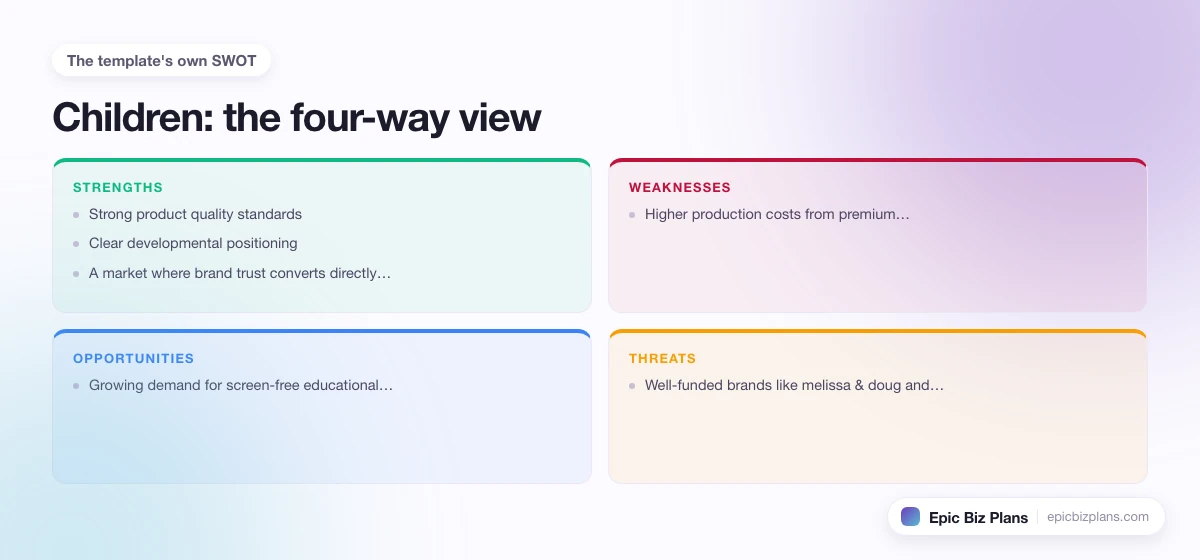
- Strengths: Strong product quality standards, clear developmental positioning, and a market where brand trust converts directly to repeat purchases.
- Weaknesses: Higher production costs from premium materials and safety certification requirements increase startup capital needs and unit economics pressure.
- Opportunities: Growing demand for screen-free educational toys and increasing parental investment in early childhood development products.
- Threats: Well-funded brands like Melissa & Doug and LeapFrog have deep retail relationships and high brand recognition that require sustained differentiation to overcome.
Children Business Name Ideas
Website
We will build our store on Shopify, which provides the ecommerce infrastructure, app integrations, and payment tools a children's product brand needs from day one. The site will be designed around parent confidence - clear safety certifications displayed prominently, age-appropriateness filters, and detailed product descriptions that explain the developmental purpose of each item. User-generated content (parent reviews and photos) will be actively collected and featured because social proof is the highest-converting marketing tool in the children's category.
Marketing Details
Our primary digital channels are Instagram and Pinterest for visual product marketing, and YouTube for educational content that builds brand authority with parents. Email will be the most important retention channel - we will build a list from day one using lead magnets (free developmental guides, activity downloads) and maintain regular communication with useful parenting content rather than purely promotional messaging. TikTok will be used selectively for product demonstrations that show educational value in action. For businesses expanding into kids' activities and programming, the kids play area business plan offers a useful operational reference for that channel. Operators selling branded children entertainment products can also reference the Disney business plan template for licensed-IP planning notes.
Industry Trends
The strongest current trends in the children's product market are the movement away from screen-based entertainment toward hands-on, tactile learning products, and a sharp increase in parental preference for non-toxic, sustainably sourced materials. Augmented reality integration in physical toys is growing among mid-range and premium brands as a differentiation strategy. The subscription model is also gaining traction - monthly educational boxes with age-appropriate activities maintain engagement between purchases and generate predictable recurring revenue. For the subscription angle, the subscription box business plan template is a practical companion resource.
Competitor Information
Direct competitors include Melissa & Doug (developmental toys), LeapFrog (tech-integrated learning), and Lovevery (subscription-based developmental play kits). Indirect competition comes from mass-market toy brands available at Target, Walmart, and Amazon. Our differentiation strategy focuses on the underserved segment between premium mass-market brands and artisan toy makers - quality products with clear developmental frameworks, priced accessibly for middle-income families who cannot always reach the Lovevery price point.
Financial Information
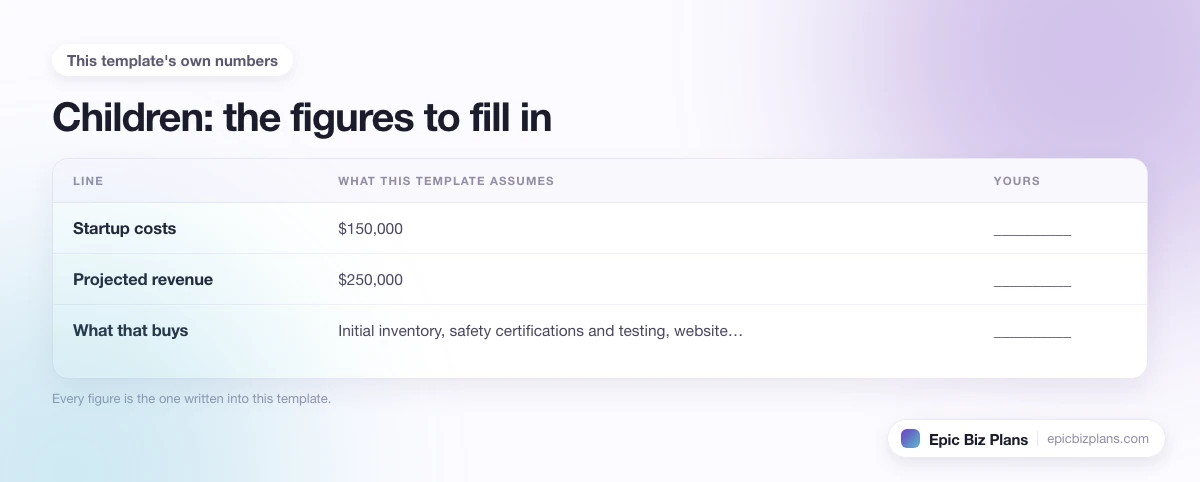
Startup costs are estimated at $150,000, covering initial inventory, safety certifications and testing, website development, and six months of marketing. First-year revenue target is $250,000, with $500,000 by year two as institutional and retail channels add to the direct-to-consumer base. Ongoing annual costs including production, marketing, and operations are budgeted at approximately $120,000 in year one. Children's product safety testing is a non-negotiable cost item - budget $5,000–$15,000 for CPSC compliance testing depending on product type, and do not bring products to market without completed certifications.
Legal and Compliance
Children's products sold in the US are regulated by the Consumer Product Safety Commission (CPSC) under the Consumer Product Safety Improvement Act (CPSIA). All products must meet applicable safety standards, including testing for lead, phthalates, and small parts hazards. Products must carry Children's Product Certificates (CPC) based on third-party testing. Age labeling must be accurate and defensible. Any educational or developmental claims in marketing should be reviewed against FTC guidelines. Trademark your brand name and any distinctive product designs before broad distribution.
Operational Plan
Supplier qualification must include a documented quality and safety review process - not just price negotiation. Every new supplier should provide safety testing documentation for materials used in production, and new products should be tested by an accredited US third-party testing lab before being listed for sale. Logistics will prioritize damage-free packaging, since children's products are frequently purchased as gifts and arrive in photographed condition. We will use a 3PL (third-party logistics provider) for fulfillment once monthly order volume exceeds 200 units, maintaining quality control through a standard packing checklist.
Contingency Planning
Key risks include a product recall (CPSC-mandated or voluntary), a primary supplier failure, and a major platform algorithm change reducing organic traffic. A product recall plan will be developed before launch - it needs to cover customer notification, product retrieval, and replacement protocols. Supplier diversification across at least two approved vendors per key product will be maintained. Search traffic diversification through email and social channels reduces dependency on Google algorithm stability. If you are building a children's services business alongside products, the kids therapy business plan covers the service-side regulatory and operational landscape in detail.
Startup Cost Breakdown
Children's product businesses have higher-than-average compliance and testing costs relative to total startup investment. Budget for these before finalizing your financial plan.
-
 SemrushSemrush is a platform with literally any online tool you will need to promote your business. Spy on your competitors, get search traffic, keyword research, social info, ad copies and much more. Used by most of the top online companies in the world. Besides all its tools, Semrush also has many available integrations possible with many other tools that will make your work even better.
 -
 Surfer SEOSurfer SEO is an incredibly smart AI tool that will give you exact explanations what to do in order to make your website rank better. They use hundreds of parameters, check your competitors and decide on the best course of action. Whether it be inner links, bold text, paragraphs, headers, images and much more. Surfer is a must-have in 2026.
- Initial inventory (first production run): $50,000–$80,000
- Safety testing and certification (CPSC/CPSIA): $5,000–$15,000
- Website and ecommerce setup: $5,000–$10,000
- Branding and packaging design: $5,000–$10,000
- Photography and content creation: $3,000–$6,000
- Marketing (first 6 months): $15,000–$25,000
- Operating reserve: $15,000–$25,000
- Total estimated startup range: $98,000–$171,000
Why Start a Children Business?
The children's market rewards businesses that prioritize safety and genuine educational value - not just attractive packaging and clever marketing. Parents research purchases carefully, share recommendations widely, and become loyal repeat customers when they trust a brand. Building that trust takes time, but the customer lifetime value it creates is among the highest of any consumer product category. For businesses also considering educational services alongside products, the learning hub business plan template covers the programming and facility side of children's education businesses.
Exploring Business Opportunities
Children's businesses span a wide range: educational toys, kids' apparel, daycare, tutoring programs, educational apps, children's books, and subscription play kits. Each has distinct economics, compliance requirements, and customer acquisition dynamics. The planning work you do before launch - understanding your specific segment, its regulatory requirements, and your realistic differentiation from established competitors - determines whether you build something sustainable or join the large number of children's product startups that exit within three years.
Embrace Growth and Adaptability
Your Children business plan should be reviewed formally at six and twelve months post-launch, comparing actual results against projections and adjusting the plan accordingly. Children's products often have longer sales cycles than expected as brand awareness builds - account for this in your cash flow planning from the start.
Ready to Take Action
Entrepreneurs focused specifically on infant and toddler care should review the day care business plan to understand how this model compares. Operators selling parent-and-baby retail products can also use our mom and baby business plan template for category-specific benchmarks. Your Children business plan is 100% free - with unlimited edits, unlimited downloads, and unlimited chances to get it right. This is your moment to make an impactful difference, so seize it with confidence. Start shaping the future today.
