
Antique Business Plan Template
-
 ShopifyPut your brand on Shopify. Launch your online store with tools designed for growth and success. Ready to turn your idea into profit? Start building your e-commerce business today.
 -
 SquarespaceShowcase your brand with Squarespace’s sleek designs. Build a professional online presence with ease. Start with a template that already looks finished.
 -
 WixBring your ideas to life with Wix. Customize every aspect of your site with unmatched flexibility. Start creating your unique online space and let your creativity shine.
 -
 ElementorCraft captivating websites effortlessly with Elementor. Enjoy complete creative control without coding. Make your site stand out to your audience. Start turning your vision into reality now.
- Executive Summary
- Business Info
- SWOT Analysis
- Antique Business Name Ideas
- Website
- Marketing Details
- Industry Trends
- Competitor Information
- Financial Information
- Legal and Compliance
- Operational Plan
- Contingency Planning
- The Real Appeal of the Antique Trade
- Types of Businesses in the Antique Niche
- Growing and Evolving
- Put Your Plan To Use
- Take the Next Step
Running an antique business is part curation, part sourcing, and part storytelling. Margins live or die on what you pay at estate sales and auctions, while revenue depends on how well you can describe and stage each piece online or in a booth. Your business plan should detail your sourcing channels, authentication process, pricing model, and the inventory turn rate you need to keep cash flowing. It is a working document, not a one-time exercise. For a related angle, see our curio business plan template. savannah business plan template.
Antique buyers are pickier than mainstream retail customers and far less price-sensitive when authenticity is proven. That changes everything from your photography standards to the time you spend on provenance research. The plan below walks through the structure used by both brick-and-mortar shops and online-only sellers, and it scales from a single-vendor booth in an antique mall to a full destination store. Use it to make the trade-offs that suit your local market.
If you are building a wider curated brand, see our collection business plan template.
Executive Summary
We will provide a curated selection of antique goods that cater to collectors and enthusiasts in the vintage market. Sellers who specialize in a single historical period can model their niche on a Cold War business plan built around era memorabilia. Our mission is to bring timeless pieces to our customers while promoting sustainability and appreciation for history. Our vision is to become a leading name in the antique industry by offering unique and high-quality products. We aim to achieve a gross revenue of $500,000 within the first three years, establishing a loyal customer base and expanding our inventory.
Business Info
Our business will focus on sourcing and selling antiques, including furniture, jewelry, art, and collectible coins, with a dedicated antique furniture category as our anchor segment. We will target collectors, interior designers, and individuals looking to decorate their homes with authentic vintage pieces. Our business model will involve direct sales through an online platform and physical pop-up sales at local markets.
SWOT Analysis
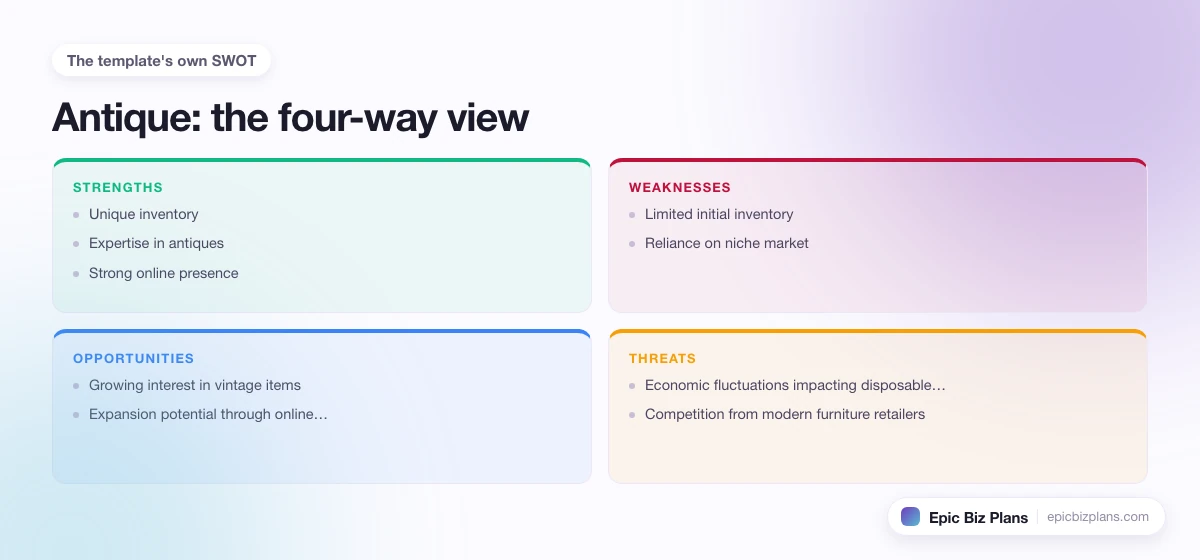
- Strengths: Unique inventory, expertise in antiques, strong online presence.
- Weaknesses: Limited initial inventory, reliance on niche market.
- Opportunities: Growing interest in vintage items, expansion potential through online marketplaces.
- Threats: Economic fluctuations impacting disposable income, competition from modern furniture retailers.
Antique Business Name Ideas
Website
We will build our website on Shopify, as it is a strong platform for e-commerce and will allow us to showcase our antique collections effectively. Shopify provides essential features for online sales, such as secure payment processing and inventory management. Additionally, we will consider Squarespace for aesthetic flexibility, especially if we want to create visually appealing landing pages for our products.
Marketing Details
Our marketing strategy will focus on a mix of digital marketing and social media engagement. We will use Semrush for search engine optimization to improve our website’s visibility and attract organic traffic. For email campaigns, we will engage with customers and potential buyers using HubSpot’s tools to send regular newsletters and promotions.
On social media, we will run TikTok ads to reach younger demographics and promote our unique antique offerings. Our content will highlight the stories behind our pieces and their historical significance, creating an emotional connection with our audience.
Industry Trends
The antique industry is seeing a resurgence as consumers become more interested in sustainability and unique home decor. Technological advancements such as augmented reality are becoming more common, allowing potential buyers to visualize antiques in their own spaces without leaving home. The growing acceptance of online shopping has also opened the door for antique sellers to reach buyers far beyond their local market.
Competitor Information
We will analyze our main competitors, which include local antique shops, consignment stores, and online marketplaces specializing in vintage goods. To differentiate ourselves, we will focus on the quality and authenticity of our products, as well as personalized customer service. We will also use unique storytelling for each piece, highlighting its history and significance, which many competitors overlook.
Financial Information
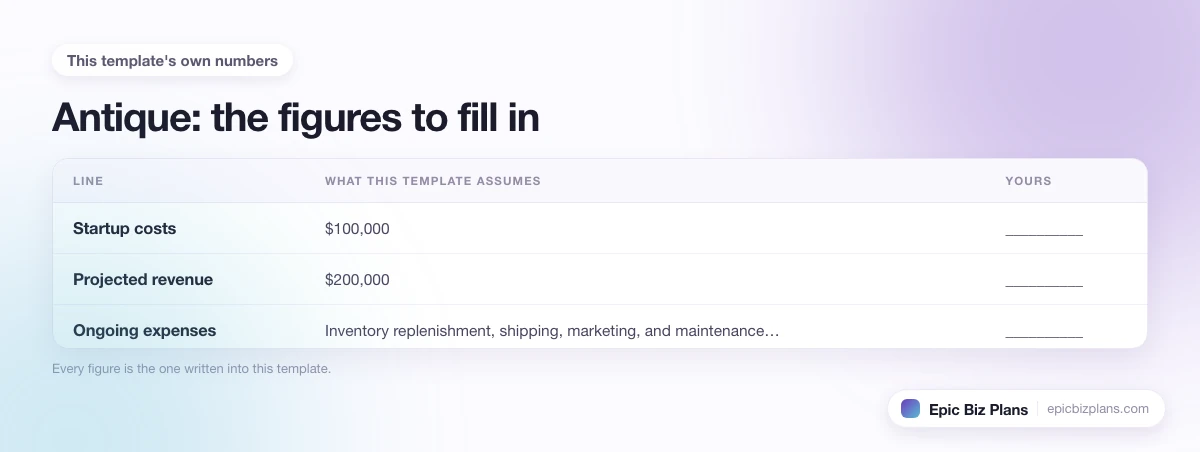
Our projected startup costs will be around $100,000, which includes inventory acquisition, website development, marketing, and operational expenses. We anticipate generating revenue primarily through online sales, with expected first-year revenue of $200,000, growing 30% annually. Ongoing expenses will include inventory replenishment, shipping, marketing, and maintenance of our website and physical sales presence.
Legal and Compliance
We will ensure compliance with local business registration requirements and necessary permits for selling antiques. Intellectual property protection will be sought for our brand, products, and any unique designs we may create, to safeguard our business against infringement.
Operational Plan
Our operations will involve procuring antiques from various sources, including auctions, estate sales, and individual sellers. We will establish relationships with reliable logistics providers for shipping and handling. Inventory management will be a priority, with a clear system for tracking and facilitating sales both online and at physical events. Operators expanding into adjacent categories may also reference the collectible business plan.
Contingency Planning
We will identify potential risks, such as economic downturns affecting sales and fluctuations in inventory acquisition costs. Our mitigation strategies will include diversifying our inventory sources and maintaining a healthy cash reserve to handle challenging periods. Regular review of our business strategy will ensure adaptability to changing market conditions.
The Real Appeal of the Antique Trade
The antique trade attracts founders who value the hunt as much as the sale. There is genuine satisfaction in finding a piece at the right price, researching its history, and matching it with a buyer who understands what it is. The plan above gives you the structure to keep that satisfaction from quietly costing you money each month.
-
 SemrushSemrush is a platform with literally any online tool you will need to promote your business. Spy on your competitors, get search traffic, keyword research, social info, ad copies and much more. Used by most of the top online companies in the world. Besides all its tools, Semrush also has many available integrations possible with many other tools that will make your work even better.
 -
 Surfer SEOSurfer SEO is an incredibly smart AI tool that will give you exact explanations what to do in order to make your website rank better. They use hundreds of parameters, check your competitors and decide on the best course of action. Whether it be inner links, bold text, paragraphs, headers, images and much more. Surfer is a must-have in 2026.
Types of Businesses in the Antique Niche
The antique niche covers brick-and-mortar shops, booths inside larger antique malls, online-only sellers on platforms like 1stDibs and Chairish, and hybrid operators who do both. Some specialize tightly in mid-century modern, mid-19th century European, or Asian antiques, while others stay general. Adjacent business models such as vintage decor resale can sit naturally alongside antique sales without diluting your brand.
Growing and Evolving
Your antique business plan is not a static document; it is a working guide that should evolve as you grow. Update it as you explore new audiences, pricing models, or sales channels. Adjust your strategy as the antique market shifts, whether that means expanding into new regions or tightening your category focus.
Put Your Plan To Use
This antique business plan can serve several practical purposes. Use it to present to potential partners, plan a launch, secure funding, or refine your overall strategy. The same document doubles as your reference when a vendor or auction house wants to know how serious a buyer you are.
Take the Next Step
Your antique business plan is 100% free, with unlimited edits, unlimited downloads, and unlimited chances to get it right. Take the next step and turn your passion for the trade into a working business.
