
Antique Furniture Business Plan Template
-
 ShopifyPut your brand on Shopify. Launch your online store with tools designed for growth and success. Ready to turn your idea into profit? Start building your e-commerce business today.
 -
 SquarespaceShowcase your brand with Squarespace’s sleek designs. Build a professional online presence with ease. Start with a template that already looks finished.
 -
 WixBring your ideas to life with Wix. Customize every aspect of your site with unmatched flexibility. Start creating your unique online space and let your creativity shine.
 -
 ElementorCraft captivating websites effortlessly with Elementor. Enjoy complete creative control without coding. Make your site stand out to your audience. Start turning your vision into reality now.
- Executive Summary
- Business Info
- Products and Services
- Target Market
- Business Model Overview
- SWOT Analysis
- Antique Furniture Business Name Ideas
- Website
- Marketing Details
- Sourcing and Authentication
- Industry Trends
- Competitor Information
- Financial Information
- Legal and Compliance
- Operational Plan
- Contingency Planning
- Embracing Your Passion
- Exploring Your Niche
- Your Business Will Evolve
- Utilizing Your Plan
- Final Thoughts
The antique furniture market rewards sellers who combine product knowledge with solid business fundamentals. Whether you plan to operate a showroom, sell through online marketplaces, or focus on restoration services, this business plan template covers the essential areas you need to address before investing your first dollar. Each section is designed to help you think through sourcing, pricing, marketing, and operations specific to the antique furniture trade. savannah business plan template. Dealers stocking smaller accents alongside furniture can also see our vintage decor business plan template.
A strong antique furniture business plan clarifies your niche, identifies your ideal buyer, and maps out a realistic path to profitability. Use this template as a working document that evolves as you learn more about your local market and refine your inventory strategy. For a deeper look at that path, see the Eye On Preloved Art business plan template.
Executive Summary
We aim to establish a premier business specializing in antique furniture, focusing on authenticated pieces that offer historical value and distinctive design. Sellers expanding into decorative lighting can also reference a crystal lamp business plan template for unit economics and breakage planning. Our mission is to connect buyers with quality antique furniture while preserving the craftsmanship of past eras. We envision becoming a trusted name in the antique furniture market by offering both curated inventory and professional restoration services.
Our value proposition centers on authenticity verification, expert restoration, and personalized buying consultations. A complementary service business is outlined in our furniture assembly business plan. Financial targets include 15% annual revenue growth over the first five years, supported by both direct sales and restoration service fees. Sellers who style restored pieces for a softer, vintage-inspired look can also reference our shabby chic business plan template.
Business Info
Products and Services
We will offer antique furniture spanning multiple periods, including Victorian, Art Deco, Mid-Century Modern, and Colonial Revival pieces; sellers building a broader styled range often pair this with a vintage home decor business plan. Categories include seating, tables, storage pieces, and decorative accessories. Restoration services will cover structural repair, refinishing, reupholstering, and hardware replacement. We will also provide in-home consultations where clients can receive guidance on selecting pieces that complement their existing decor. Businesses focused on refurbished furniture often overlap with our restoration services, creating potential referral partnerships.
Target Market
Our primary buyers include interior designers sourcing statement pieces for client projects, collectors building period-specific collections, and homeowners seeking furniture with character and provenance. We will focus on middle-to-high-income consumers who prioritize craftsmanship and historical significance over mass-produced alternatives, the same buyers served by our old fashioned business plan template. If you're considering adjacent ventures, check out our custom furniture business plan.
Business Model Overview
Revenue will come from three channels: direct sales through our online store and physical showroom, restoration service fees, and consulting engagements with interior designers. Some dealers also run a parallel upcycling line for younger buyers, which our furniture upcycling business plan template covers in detail. The physical showroom will serve as both a retail space and a staging area where buyers can inspect pieces before purchase. Online sales through our own website and marketplaces like 1stDibs and Chairish will extend our geographic reach.
SWOT Analysis
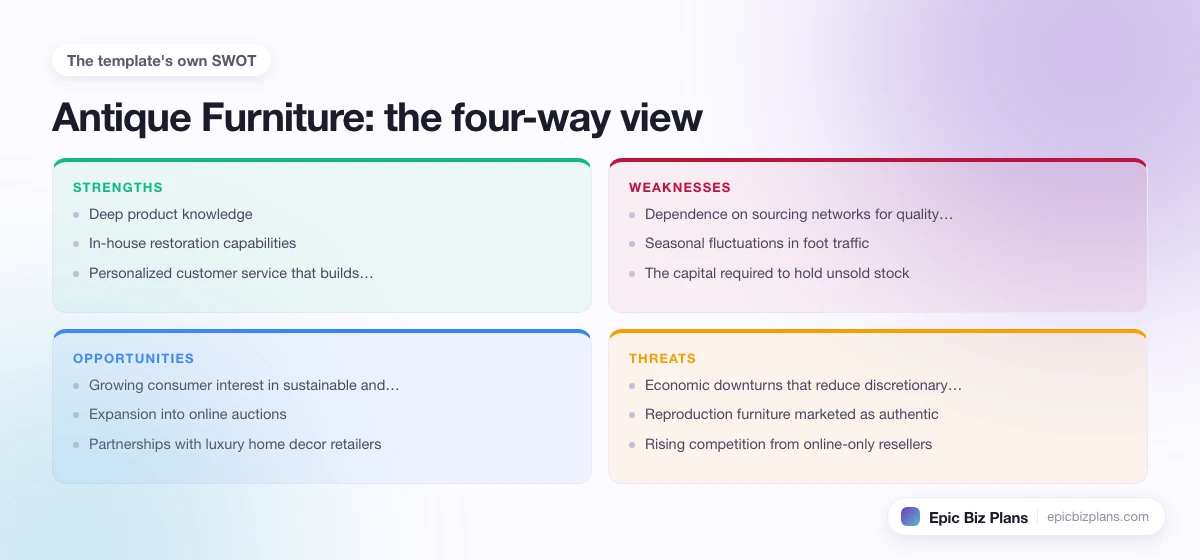
- Strengths: Deep product knowledge, in-house restoration capabilities, and personalized customer service that builds repeat business.
- Weaknesses: Dependence on sourcing networks for quality inventory, seasonal fluctuations in foot traffic, and the capital required to hold unsold stock.
- Opportunities: Growing consumer interest in sustainable and secondhand furnishings, expansion into online auctions, and partnerships with luxury home decor retailers.
- Threats: Economic downturns that reduce discretionary spending, reproduction furniture marketed as authentic, and rising competition from online-only resellers.
Antique Furniture Business Name Ideas
Website
We will build our ecommerce store on Shopify, which provides strong inventory management, product photography layouts, and payment processing out of the box. Each listing will include provenance details, condition reports, dimensions, and multiple high-resolution photographs. For content marketing and storytelling around featured pieces, we may integrate a blog section using Shopify's built-in CMS or a dedicated platform like WordPress.
Marketing Details
Our marketing strategy combines search engine optimization with relationship-based outreach. We will optimize product pages for long-tail keywords such as "Victorian mahogany dining table" and "Art Deco sideboard for sale" to capture buyers actively searching for specific pieces. Email marketing will keep past buyers and subscribers informed about new arrivals, upcoming estate sale finds, and restoration tips.
Social media will play a key role in reaching younger buyers who are drawn to vintage aesthetics. Instagram and Pinterest will showcase styled photography of our inventory, while short-form video content will document restoration projects from start to finish. Paid advertising will be tested on platforms where our target demographics spend time.
Sourcing and Authentication
Reliable sourcing is the foundation of an antique furniture business. We will build relationships with estate sale companies, auction houses, private collectors, and international dealers. Each acquisition will go through an authentication process that evaluates construction methods, hardware, wood species, and finish characteristics to confirm period and origin. Maintaining detailed provenance records adds value for collectors and supports premium pricing.
Industry Trends
Consumer preference is shifting toward sustainable and secondhand furniture, driven by environmental awareness and a desire for pieces with character that mass production cannot replicate. Online marketplaces dedicated to antiques and vintage goods have expanded the buyer pool beyond local markets. Additionally, the overlap between the furniture flipping community and the antique trade continues to grow, as social media content around restoration projects drives interest in older pieces.
Competitor Information
Direct competitors include other antique dealers in our region and online-only resellers who compete on price and convenience. Dealers expanding into new home accents alongside their antiques can review our homeware business plan template for that adjacent category. Indirect competitors include modern furniture retailers that offer reproduction or "vintage-inspired" lines. We will differentiate through authentication expertise, in-house restoration quality, and a curated selection that emphasizes fewer, higher-quality pieces over volume.
Financial Information
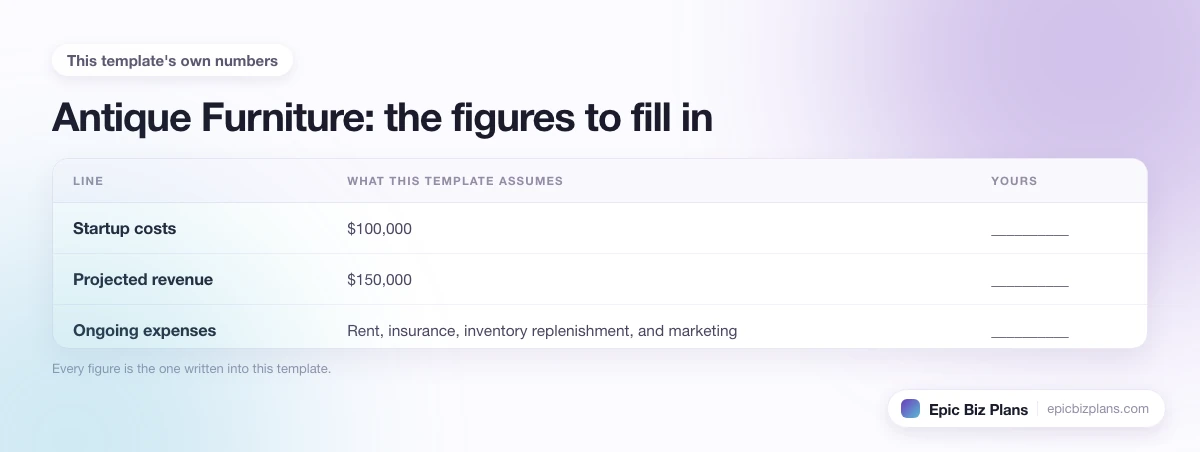
Initial startup costs are estimated at $100,000, covering inventory acquisition, showroom lease and buildout, restoration workshop equipment, and initial marketing. We project first-year revenue of $150,000, growing to $200,000 in year two as our online presence matures and repeat customers increase. Ongoing expenses include rent, insurance, inventory replenishment, and marketing. Monthly financial reviews will track margins by product category and sales channel to identify our most profitable inventory segments.
Legal and Compliance
We will register the business, obtain a resale license, and carry general liability and inventory insurance. Trademark protection will cover our brand name and logo. We will also stay current with regulations governing the sale of items containing materials like ivory, certain hardwoods, or lead-based finishes, which are subject to federal and state restrictions. Businesses in the collectibles market face similar regulatory considerations around provenance documentation and material restrictions.
-
 SemrushSemrush is a platform with literally any online tool you will need to promote your business. Spy on your competitors, get search traffic, keyword research, social info, ad copies and much more. Used by most of the top online companies in the world. Besides all its tools, Semrush also has many available integrations possible with many other tools that will make your work even better.
 -
 Surfer SEOSurfer SEO is an incredibly smart AI tool that will give you exact explanations what to do in order to make your website rank better. They use hundreds of parameters, check your competitors and decide on the best course of action. Whether it be inner links, bold text, paragraphs, headers, images and much more. Surfer is a must-have in 2026.
Operational Plan
Daily operations will include sourcing trips, inventory intake and photography, restoration work, customer inquiries, and order fulfillment. We will use inventory management software that tracks each piece from acquisition through sale, including purchase cost, restoration hours, and final sale price. Shipping logistics for large furniture items require white-glove delivery partners who specialize in handling fragile and high-value goods.
Contingency Planning
Key risks include supply chain disruptions when sourcing channels dry up, economic slowdowns that reduce discretionary spending, and damage to inventory in transit or storage. We will mitigate these by maintaining relationships with multiple sourcing partners across different regions, keeping three months of operating expenses in reserve, and carrying comprehensive inventory insurance. If showroom traffic declines, we can shift marketing spend toward online channels and consignment partnerships.
Entrepreneurs building broader home furnishing businesses alongside vintage furniture will find the furnishing business plan template covers e-commerce and showroom strategy in complementary detail.
Embracing Your Passion
Starting an antique furniture business lets you turn a genuine appreciation for craftsmanship and history into a sustainable livelihood. Every piece you source, restore, and sell carries a story that connects the past to a new owner. That combination of commerce and cultural preservation is what makes this niche rewarding beyond the financial returns.
Exploring Your Niche
The antique furniture market offers several viable paths. You might specialize in a single period like Mid-Century Modern, focus exclusively on restoration services, or build an online-only operation that ships nationally. Operators in the woodworking trade sometimes transition into antique restoration, bringing complementary skills to the business. Choose the path that matches your expertise and local demand.
Your Business Will Evolve
This business plan is a starting point. As you learn which pieces sell fastest, which sourcing channels yield the best margins, and which marketing tactics drive qualified buyers, update your plan accordingly. Quarterly reviews keep your strategy aligned with what the market is actually telling you.
Utilizing Your Plan
Use this plan to secure a small business loan, present to potential showroom landlords, onboard a business partner, or simply organize your own thinking before launch. Each section serves as a reference point you will revisit as your business matures. Dealers expanding from furniture into broader resale categories can also reference a used items business plan.
Final Thoughts
Your Antique Furniture business plan is 100% free If your model focuses on buying, restoring, and reselling rather than dealing in true antiques, the furniture flip business plan template covers upcycling and sourcing strategy for that model. - with unlimited edits, unlimited downloads, and unlimited chances to get it right. Create it, revise it, and let it guide you toward building something that lasts.
