
Ancient Business Plan Template
-
 ShopifyPut your brand on Shopify. Launch your online store with tools designed for growth and success. Ready to turn your idea into profit? Start building your e-commerce business today.
 -
 SquarespaceShowcase your brand with Squarespace’s sleek designs. Build a professional online presence with ease. Start with a template that already looks finished.
 -
 WixBring your ideas to life with Wix. Customize every aspect of your site with unmatched flexibility. Start creating your unique online space and let your creativity shine.
 -
 ElementorCraft captivating websites effortlessly with Elementor. Enjoy complete creative control without coding. Make your site stand out to your audience. Start turning your vision into reality now.
- Executive Summary
- Business Info
- Business Model Overview
- SWOT Analysis
- Ancient Business Name Ideas
- Website
- Marketing Details
- Industry Trends
- Competitor Information
- Financial Information
- Legal and Compliance
- Operational Plan
- Contingency Planning
- Sourcing and Authenticity
- Your Plan Awaits
- Flexibility & Growth
- Practical Applications
- Bold Steps Forward
The Ancient business plan turns timeless cultural heritage into a working commercial strategy. This is not a stale template. It pairs the principles of past civilizations with the realities of running a modern store. As you work through this plan, keep it tied to your brand's identity and to what your customers actually want to buy.
This is your chance to stand apart in a market full of look-alike products. Let the plan reflect your own style and vision, and build a path to a business that feels distinct. Take your time, get specific about your offer, and turn those ancient ideas into a venture that pays. The direction you set here shapes everything that follows.
Executive Summary
Our mission is to offer products inspired by ancient cultures, showcasing their history and significance. We picture a brand that works as a marketplace and also teaches customers about the legacy of past civilizations. Our value proposition is high-quality, handcrafted items that connect modern buyers to ancient traditions. Financially, we aim to break even within the first year and project revenue growth of 20% annually after that.
Business Info
We will sell handcrafted artifacts, jewelry, and home décor inspired by various ancient civilizations, including Egyptian, Greek, and Mesopotamian cultures. Our target market consists of history enthusiasts, collectors, and people who want meaningful decorations for their homes. Many of these buyers already shop for handmade home décor and gravitate toward pieces with a clear story behind them.
Business Model Overview
Our business model centers on e-commerce sales, supported by educational content on our website that explains the cultural significance of each product. We will use direct-to-consumer sales alongside collaborations with museums and historical institutions for curated events. This mix is closer to a focused handcrafted goods business than a generic retail store, so storytelling drives the sale as much as the product itself.
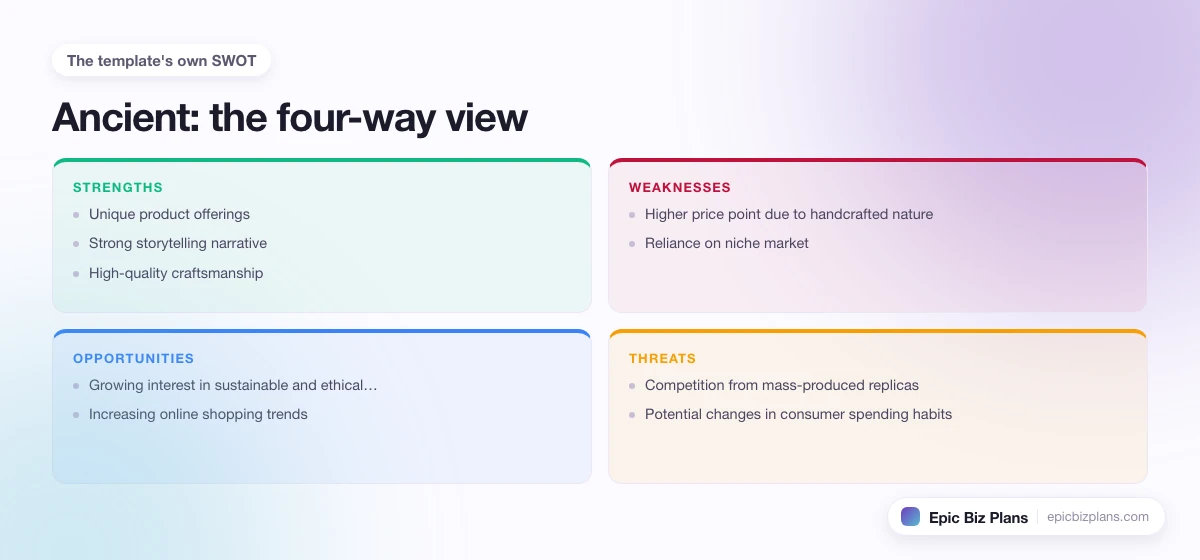
SWOT Analysis
- Strengths: Unique product offerings, strong storytelling narrative, high-quality craftsmanship.
- Weaknesses: Higher price point due to handcrafted nature, reliance on niche market.
- Opportunities: Growing interest in sustainable and ethical products, increasing online shopping trends.
- Threats: Competition from mass-produced replicas, potential changes in consumer spending habits.
Ancient Business Name Ideas
Website
We will build our website on Shopify to use its e-commerce features, which let us manage online sales and customer interactions in one place. Shopify suits our business well, since it offers tools made for selling handcrafted goods while keeping the shopping experience simple for customers. If you sell related pieces, the same setup works for an handmade jewelry business built on the same platform.
Marketing Details
Our marketing strategy covers digital marketing and social media. We will use Semrush for search engine optimization to improve our online visibility, and HubSpot for email campaigns that keep customers informed about updates and promotions.
We will also run TikTok ads to reach a younger audience interested in unique home décor and cultural artifacts, building awareness for our brand in a way that fits the platform.
Industry Trends
The move toward sustainability and ethical consumption keeps growing, as shoppers look for products that carry both aesthetic value and a story. The rise of e-commerce, pushed further by the pandemic, points to a lasting shift in buying habits, with a clear preference for unique, handcrafted items over mass-produced goods.
Technology trends show that customers want to engage with brands that keep an active online presence and build a community around shared interests. Demand for antique and heritage-style goods reflects the same pull toward objects with history and meaning.
Competitor Information
Our main competitors include established retailers of handcrafted goods, plus local artisans selling through marketplaces and craft fairs. Indirect competitors are mass-market retailers offering similar-looking products at lower prices.
To set ourselves apart, we will stress the craftsmanship of our items and pair each piece with the historical context behind it. Partnerships with museums and cultural institutions will add visibility and credibility in our niche.
Financial Information
Initial startup costs are estimated at $50,000, covering inventory, website development, marketing, and other operating costs. We project $100,000 in revenue for our first year, with roughly 20% growth in the years that follow. Ongoing expenses include inventory restocking, marketing, and website maintenance.
We will track our cash flow closely and run a profit and loss (P&L) analysis each quarter to keep the business financially stable.
Legal and Compliance
We will register our business in line with local laws and obtain any required permits or licenses. To protect our designs and brand identity, we will seek intellectual property protection, including trademarks for our brand name and logo.
-
 SemrushSemrush is a platform with literally any online tool you will need to promote your business. Spy on your competitors, get search traffic, keyword research, social info, ad copies and much more. Used by most of the top online companies in the world. Besides all its tools, Semrush also has many available integrations possible with many other tools that will make your work even better.
 -
 Surfer SEOSurfer SEO is an incredibly smart AI tool that will give you exact explanations what to do in order to make your website rank better. They use hundreds of parameters, check your competitors and decide on the best course of action. Whether it be inner links, bold text, paragraphs, headers, images and much more. Surfer is a must-have in 2026.
Operational Plan
Key operations involve sourcing materials for our handcrafted products from ethical suppliers and checking quality at every stage of production. We will run an efficient supply chain that balances quality with cost.
For logistics, we will partner with reliable shipping carriers to support timely deliveries, with international shipping options to reach a wider audience.
Contingency Planning
We recognize potential risks, including market swings and supply chain disruptions. To reduce these risks, we will keep strong relationships with several suppliers and watch market trends so we can adjust inventory in time.
Building an emergency fund and keeping flexible operating strategies will let us adapt quickly to any challenges that come up.
Sourcing and Authenticity
Customers buying culturally inspired products care about where the work comes from and how it is made. We will document the origin of each design, name the cultures that inspired it, and explain how our artisans produce each piece. This transparency builds trust and helps justify a higher price point.
We will also avoid claims that a modern reproduction is a genuine relic, and we will respect the cultures we draw from rather than copying sacred or restricted designs. Clear labeling protects both the customer and the brand. Shoppers who appreciate this approach often browse vintage décor pieces for the same reason: provenance and character matter to them.
Your Plan Awaits
Picture a business that reflects who you are and gives you room to shape your own direction. An Ancient business plan sets the foundation for a venture built on identity and a real point of view, whether it is a local artisan shop, an e-commerce platform, or a service-based company. From busy marketplaces to quiet workshops, this niche leaves plenty of room to grow.
Flexibility & Growth
Your Ancient business plan is not set in stone. As you grow and reach new markets, update the plan to target different audiences, test new pricing models, or add products. Each revision sharpens your strategy and keeps it tied to your goals.
Practical Applications
Use this plan to present to potential partners, plan your launch, secure funding, or clarify your overall strategy. It is a working blueprint that turns your ideas into clear, actionable steps.
Bold Steps Forward
Your Ancient business plan is 100% free, with unlimited edits, unlimited downloads, and unlimited chances to get it right. Step into your next move with a plan that backs it up.
-
ShopifyPut your brand on Shopify. Launch your online store with tools designed for growth and success. Ready to turn your idea into profit? Start building your e-commerce business today.
-
SquarespaceShowcase your brand with Squarespace’s sleek designs. Build a professional online presence with ease. Start with a template that already looks finished.
-
WixBring your ideas to life with Wix. Customize every aspect of your site with unmatched flexibility. Start creating your unique online space and let your creativity shine.
-
ElementorCraft captivating websites effortlessly with Elementor. Enjoy complete creative control without coding. Make your site stand out to your audience. Start turning your vision into reality now.
