
Amplifier Business Plan Template
-
 ShopifyPut your brand on Shopify. Launch your online store with tools designed for growth and success. Ready to turn your idea into profit? Start building your e-commerce business today.
 -
 SquarespaceShowcase your brand with Squarespace’s sleek designs. Build a professional online presence with ease. Start with a template that already looks finished.
 -
 WixBring your ideas to life with Wix. Customize every aspect of your site with unmatched flexibility. Start creating your unique online space and let your creativity shine.
 -
 ElementorCraft captivating websites effortlessly with Elementor. Enjoy complete creative control without coding. Make your site stand out to your audience. Start turning your vision into reality now.
- Executive Summary
- Business Info
- Products and Services
- Target Market
- Business Model Overview
- SWOT Analysis
- Amplifier Business Name Ideas
- Website
- Marketing Details
- Industry Trends
- Competitor Information
- Financial Information
- Legal and Compliance
- Operational Plan
- Contingency Planning
- Building Your Future Begins Now
- Keep Your Amplifier Business Plan Current
- Practical Applications of Your Plan
The amplifier business plan is your starting point for entering a specialized audio market with loyal, knowledgeable buyers. This is where you turn your ambitions into a clear yet flexible strategy that matches your brand and audience. Your amplifier business plan is more than a document; it is a working statement of your vision and the path you intend to follow. The goal is to set up a plan that holds up when you take it to manufacturers, retailers, or investors.
The audio market moves quickly, so your amplifier business plan should reflect both current technology and where the category is heading. It pays to question assumptions and build a plan that fits your actual product and purpose rather than a generic template. You have the tools to do this well; the work is putting them to use and turning ideas into concrete steps. Treat this as the moment to define how your brand will compete.
Executive Summary
Our mission is to improve the listening experience by offering high-quality amplifiers for both casual listeners and audiophiles. We want products that bring out clarity and detail in music across a range of setups.
Our value proposition centers on careful engineering, reliable performance, and strong customer service. Financially, we aim to reach $500,000 in revenue within the first year of operations, with a target profit margin of 20%. Founders in related audio categories can also review our sound business plan for a broader market view.
Business Info
Products and Services
We will primarily offer a range of amplifiers, including portable, home, and professional models, alongside accessories like speaker cables and power conditioners.
Target Market
Our target market includes music enthusiasts, audio professionals, and home theater lovers, spanning various demographics from teenagers to adults aged 50 and above.
Business Model Overview
We will use a direct-to-consumer e-commerce model that handles online sales through our website and third-party platforms. This approach reduces overhead costs while widening our market reach.
SWOT Analysis
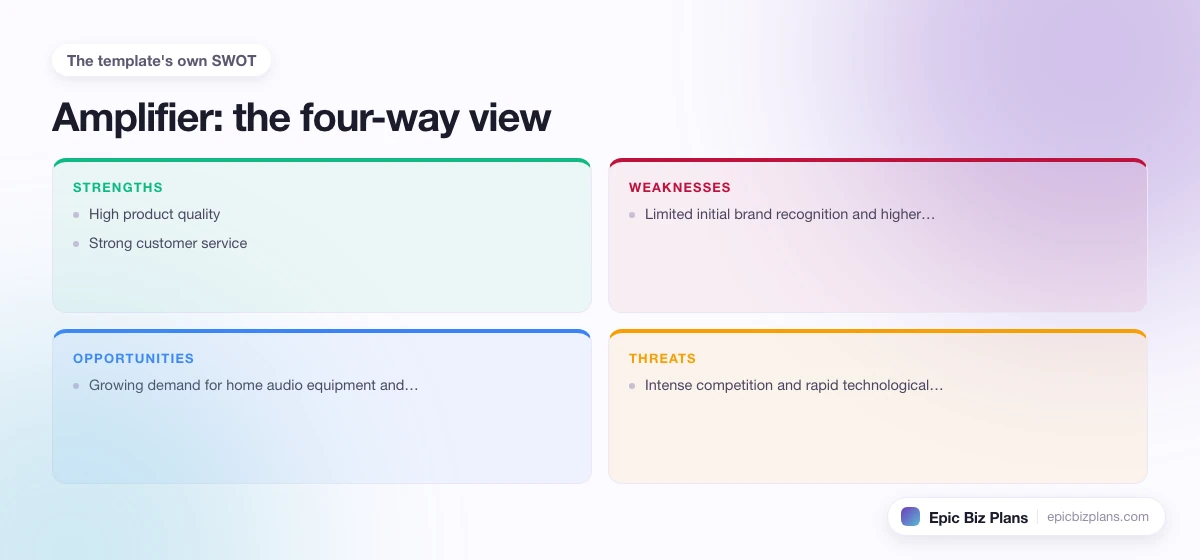
- Strengths: High product quality, strong customer service, and innovative design.
- Weaknesses: Limited initial brand recognition and higher price points compared to some competitors.
- Opportunities: Growing demand for home audio equipment and potential partnerships with music festivals or events.
- Threats: Intense competition and rapid technological changes in audio equipment.
Amplifier Business Name Ideas
Website
We will build our online presence using Shopify, which suits e-commerce businesses and lets us manage sales and inventory efficiently. We may also consider Squarespace for its design options if we want a more visually driven product showcase.
Marketing Details
Our marketing strategy covers both digital marketing and social media engagement. We will use Semrush for SEO to improve our search visibility and HubSpot for email campaigns that nurture leads and drive sales. Buyers shopping for amplifiers often need related gear too, so we can cross-promote alongside wireless headphones brands and similar audio retailers.
To reach a younger audience, we will run TikTok ads with content that shows our gear in real listening setups and demonstrations.
Industry Trends
The audio equipment market is shifting toward wireless technology and high-resolution audio formats. Innovations such as smart amplifier systems that connect with home automation are gaining traction.
There is also a growing move toward sustainable manufacturing and eco-friendly materials, which can strengthen our appeal among environmentally conscious buyers. The rise of in-car listening also makes the car audio business plan a useful reference for adjacent product lines.
Competitor Information
We will analyze key competitors in the amplifier market, including established brands and newer companies. Our strategy focuses on sound quality, distinctive design, and strong customer service.
By tailoring our products to specific buyer needs and preferences, we will find our position in a competitive market. Brands looking to anchor their identity around music culture can borrow ideas from a music business plan.
Financial Information
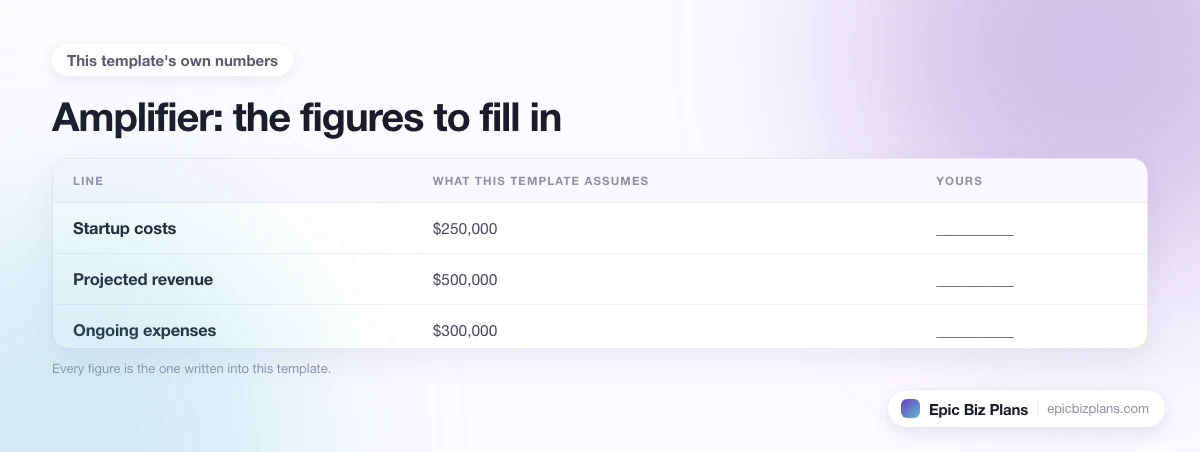
Estimated startup costs are $250,000, covering product development, initial inventory, marketing, and operations. We expect projected revenue of $500,000 in the first year, with ongoing expenses around $300,000.
-
 SemrushSemrush is a platform with literally any online tool you will need to promote your business. Spy on your competitors, get search traffic, keyword research, social info, ad copies and much more. Used by most of the top online companies in the world. Besides all its tools, Semrush also has many available integrations possible with many other tools that will make your work even better.
 -
 Surfer SEOSurfer SEO is an incredibly smart AI tool that will give you exact explanations what to do in order to make your website rank better. They use hundreds of parameters, check your competitors and decide on the best course of action. Whether it be inner links, bold text, paragraphs, headers, images and much more. Surfer is a must-have in 2026.
Cash flow will be monitored closely, with a detailed P&L statement created quarterly to keep finances healthy and guide decisions.
Legal and Compliance
We will meet business registration requirements and secure the licenses needed to operate. We will also protect intellectual property tied to our product designs and branding.
Operational Plan
Key operations include sourcing high-quality raw materials, building relationships with reliable manufacturers, and keeping our supply chain efficient. Logistics will run through third-party shipping providers to ensure timely deliveries.
Contingency Planning
Potential risks include market fluctuations and supply chain disruptions. Our responses include diversifying suppliers and keeping a flexible inventory system that adapts to changing conditions. We will run regular risk assessments to address challenges before they grow.
Building Your Future Begins Now
People start amplifier businesses for the chance to connect their work to something they care about and to build a brand that reflects their taste in sound. Whether you are designing your first home model, partnering with local studios, or building an e-commerce shop for niche audio gear, amplifier businesses take many forms, large and small. They reward attention to detail and a genuine interest in how music is heard.
Keep Your Amplifier Business Plan Current
As your work unfolds, remember that your amplifier business plan is not fixed. It should change as your vision does. Adjust it for different audiences, refine your pricing, expand your product lines, or explore new regions and sales channels. Growth and revision go together.
Practical Applications of Your Plan
Treat your amplifier business plan as a versatile tool. It can guide you when pitching to partners, planning a launch, securing funding, or clarifying your objectives. Each time you return to it, make sure it still reflects where the business is headed.
Your amplifier business plan is 100% free, with unlimited edits, unlimited downloads, and unlimited chances to get it right. Start the work today and build something worth hearing.
