
Waste Free World Business Plan Template
-
 ShopifyPut your brand on Shopify. Launch your online store with tools designed for growth and success. Ready to turn your idea into profit? Start building your e-commerce business today.
 -
 SquarespaceShowcase your brand with Squarespace’s sleek designs. Build a professional online presence with ease. Start with a template that already looks finished.
 -
 WixBring your ideas to life with Wix. Customize every aspect of your site with unmatched flexibility. Start creating your unique online space and let your creativity shine.
 -
 ElementorCraft captivating websites effortlessly with Elementor. Enjoy complete creative control without coding. Make your site stand out to your audience. Start turning your vision into reality now.
- Executive Summary
- Business Info
- SWOT Analysis
- Waste Free World Business Name Ideas
- Website
- Marketing Details
- Industry Trends
- Competitor Information
- Financial Information
- Startup Cost Breakdown
- Legal and Compliance
- The recycling label deadline has already passed
- Operational Plan
- Contingency Planning
- Build a Business That Creates Real Impact
- Types of Businesses in the Zero-Waste Niche
- Evolve Your Plan
- Entrepreneurs working specifically on climate solutions should also explore the broader global warming business plan to understand how this model compares. Your Path to Impact and Success
A waste-free business addresses one of the most pressing operational and consumer trends of the decade: the shift toward sustainable practices, reduced packaging, and circular product models. Whether you are launching a zero-waste retail store, a sustainable product brand, or a waste management consultancy, a clearly structured business plan helps you translate your mission into a financially viable operation. The sustainability sector rewards businesses that combine genuine environmental impact with sound commercial fundamentals.
This Waste Free World business plan covers the key components of building a sustainability-focused business: market positioning, product and service offerings, financial projections, and operational structure. Eco-conscious consumers are increasingly demanding credibility alongside purpose: your plan needs to demonstrate both. Use this framework to build a business that delivers measurable environmental impact while generating sustainable revenue growth.
Executive Summary
Waste Free World is committed to reducing environmental impact through sustainable practices and original waste management solutions. Our mission is to promote a circular economy by providing products and services that minimize waste generation and educate communities on sustainable alternatives. We envision a model where waste is treated as a resource rather than a liability, creating economic value from materials that would otherwise enter landfills. Financially, we aim to achieve break-even within the first two years, followed by steady annual growth of 20%.
Business Info
Waste Free World specializes in eco-friendly consumer products, waste management consulting, and educational workshops for businesses and communities. Our primary target market includes environmentally conscious consumers, schools, and small to medium-sized enterprises seeking to reduce their environmental footprint and improve sustainability credentials. Our business model operates across three revenue streams: direct-to-consumer product sales, B2B consulting contracts, and paid educational workshops. This diversified structure reduces dependence on any single revenue source and builds long-term client relationships.
SWOT Analysis
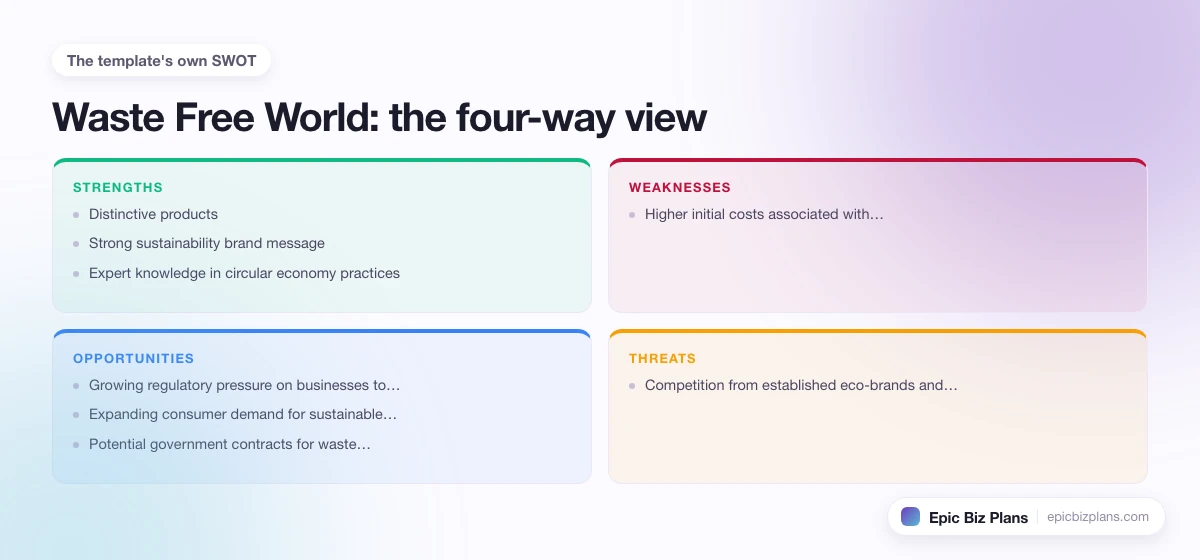
- Strengths: Distinctive products, strong sustainability brand message, and expert knowledge in circular economy practices.
- Weaknesses: Higher initial costs associated with eco-friendly materials and potential market saturation in major urban centers.
- Opportunities: Growing regulatory pressure on businesses to reduce waste, expanding consumer demand for sustainable products, and potential government contracts for waste education programs.
- Threats: Competition from established eco-brands and greenwashing by larger companies that dilutes consumer trust in the category.
Waste Free World Business Name Ideas
Website
We will build our website on Shopify to support e-commerce product sales, using its inventory management and checkout tools to handle orders efficiently. Shopify's sustainability-focused app integrations (carbon offsetting, eco-friendly packaging options, and sustainability badges) align well with our brand positioning. The site will also feature a content hub covering zero-waste living tips, product guides, and workshop schedules to attract organic search traffic from eco-conscious consumers.
Marketing Details
Our marketing strategy uses Semrush for SEO to capture high-intent searches from consumers researching zero-waste products and businesses seeking sustainability consulting. HubSpot will manage email campaigns targeting past customers and workshop attendees with product updates and follow-on service offers. Social media content on TikTok and Instagram will focus on practical waste reduction demonstrations, which perform well organically and reduce paid acquisition costs. Partnerships with environmental nonprofits and local governments will provide credibility and referral volume that paid advertising cannot replicate.
Industry Trends
The sustainability market is moving from niche to mainstream as regulatory requirements tighten and consumer expectations shift. Extended producer responsibility (EPR) laws are forcing businesses across industries to take responsibility for product end-of-life, creating consulting and compliance opportunities for sustainability specialists. Biodegradable packaging innovation is reducing the cost premium on sustainable materials, making eco-friendly products more price-competitive. Businesses that have built credibility in the zero-waste space early will have a significant advantage as larger corporations seek sustainability partners to meet compliance and ESG reporting requirements.
Competitor Information
Our competitive landscape includes established eco-friendly consumer brands, local zero-waste retailers, and sustainability consultancies serving corporate clients. Our differentiation centers on providing genuine expertise rather than just products, our consulting and educational workshop offerings create a value layer that product-only competitors cannot match. We will track competitor positioning quarterly and focus marketing efforts on our unique combination of practical sustainability services and high-quality eco-friendly products.
Financial Information
Startup costs are projected at $150,000 to cover initial inventory, marketing, website development, and operational setup. We anticipate first-year revenue of $250,000 across product sales, consulting engagements, and workshops, with profit margins improving to 30% by year three as consulting revenue scales without proportional cost increases. Monthly profit and loss statements will track financial health across all three revenue streams. Cash flow management is particularly important in the consulting segment due to 30-60 day invoice payment cycles from business clients.
Startup Cost Breakdown
Product inventory and supplier development typically represent the largest startup expense, running $50,000 ($80,000 for an initial product range. Marketing and brand development) website, photography, launch campaign (should be budgeted at $20,000) $30,000 to establish the brand credibility that sustainability consumers expect before purchasing. Workshop curriculum development and instructor training require a one-time investment of approximately $10,000 to $15,000 but generate recurring revenue with minimal ongoing costs.
Consulting service setup (including proposal templates, client onboarding systems, and compliance research) adds $5,000 to $10,000 in pre-launch preparation costs. Maintaining a 3-month operating reserve of approximately $30,000 ensures the business can weather slow periods in any single revenue stream without compromising service quality.
Legal and Compliance
We will register Waste Free World as a limited liability company to protect personal assets and establish credibility with business clients. Trademark registration will protect our brand name and logo as the business scales. For consulting services, professional liability insurance is essential to protect against client claims related to advice or recommendations. Any unique product formulations or packaging innovations will be reviewed for patent protection to prevent competitors from copying our most differentiated offerings.
The recycling label deadline has already passed
If you sell packaged goods into California, one date matters more than anything else in this section. California's truth-in-labeling law bans the chasing-arrows symbol, or any other claim of recyclability, on products and packaging manufactured after 4 October 2026 unless the material meets two tests: it is collected by curbside programmes covering at least 60 percent of the state's population, and properly sorted by facilities serving at least 60 percent of those programmes. The clock started when the state published its final material characterization study on 4 April 2025, which set an 18 month compliance window. Of more than 90 material types assessed, only about 35 passed.
So a zero-waste shop or sustainable brand cannot assume its packaging may carry the symbol. Check your specific material and form against the published study, and remove the symbol where it does not pass. The study is revised in 2027 and every five years after, so this is a recurring check rather than a one-off.
Europe tightened at almost the same moment. Rules under the EU directive on help consumers for the green transition apply to traders from 27 September 2026, with no transition period for stock already on shelves. Generic environmental claims are banned unless you can show recognised excellent environmental performance, and product-level carbon-neutral claims resting on offsets are prohibited outright. The ecommerce green business plan template covers the retail-side version of this problem.
-
 SemrushSemrush is a platform with literally any online tool you will need to promote your business. Spy on your competitors, get search traffic, keyword research, social info, ad copies and much more. Used by most of the top online companies in the world. Besides all its tools, Semrush also has many available integrations possible with many other tools that will make your work even better.
 -
 Surfer SEOSurfer SEO is an incredibly smart AI tool that will give you exact explanations what to do in order to make your website rank better. They use hundreds of parameters, check your competitors and decide on the best course of action. Whether it be inner links, bold text, paragraphs, headers, images and much more. Surfer is a must-have in 2026.
Operational Plan
Key operations center on three distinct activity streams: product sourcing and fulfillment, consulting service delivery, and workshop scheduling and facilitation. We will source eco-friendly materials from vetted suppliers who can provide certification documentation for our marketing claims: greenwashing accusations can permanently damage a sustainability brand. Consulting engagements will follow a structured delivery framework covering waste audits, reduction planning, and implementation support.
Businesses in adjacent sustainability categories provide useful operational benchmarks. A recycling business plan covers the logistics and compliance requirements for materials processing operations. A sustainability consulting business plan outlines how to structure service packages and client contracts for B2B sustainability engagements. For product businesses focused on upcycled goods, a furniture upcycling business plan demonstrates how to price and market transformed materials effectively.
Contingency Planning
Key risks include supply chain disruptions affecting eco-friendly material availability, shifts in consumer sustainability interest, and regulatory changes that alter compliance requirements for our consulting clients. We will mitigate supply chain risk by qualifying multiple suppliers for each product category and maintaining 60-day safety stock for top-selling items. Diversifying revenue across products, consulting, and workshops ensures that a slowdown in any single channel does not threaten overall business viability. Regular market monitoring will help us anticipate regulatory changes and position our consulting services accordingly.
Build a Business That Creates Real Impact
The most successful businesses in the zero-waste and sustainability space are those that combine genuine expertise with commercially viable models. A compelling mission attracts customers and partners, but sound financial management and operational discipline are what keep the business running long enough to make that impact. Your Waste Free World business plan is the tool for ensuring both elements are in place before you launch. If your business model also includes a broader product line with a long-term sustainability focus, the forever business plan template covers that strategic approach in detail.
Types of Businesses in the Zero-Waste Niche
The zero-waste niche encompasses a broad range of business models: zero-waste retail stores, eco-friendly product brands, waste management consultancies, corporate sustainability training providers, and composting or materials recovery services. Each model has different capital requirements, client acquisition approaches, and scaling dynamics. The most common entry points are product-based businesses that generate cash flow early, with consulting and educational services added as expertise and brand credibility develop.
Related businesses worth reviewing include the waste removal business plan for operational logistics and the waste solutions business plan for a broader look at technology-driven approaches to waste reduction. Operators focused on the collection and sorting side can follow a dedicated recycling center business plan. Sustainable product businesses can also learn from the sustainable business plan template covering brand positioning and ESG reporting frameworks.
Evolve Your Plan
Your Waste Free World business plan should grow alongside your business. As you add new products, expand consulting services, or enter new markets, update the financial projections and operational sections to reflect your actual experience. The plan you create today is a starting point: the version you use in year two should incorporate real data on customer acquisition costs, average order values, and consulting contract sizes.
Entrepreneurs working specifically on climate solutions should also explore the broader global warming business plan to understand how this model compares. Your Path to Impact and Success
Your Waste Free World business plan is 100% free: with unlimited edits, unlimited downloads, and unlimited chances to get it right. Build the sustainability business you have been planning and start creating measurable impact from day one.
