
Tomorrow Business Plan Template
-
 ShopifyPut your brand on Shopify. Launch your online store with tools designed for growth and success. Ready to turn your idea into profit? Start building your e-commerce business today.
 -
 SquarespaceShowcase your brand with Squarespace’s sleek designs. Build a professional online presence with ease. Start with a template that already looks finished.
 -
 WixBring your ideas to life with Wix. Customize every aspect of your site with unmatched flexibility. Start creating your unique online space and let your creativity shine.
 -
 ElementorCraft captivating websites effortlessly with Elementor. Enjoy complete creative control without coding. Make your site stand out to your audience. Start turning your vision into reality now.
- Executive Summary
- Business Info
- Business Model Overview
- SWOT Analysis
- Tomorrow Business Name Ideas
- Website
- Marketing Details
- Industry Trends
- Competitor Information
- Financial Information
- Licensing and Regulatory Requirements
- Legal and Compliance
- The homeowner credit ended on 31 December 2025
- Operational Plan
- Contingency Planning
- Build Your Renewable Energy Business on Solid Foundations
- Adapt and Evolve
- Practical Use and Impact
The renewable energy sector is one of the fastest-growing industries in the global economy, driven by policy mandates, declining technology costs, and increasing consumer and corporate demand for clean power. Launching a renewable energy business (whether in solar installation, wind energy, energy storage, or clean tech consulting) requires significant capital and a strong understanding of the regulatory environment. A well-structured business plan is the foundation for securing the financing, permits, and partnerships that make these businesses viable.
This Tomorrow business plan covers the essential components of a renewable energy startup: service and product definition, target market analysis, financial projections, and the regulatory compliance framework that governs energy businesses. Investors and lenders in this sector expect detailed financial modeling and clear evidence of market demand: your plan must reflect that standard to access the capital needed to launch and scale.
Executive Summary
Our mission is to become a leading provider of original and sustainable renewable energy solutions that reduce carbon footprints and energy costs for residential and commercial clients. We offer solar panel systems, energy storage solutions, and wind energy installations, backed by ongoing maintenance and monitoring services. Our financial target is $2 million in cumulative revenue within the first three years, with profitability achieved by the end of year two. Our value proposition centers on affordable, efficient clean energy products with simplified installation and responsive customer service.
Business Info
We provide renewable energy products and installation services including solar panels, wind turbines, and battery storage systems. Our target market includes environmentally conscious homeowners seeking energy independence, small businesses looking to reduce utility costs, and institutions with sustainability mandates and ESG reporting requirements. Our primary business model is direct sales and installation through a network of certified installation partners, supplemented by maintenance contracts that generate recurring revenue after initial system deployment.
Business Model Overview
Renewable energy businesses generate revenue through multiple streams: equipment sales, installation fees, maintenance contracts, and financing fee income when helping customers access third-party financing. The recurring revenue from maintenance and monitoring contracts is the most valuable component of the model long-term: a growing installed base creates stable cash flow that smooths out the project-based nature of new installations. Building these recurring contracts into every sale from the start is a critical early decision.
SWOT Analysis
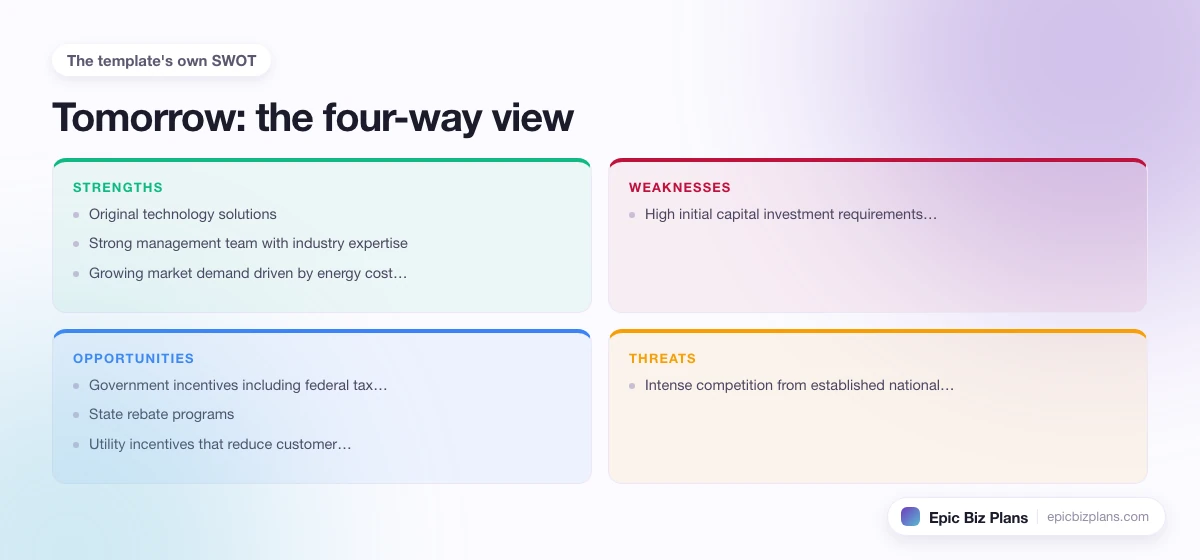
- Strengths: Original technology solutions, strong management team with industry expertise, and growing market demand driven by energy cost increases.
- Weaknesses: High initial capital investment requirements and reliance on external component suppliers with global supply chain exposure.
- Opportunities: Government incentives including federal tax credits, state rebate programs, and utility incentives that reduce customer acquisition costs significantly.
- Threats: Intense competition from established national installers and potential regulatory changes affecting incentive structures.
Tomorrow Business Name Ideas
Website
We will build our website on Shopify to handle product sales and quote request forms, with Squarespace as an alternative if the brand-forward aesthetic is the priority over ecommerce functionality. The site will include a residential solar calculator that helps homeowners estimate savings based on their location and energy usage, this tool generates qualified leads and demonstrates expertise before the first conversation. Case studies showing completed installations with energy savings data will be central to the content strategy.
Marketing Details
Our marketing strategy focuses on generating qualified inbound leads from homeowners and businesses actively researching renewable energy options. We will use Semrush for SEO to rank for high-intent terms like "solar installation [your city]" and "residential solar savings." HubSpot will manage lead nurturing sequences for prospects who are in research mode but not yet ready to buy (a critical function given the typical 3) 6 month decision cycle for residential solar. TikTok and YouTube content showing actual installation projects and customer testimonials reach younger homeowners early in the decision process.
Industry Trends
The renewable energy industry is experiencing rapid expansion driven by falling technology costs, the Inflation Reduction Act's extended federal tax credits, and increasing utility rate volatility that makes solar economics more compelling each year. Battery storage adoption is accelerating as homeowners seek energy independence and backup power capabilities. Commercial and institutional buyers are now driven not just by cost savings but by ESG reporting requirements that make renewable energy purchases a compliance necessity rather than just a preference. Companies that can serve both residential and commercial clients have access to a larger addressable market with diverse revenue streams.
Competitor Information
Our competitive landscape includes national solar installers, regional clean energy companies, and local electricians expanding into renewable installations. National brands have marketing scale but often sacrifice customer service quality in the process. Our differentiation focuses on personalized project management, faster installation timelines, and the local reputation that comes from deep community ties. We will also monitor incentive structures closely: in markets where specific products qualify for additional rebates, our product selection will reflect those opportunities.
Financial Information
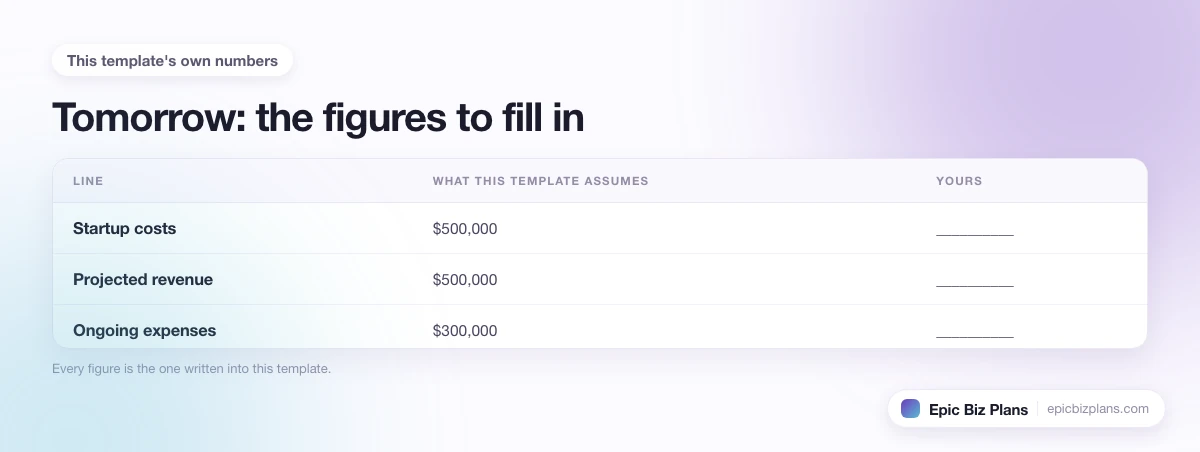
Startup costs are estimated at $500,000, covering inventory of initial equipment, installation vehicles and tools, licensing fees, marketing infrastructure, and working capital for the first two quarters before project cash flow stabilizes. First-year revenue of $500,000 is projected based on a target of 15 (20 residential installations and 2) 3 commercial projects. Annual growth of 20% is achievable as referrals accumulate from completed installations and the maintenance contract base grows. Operating expenses of approximately $300,000 annually cover salaries, equipment, insurance, and marketing.
Licensing and Regulatory Requirements
Renewable energy businesses face a more complex regulatory environment than most industries. Solar and wind installers typically require a state electrical contractor license, specific renewable energy certification (NABCEP is the industry standard), and building permits for each installation. Commercial projects add utility interconnection agreements and may require environmental review depending on installation size and location.
Staying current with incentive program requirements is an ongoing operational task: federal, state, and utility programs each have specific equipment eligibility criteria, documentation requirements, and submission deadlines that affect project economics. Operators expanding into energy storage should review how a solar energy business plan structures the compliance and permitting workflow for residential and commercial projects. Those focused on wind power installations will find a wind energy business plan useful for understanding the distinct site assessment and interconnection requirements of that technology.
Legal and Compliance
Business registration, contractor licensing, general liability insurance, and workers' compensation coverage are the minimum requirements for a renewable energy installation business. Errors and omissions insurance is advisable given the financial significance of system performance guarantees. All installation work must comply with the National Electrical Code (NEC), local building codes, and utility interconnection standards. Failure to obtain proper permits or maintain current licensing can result in project shutdowns, fines, and reputational damage that is particularly costly in a referral-driven business.
The homeowner credit ended on 31 December 2025
Any plan for residential renewable installation written before mid-2025 is now wrong about demand, so state the current position plainly. Public Law 119-21, signed on 4 July 2025, cut short the residential clean energy credit under section 25D. It is not allowed for expenditures made after 31 December 2025. Before that law the credit ran to the end of 2034, so nine years of assumed 30 percent homeowner subsidy disappeared in one stroke.
The timing test is stricter than it looks, and it is where deposits get lost. The Revenue Service treats an expenditure as made when the original installation is completed, not when the customer pays. A homeowner who paid in full during 2025 but whose system was commissioned in 2026 gets nothing. If you are selling into this market, say so in writing before taking money, and build your pricing on the unsubsidised number rather than a credit the buyer may not qualify for.
-
 SemrushSemrush is a platform with literally any online tool you will need to promote your business. Spy on your competitors, get search traffic, keyword research, social info, ad copies and much more. Used by most of the top online companies in the world. Besides all its tools, Semrush also has many available integrations possible with many other tools that will make your work even better.
 -
 Surfer SEOSurfer SEO is an incredibly smart AI tool that will give you exact explanations what to do in order to make your website rank better. They use hundreds of parameters, check your competitors and decide on the best course of action. Whether it be inner links, bold text, paragraphs, headers, images and much more. Surfer is a must-have in 2026.
Everything else still applies: contractor licensing, general liability, workers' compensation, errors and omissions cover, the electrical code, local building codes and utility interconnection. Related models are set out in the solar energy business plan template and the energy saving business plan template.
Operational Plan
Core operations cover project development, installation management, and ongoing service delivery. We will establish relationships with reliable equipment suppliers for solar panels, inverters, and battery storage systems, with backup supplier agreements to manage supply chain disruptions. Project management will follow a standardized workflow from site assessment through permitting, installation, and utility interconnection. Quality control inspections at each project phase ensure system performance meets warranty specifications. For operators also interested in energy efficiency consulting alongside clean energy installation, a green energy business plan covers the complementary services that can increase average project value.
Contingency Planning
Key risks include supply chain disruptions affecting panel and inverter availability, changes to federal or state incentive programs that alter customer ROI calculations, and labor market tightness for certified installers. We will maintain relationships with multiple equipment suppliers to reduce single-source risk and hold strategic inventory for confirmed project pipelines. Scenario planning for different incentive structures will ensure our pricing model remains viable under changed regulatory conditions. A financial reserve of $100,000 provides operating runway during slow project periods or unexpected project delays.
Build Your Renewable Energy Business on Solid Foundations
The renewable energy sector offers strong long-term growth potential, but it demands operators who combine genuine technical expertise with sound business management. The businesses that succeed long-term are those that deliver reliable system performance, manage their regulatory compliance rigorously, and build strong referral networks in the communities they serve. Your Tomorrow business plan is the foundation for making those operational decisions deliberately from the start.
Adapt and Evolve
The regulatory and technology landscape in renewable energy moves quickly. Your business plan should be updated at least annually to reflect changes in incentive structures, new technology options, and shifts in your target market's priorities. The financial model you build today will need significant revision after your first full year of operations when you have real data on project margins, customer acquisition costs, and maintenance contract retention rates.
Practical Use and Impact
Use this plan to present to investors seeking clean energy opportunities, apply for small business loans or SBA programs, develop partnerships with local utilities and municipal programs, and guide your team as the business scales. A well-documented plan demonstrates the operational readiness that lenders and partners require before committing capital or resources to a new clean energy business.
Your Tomorrow business plan is 100% free: with unlimited edits, unlimited downloads, and unlimited chances to get it right. Start building the clean energy business that will serve your community and contribute to a more sustainable future.
