
Tiny Home Business Plan Template
-
 ShopifyPut your brand on Shopify. Launch your online store with tools designed for growth and success. Ready to turn your idea into profit? Start building your e-commerce business today.
 -
 SquarespaceShowcase your brand with Squarespace’s sleek designs. Build a professional online presence with ease. Start with a template that already looks finished.
 -
 WixBring your ideas to life with Wix. Customize every aspect of your site with unmatched flexibility. Start creating your unique online space and let your creativity shine.
 -
 ElementorCraft captivating websites effortlessly with Elementor. Enjoy complete creative control without coding. Make your site stand out to your audience. Start turning your vision into reality now.
- Executive Summary
- Business Info
- Products and Services
- Target Market
- Business Model Overview
- SWOT Analysis
- Tiny Home Business Name Ideas
- Website
- Marketing Details
- Industry Trends
- Competitor Information
- Financial Information
- Legal and Compliance
- Whether your county recognises a tiny house at all
- Operational Plan
- Contingency Planning
- Embrace Your Freedom with a Tiny Home Business Plan
- Exploring Business Opportunities
- Adapt and Evolve
- Practical Uses for Your Plan
- Get Started Today
A tiny home business plan gives you a practical framework for entering one of the most purpose-driven sectors in residential construction. Consumer interest in tiny homes has grown steadily over the past decade, fueled by rising housing costs, growing awareness of environmental impact, and a genuine cultural shift toward simpler, more intentional living. If you're building, selling, or renting tiny homes, a clear business plan helps you define your product offering, target your buyers precisely, and build a financially sustainable operation from the ground up.
The tiny home market rewards builders who understand both their customers and their constraints. Zoning regulations, financing limitations, and varying definitions of what qualifies as a tiny home all shape how you go to market. Your plan should address these realities directly rather than treating them as footnotes.
Executive Summary
We will build a tiny home business focused on sustainable, energy-efficient residential units for buyers seeking an affordable, minimalist lifestyle without sacrificing quality or comfort. Our mission is to deliver thoughtfully designed tiny homes at price points that make ownership genuinely accessible, not just aspirational. Our vision is to become a recognized leader in our regional market, known for build quality, customization options, and transparent customer service. We are targeting $500,000 in revenue within the first two years, with a healthy profit margin achieved through cost discipline and operational efficiency.
Our core value proposition combines affordability, sustainability, and genuine personalization: three things the mass market consistently fails to deliver together.
Business Info
Products and Services
We will offer a range of tiny home models including both mobile (trailer-mounted) and stationary foundation units. Customers can select from standard floor plans or work with us on custom configurations. Beyond the homes themselves, we will offer design consultations, referrals to financing partners, and post-purchase support to help clients work through the zoning and permitting requirements in their area.
Target Market
Our target customers include young professionals seeking a lower cost of homeownership, retirees looking to downsize to a manageable footprint, and eco-conscious buyers who want to reduce their environmental impact through intentional living. We will also work with real estate developers building sustainable tiny home communities and short-term rental operators who see tiny homes as attractive accommodation options. Those building in adjacent sustainable living markets may also find useful context in our sustainable fashion business plan template for how to frame eco-conscious brand positioning.
Business Model Overview
We will sell directly to consumers through our website, at tiny home expos, and through partnerships with sustainable community developers. Our primary revenue will come from completed home sales, supplemented by design consultation fees and post-sale support packages. This multi-channel approach reduces dependence on any single acquisition path while keeping our customer relationships direct and personal.
SWOT Analysis
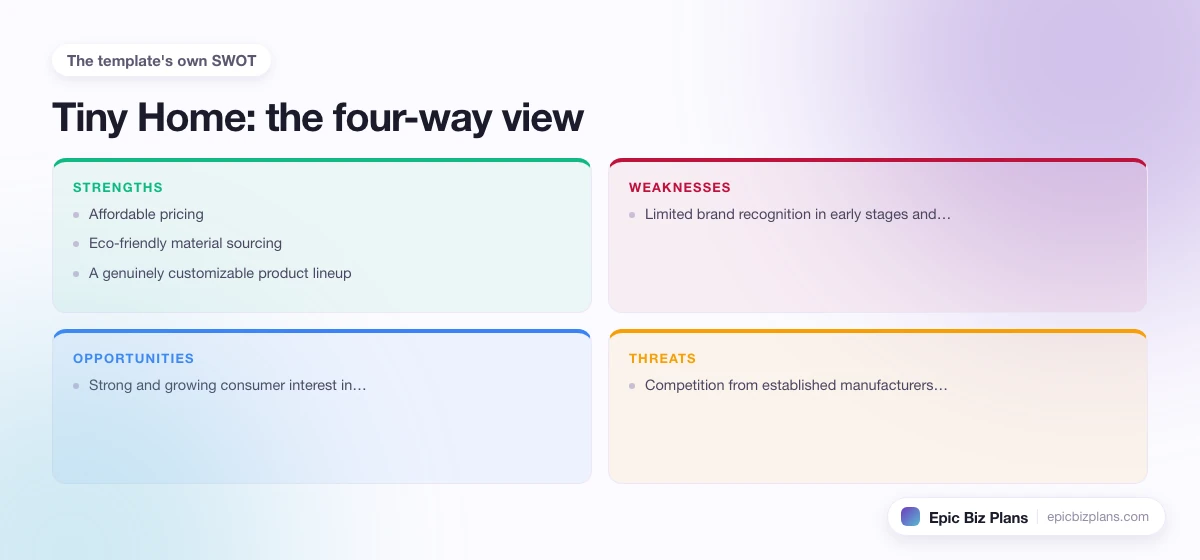
- Strengths: Affordable pricing, eco-friendly material sourcing, and a genuinely customizable product lineup.
- Weaknesses: Limited brand recognition in early stages and the complexity of navigating inconsistent zoning regulations across different markets.
- Opportunities: Strong and growing consumer interest in sustainable living and the tiny home movement.
- Threats: Competition from established manufacturers with larger production capacity and the continued uncertainty around tiny home zoning in many jurisdictions.
Tiny Home Business Name Ideas
Website
We will build our website on Shopify to handle our online store, customer inquiries, and direct sales. Shopify's product display tools are well-suited for showcasing home models with photo galleries, floor plans, and pricing: the type of visual and detailed content that converts visitors into buyers in this category.
Squarespace is worth considering if we want to lead with portfolio-style presentation of completed homes before building out the full commerce functionality. Regardless of platform, our site needs to include a detailed FAQ addressing common concerns around financing, zoning, delivery, and customization. Those exploring related residential business models can reference a smart home business plan template for how technology integrations are changing the residential market.
Marketing Details
Our marketing strategy will use SEO through Semrush to capture organic traffic from people actively searching for tiny home builders, floor plans, and pricing. This audience has high commercial intent. They are not casually browsing; they're actively comparing options. HubSpot will power our email sequences for leads who've requested information but haven't yet committed.
TikTok and YouTube are our primary social platforms: both have strong tiny home communities with engaged audiences who watch build walkthroughs, before-and-after reveals, and daily-life-in-a-tiny-home content. We will invest in video content that builds brand recognition and drives traffic to our site. Those building in adjacent markets should also review our living solutions business plan template for complementary residential product positioning.
Industry Trends
The tiny home industry is benefiting from multiple converging trends: rising conventional home prices, growing environmental awareness, and a younger generation that places less value on square footage and more on location flexibility and financial freedom. Green building materials and energy-efficient design (solar panels, composting systems, advanced insulation) are becoming standard expectations rather than premium add-ons. Regulatory environments are also slowly improving in many regions as local governments recognize tiny homes as a partial solution to housing affordability challenges.
Competitor Information
Direct competitors include established tiny home manufacturers like Tumbleweed and Tiny Heirloom, as well as regional builders operating in our target markets. We will not compete on production volume but on design quality, customization depth, and the client relationship throughout the build process. Our size is an advantage here: clients dealing with large manufacturers often feel like a number, while our approach keeps communication direct and personal throughout. Our cozy home business plan template explores a related residential comfort-focused model.
Financial Information
We estimate startup costs of approximately $250,000, covering initial manufacturing equipment, display model construction, website development, and first-year marketing. We target $500,000 in revenue by end of year two, with the revenue mix shifting toward higher-margin custom builds as our reputation grows. Ongoing costs include materials, labor, delivery, marketing, and administrative expenses. Monthly cash flow statements will be maintained and reviewed to ensure we stay liquid as we scale.
Legal and Compliance
We will register as an LLC and consult with a construction attorney to understand the licensing and permitting requirements for tiny home building in our jurisdiction. Zoning is the most complex legal consideration in this business: many of our customers will be building in jurisdictions with unclear or restrictive rules, and we need to be equipped to help them understand their options. Intellectual property protection will be sought for our proprietary floor plans and brand identity.
-
 SemrushSemrush is a platform with literally any online tool you will need to promote your business. Spy on your competitors, get search traffic, keyword research, social info, ad copies and much more. Used by most of the top online companies in the world. Besides all its tools, Semrush also has many available integrations possible with many other tools that will make your work even better.
 -
 Surfer SEOSurfer SEO is an incredibly smart AI tool that will give you exact explanations what to do in order to make your website rank better. They use hundreds of parameters, check your competitors and decide on the best course of action. Whether it be inner links, bold text, paragraphs, headers, images and much more. Surfer is a must-have in 2026.
Whether your county recognises a tiny house at all
Zoning is the usual worry, but the building code question comes first and has a specific answer. Appendix AQ of the residential code covers tiny houses and defines one as a dwelling of 400 square feet or less in floor area, excluding lofts. It relaxes requirements that make small plans impossible: compact stairs with their own riser, tread, handrail and headroom allowances, reduced ceiling heights in lofts, and loft access by ladder without a guard, where rungs must be at least 12 inches wide and spaced between 10 and 14 inches apart. A loft is defined as a floor level more than 30 inches above the main floor, open to it on one or more sides, with a ceiling height under 6 feet 8 inches.
Here is the part that decides projects. Appendix AQ is an appendix, so it has no legal force in a jurisdiction that has not adopted it, and adoption varies by state and often by county. Before you quote a build, confirm in writing which code edition the authority enforces and whether it has adopted the tiny house appendix. If it has not, your plan has to meet the full residential code, and the stair and loft allowances above are not available to you.
Towable and park-model products sit under a different regime again, closer to the trailer business plan template. Site-based rental models are covered in the RV park business plan template.
Operational Plan
Core operations include design, manufacturing, quality inspection, and delivery. We will source sustainable building materials locally where possible, using vetted national suppliers as backup when local sourcing isn't feasible. Transportation partnerships will handle delivery of mobile units to customer locations, and we will maintain service relationships for post-delivery support. Scheduling will be managed carefully to avoid production bottlenecks, particularly during the peak buying season in late spring and summer.
Contingency Planning
Key risks include material cost fluctuations, regulatory changes that affect tiny home placement, and construction delays that push delivery timelines. We will maintain supply chain relationships with multiple vendors per material category to absorb price volatility, and we will build realistic buffer time into every production schedule. Staying active in tiny home advocacy groups will help us anticipate and respond to regulatory changes before they affect customer orders.
Embrace Your Freedom with a Tiny Home Business Plan
The tiny home market offers real opportunities for builders who combine design quality with a genuine understanding of what their customers are trying to accomplish. Your Tiny Home business plan is the tool that gets you from idea to operational business: helping you define your product, know your market, and manage your finances with clarity.
Exploring Business Opportunities
The tiny home business model has many viable expressions: custom builds for individual buyers, production of standardized models for rental operators, eco-community development partnerships, or a platform for tiny home accessories and furnishings. Explore the model that matches your skills and resources, then focus your plan around executing it well.
Adapt and Evolve
As your business develops, update your plan to reflect your actual customer profile, pricing adjustments, new design lines, and expanded geographic markets. The regulatory landscape for tiny homes is changing: your strategy should keep pace with those changes rather than being anchored to assumptions that may no longer hold.
Practical Uses for Your Plan
Use your Tiny Home business plan to secure supplier relationships, present to potential investors or community developers, plan your production capacity, or sharpen your go-to-market approach before spending on marketing. A clear, specific plan is worth far more than a generic template.
Get Started Today
Your Tiny Home business plan is 100% free: with unlimited edits, unlimited downloads, and unlimited chances to get it right. Build the business you've been planning.
-
ShopifyPut your brand on Shopify. Launch your online store with tools designed for growth and success. Ready to turn your idea into profit? Start building your e-commerce business today.
-
SquarespaceShowcase your brand with Squarespace’s sleek designs. Build a professional online presence with ease. Start with a template that already looks finished.
-
WixBring your ideas to life with Wix. Customize every aspect of your site with unmatched flexibility. Start creating your unique online space and let your creativity shine.
-
ElementorCraft captivating websites effortlessly with Elementor. Enjoy complete creative control without coding. Make your site stand out to your audience. Start turning your vision into reality now.
