
Sustainable Toaster Business Plan Template
-
 ShopifyPut your brand on Shopify. Launch your online store with tools designed for growth and success. Ready to turn your idea into profit? Start building your e-commerce business today.
 -
 SquarespaceShowcase your brand with Squarespace’s sleek designs. Build a professional online presence with ease. Start with a template that already looks finished.
 -
 WixBring your ideas to life with Wix. Customize every aspect of your site with unmatched flexibility. Start creating your unique online space and let your creativity shine.
 -
 ElementorCraft captivating websites effortlessly with Elementor. Enjoy complete creative control without coding. Make your site stand out to your audience. Start turning your vision into reality now.
- Executive Summary
- Business Info
- Business Model Overview
- SWOT Analysis
- Sustainable Toaster Business Name Ideas
- Website
- Marketing Details
- Industry Trends
- Competitor Information
- Financial Information
- Legal and Compliance
- There is no efficiency label for a toaster to win
- Operational Plan
- Contingency Planning
- Your Plan Begins Here
- Explore Business Models
- Grow with Your Vision
- Take the Next Step
The kitchen appliance market is mature, but sustainability has opened a meaningful gap inside it. Customers are actively looking for everyday appliances built with more responsible materials and energy-efficient designs, and they are willing to pay a price premium when the brand can back up its claims. A Sustainable Toaster business plan is the document that converts that demand signal into a specific, financeable operation: one that names suppliers, defines the product, and lays out a realistic path to profitability.
This plan should be specific to the version of the business you are actually building. A direct-to-consumer brand selling a single hero product, a broader sustainable kitchen line, and a B2B-focused operation supplying eco-conscious hotel chains all share the same category but require different financial models, marketing approaches, and operational structures. Use this template as a starting framework, then make every section concrete to your real plan.
Executive Summary
Our mission is to design and sell sustainable toasters that perform as well as conventional alternatives while reducing the environmental impact of the manufacturing and use cycle. We are building a brand recognized for product quality, transparent sourcing, and energy-efficient design: three areas where most kitchen appliance brands underperform. Our value proposition combines aesthetic design with verifiable sustainability credentials. The financial goal is profitability within the first two years, with international expansion targeted within five.
Business Info
The product line includes sustainable toasters built with recycled and recyclable materials, energy-efficient internals, and a design language that fits modern kitchen aesthetics. The target customer is the eco-conscious household, primarily aged 25 to 45, who already factors sustainability into purchasing decisions and is willing to pay more for products that match those values. Sellers planning a wider eco-friendly product line can also work from our Stephanie business plan template. Founders building a broader sustainable kitchen brand should review the kitchen business plan template for the full multi-product framework. Founders structuring the values story behind a sustainable product can also study our Ethos business plan template.
Business Model Overview
The model is direct-to-consumer through our own website, with selected retail partnerships in eco-conscious specialty stores. Online channels are the primary acquisition route: they preserve margin, give us direct access to customer data, and let us tell the sustainability story properly without relying on retailer-controlled marketing. The home appliance business plan template covers the broader appliance category for founders who plan to expand beyond toasters.
SWOT Analysis
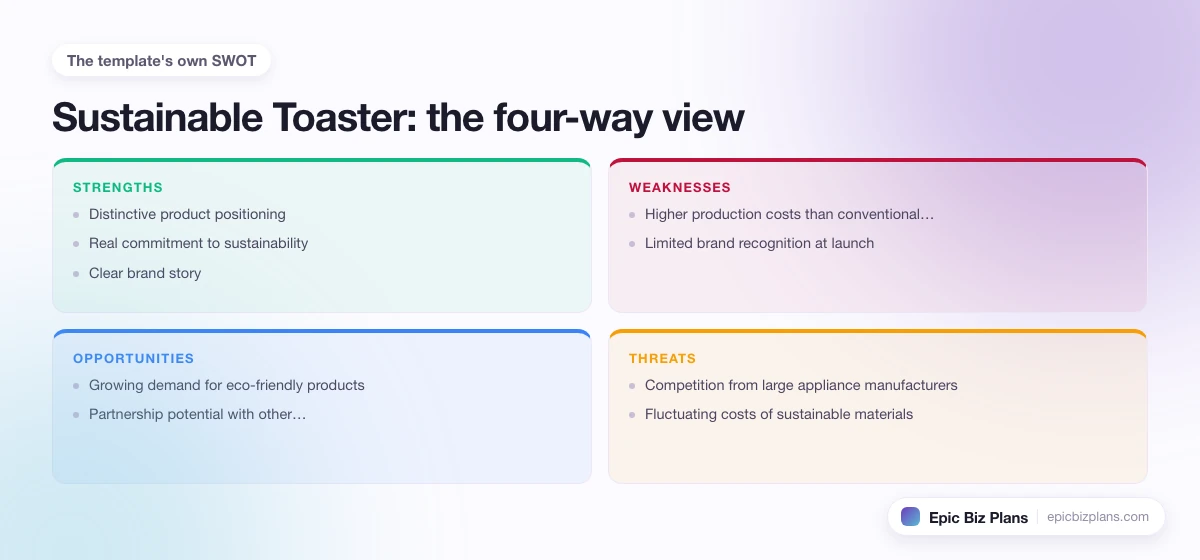
- Strengths: Distinctive product positioning, real commitment to sustainability, clear brand story.
- Weaknesses: Higher production costs than conventional alternatives, limited brand recognition at launch.
- Opportunities: Growing demand for eco-friendly products, partnership potential with other sustainability-focused brands.
- Threats: Competition from large appliance manufacturers, fluctuating costs of sustainable materials.
Sustainable Toaster Business Name Ideas
Website
The site will be built on Shopify, which handles the operational requirements of a product-based DTC business (variants, inventory, payments, shipping, and reviews) without custom development. We will track engagement metrics from launch and iterate the storefront based on what actually converts, particularly around how the sustainability story is presented on product detail pages.
Marketing Details
The marketing plan combines paid digital, organic social, and SEO. Semrush will guide keyword research so we capture customers searching for sustainable kitchen alternatives. HubSpot will manage email (including welcome flows, post-purchase follow-up, and re-engagement campaigns) to build customer lifetime value beyond the initial sale. TikTok ads will reach the younger end of our target audience where short-form product content performs strongly, and influencer partnerships with sustainability-focused creators will provide social proof at lower cost than large-scale ad campaigns.
Industry Trends
Customers are increasingly skeptical of vague sustainability claims, and brands that document their sourcing and manufacturing practices earn more trust than those relying on broad environmental language. Advances in recyclable materials and energy-efficient manufacturing are making sustainable kitchen appliances price-competitive with conventional alternatives, which lowers the barrier for new brands entering the category. The brands that document their supply chain (supplier names, materials, certifications) will continue to outperform those that don't. Founders building a related sustainability brand can also reference our We Care business plan template.
Competitor Information
Competitors include traditional kitchen appliance manufacturers building token sustainable lines, and emerging eco-focused appliance brands building from the ground up. We will differentiate on product specificity, transparent sourcing, and direct customer engagement, areas where larger competitors typically underperform. The household appliances business plan template provides additional competitive analysis frameworks for the broader appliance category.
Financial Information
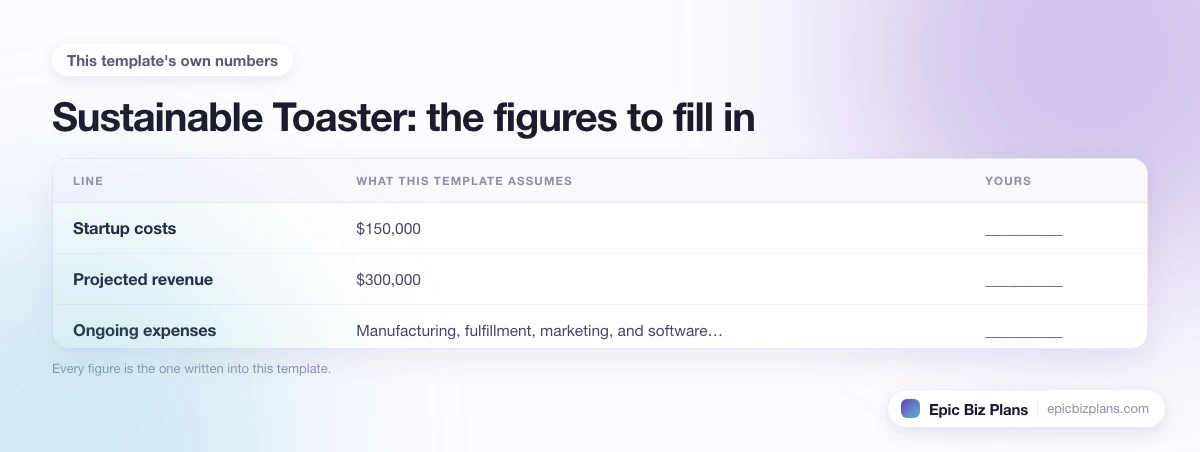
Startup costs are estimated at approximately $150,000, covering production tooling, initial inventory, marketing, and operational setup. First-year revenue is projected at $300,000, with target growth of approximately 20% annually through year three. Ongoing expenses include manufacturing, fulfillment, marketing, and software subscriptions. Cash flow will be tracked monthly with quarterly P&L reviews, particularly to catch inventory buildup early: a common cash drain in product businesses.
Legal and Compliance
We will register the business and comply with environmental regulations covering both materials and manufacturing processes. Sustainability claims need to be defensible (vague or unverifiable environmental marketing is a regulatory risk in addition to a trust risk) so any claim made on the website or packaging will be supported by supplier documentation. Trademark protection for the brand name and core product designs will be addressed before launch. For an adjacent topic, see our futureistic toaster business plan.
There is no efficiency label for a toaster to win
This is the correction that should shape the whole positioning. There is no Energy Star specification covering toasters or toaster ovens, and no federal minimum efficiency standard covers them either. The agency's own market scoping report on toaster ovens found that no widely adopted procedure exists in the United States for measuring their energy use, so comparable data are not available, and that the home appliance trade association offers no certification programme for toasters or toaster ovens. A specification was never issued. The report also noted that roughly 1.7 million toaster ovens are sold in the United States each year, and that because most of the energy goes on the preheat, trimming temperature or cooking time barely moves consumption.
Plan around that rather than against it. An efficiency claim on this product cannot be certified by anyone, so the defensible ground is materials, repairability, spare-part availability and warranty length, each of which you can document and a buyer can check. Any environmental claim on the site or the packaging needs supplier paperwork behind it.
Europe is moving toward exactly those measures for small appliances. The first working plan under the EU ecodesign regulation, published on 16 April 2025, sets horizontal requirements for reparability, including a repair score, plus recyclability and recycled content in electrical and electronic equipment, with a digital product passport carrying the information. Designing for a repair score now is cheaper than retrofitting one. The household appliances business plan template covers the wider category.
Operational Plan
Operations focus on supplier qualification, manufacturing partnerships, and fulfillment. We will work with suppliers who can document their sourcing and manufacturing practices, and we will maintain enough inventory headroom to handle demand spikes without going out of stock on key SKUs. Logistics will prioritize speed: shipping time is a meaningful factor in DTC customer satisfaction, especially when the product is a kitchen item the customer is excited to use.
-
 SemrushSemrush is a platform with literally any online tool you will need to promote your business. Spy on your competitors, get search traffic, keyword research, social info, ad copies and much more. Used by most of the top online companies in the world. Besides all its tools, Semrush also has many available integrations possible with many other tools that will make your work even better.
 -
 Surfer SEOSurfer SEO is an incredibly smart AI tool that will give you exact explanations what to do in order to make your website rank better. They use hundreds of parameters, check your competitors and decide on the best course of action. Whether it be inner links, bold text, paragraphs, headers, images and much more. Surfer is a must-have in 2026.
Contingency Planning
Risks include raw material price shifts, regulatory changes affecting sustainability standards, and competition from larger brands launching their own eco-focused lines. Mitigation includes qualifying multiple suppliers for critical components, maintaining a cash reserve for unexpected costs, and reviewing product performance quarterly to phase out slow-movers and invest behind what is working. Sustainable appliance and household product brands looking to build a full DTC eco goods catalog should review the Millie business plan for a model on subscription revenue, eco supplier management, and sustainable product marketing. Founders building a wider sustainability-focused product range should also see the sustainable business plan template for the broader operational framework.
Your Plan Begins Here
A sustainable toaster business is a focused entry point into the eco-conscious kitchen appliance market. The customer base is well-defined, the product category is mature enough to have established demand patterns, and digital marketing tools give small brands a real path to building an audience without massive ad budgets. The brands that succeed combine product quality with verifiable sustainability credentials and consistent customer communication.
Explore Business Models
The category supports several business models: DTC online brands with a single hero product, multi-product sustainable kitchen lines, B2B operations supplying eco-focused hotels and hospitality groups, and subscription replacement programs that supply parts and accessories on a regular cadence. Each model has its own operational profile and customer acquisition strategy.
Grow with Your Vision
Treat the business plan as a working document. The numbers in your initial model will be different from your actual results, and the most useful thing you can do is update the plan as real data comes in. Refine your assumptions about average order value, repeat purchase rates, and customer acquisition cost as you learn from real customers.
Take the Next Step
Your Sustainable Toaster business plan is 100% free: with unlimited edits, unlimited downloads, and unlimited chances to get it right. Build the version that fits your actual business.
