
Pressure Business Plan Template
-
 ShopifyPut your brand on Shopify. Launch your online store with tools designed for growth and success. Ready to turn your idea into profit? Start building your e-commerce business today.
-
 SquarespaceShowcase your brand with Squarespace’s sleek designs. Build a professional online presence with ease. Start with a template that already looks finished.
-
 WixBring your ideas to life with Wix. Customize every aspect of your site with unmatched flexibility. Start creating your unique online space and let your creativity shine.
-
 ElementorCraft captivating websites effortlessly with Elementor. Enjoy complete creative control without coding. Make your site stand out to your audience. Start turning your vision into reality now.
- Executive Summary
- Business Info
- Business Model Overview
- SWOT Analysis
- Pressure Business Name Ideas
- Website
- Marketing Details
- Industry Trends
- Competitor Information
- Financial Information
- Legal and Compliance
- The rules that apply to a pressure washing business (checked November 2026)
- Operational Plan
- Contingency Planning
- Why Start a Pressure Washing Business
- Grow, Edit, Evolve
- Practical Applications of Your Plan
- Your Path Starts Now
A pressure washing business is one of the cheapest service businesses to start, and one of the easiest to get wrong. The equipment fits in a truck, but the margin depends on pricing each job by the square foot, keeping wash water out of storm drains, and winning repeat commercial work rather than one-off driveways. This plan covers the services, prices, rules and numbers you need before your first booking.
If your plan centers on the equipment itself, such as selling or renting machines, our pressure washer business plan covers that model. This one is about the cleaning service.
Executive Summary
Our mission is to provide high-quality pressure washing services to residential and commercial clients. We aim to offer exceptional customer service and make outdoor spaces spotless. Our vision is to become a recognized leader in the pressure washing industry within our region, known for our reliability and results.
Our value proposition includes specific, provable environmental practices, such as capturing wash water instead of sending it down storm drains and naming the exact benefit of each product we use, plus attention to detail and a commitment to customer satisfaction. Financially, we aim for $250,000 in first-year revenue, which at a $400 average job means about 625 jobs or 12 to 13 a week, so the plan assumes two crews from early in the year, followed by 15 percent annual growth.
Business Info
We will offer a range of pressure washing services, including but not limited to, residential driveway cleaning, commercial building washing, and deck restoration services. Our target market consists of homeowners and businesses in suburban areas, looking for professional cleaning services.
Business Model Overview
We will operate on a service-based model, charging clients per job performed. Additionally, we will offer subscription options for regular maintenance services. Customer referrals and online reviews will play a critical role in our marketing strategy.
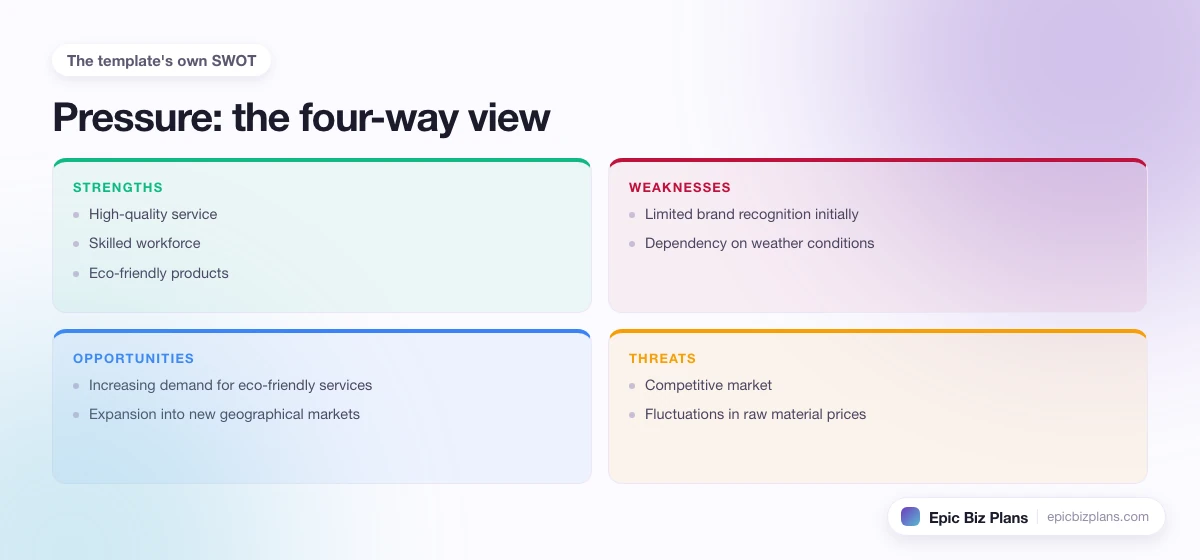
SWOT Analysis
- Strengths: High-quality service, skilled workforce, eco-friendly products.
- Weaknesses: Limited brand recognition initially, dependency on weather conditions.
- Opportunities: Increasing demand for eco-friendly services, expansion into new geographical markets.
- Threats: Competitive market, fluctuations in raw material prices.
Pressure Business Name Ideas
Website
We will build our website using Wix, as it offers an easy-to-use platform for maintaining our online presence. This choice will allow us to provide information about our services, showcase testimonials, and attract potential clients easily.
Marketing Details
Our marketing strategy will include digital marketing efforts primarily focused on SEO using Semrush to improve our online visibility. We will also use HubSpot for our email campaigns to engage with clients and send promotional offers.
For social media marketing, we will run TikTok ads targeting younger demographics to create awareness and generate leads. Maintaining a strong presence on platforms like Instagram and Facebook will help us showcase our work and engage with our community.
Industry Trends
US pressure washing services brought in about $1.2 billion in 2024 and grew only about 0.6 percent a year from 2019 to 2024, according to IBISWorld, so a new company grows by winning customers from others through reliability, reviews and repeat plans. Technological advancements, such as more efficient pressure washing equipment, are also contributing to the sector's evolution.
Additionally, storm water rules in many cities now require wash water to be captured, which favors companies that invest in recovery equipment. We will align our services with these trends to attract environmentally conscious customers.
Competitor Information
Our main competitors include established local pressure washing companies and general cleaning services that may offer pressure washing as an additional service. We will differentiate our business through quality and through water recovery on every job, which lets us work legally where cities ban runoff into storm drains.
Additionally, we will build a strong brand presence online and use customer testimonials to showcase our reliability and efficacy, setting us apart in the industry.
Financial Information
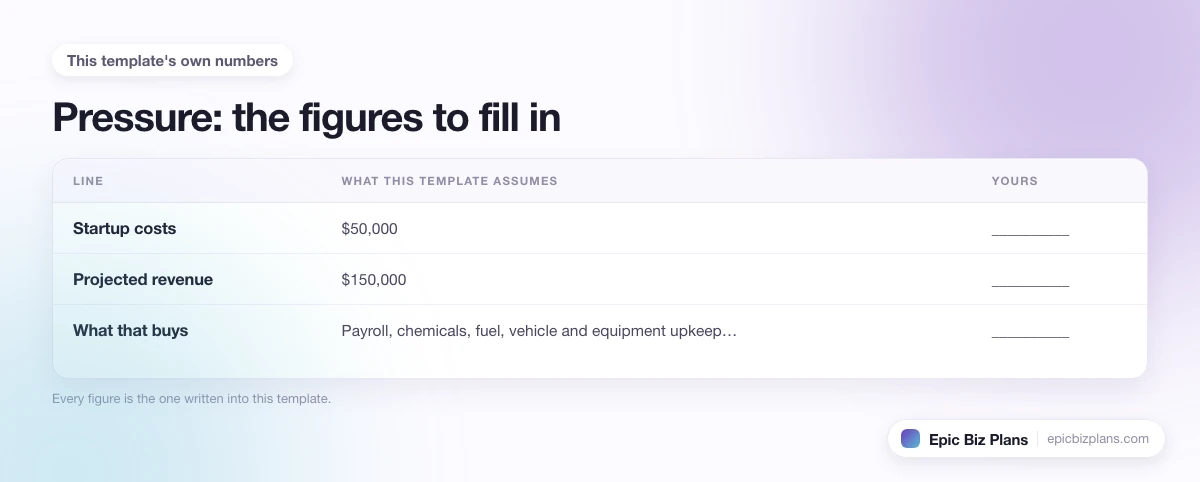
Our estimated startup costs include equipment purchase, marketing expenses, initial salaries, and operational costs, totaling approximately $50,000. We anticipate $250,000 in first-year revenue against $150,000 of yearly costs covering payroll, chemicals, fuel, vehicle and equipment upkeep, insurance, wash water recovery and disposal, and marketing, a 40 percent margin we will test against our actual cost per job each month.
We expect a positive cash flow by the end of our first operational year, with profit margins increasing as we grow our customer base.
-
 SemrushSemrush is a platform with literally any online tool you will need to promote your business. Spy on your competitors, get search traffic, keyword research, social info, ad copies and much more. Used by most of the top online companies in the world. Besides all its tools, Semrush also has many available integrations possible with many other tools that will make your work even better.
-
 Surfer SEOSurfer SEO is an incredibly smart AI tool that will give you exact explanations what to do in order to make your website rank better. They use hundreds of parameters, check your competitors and decide on the best course of action. Whether it be inner links, bold text, paragraphs, headers, images and much more. Surfer is a must-have in 2026.
Legal and Compliance
We will get the business licenses our city and state require, check the local storm water ordinance before each new service area (many cities ban wash water in storm drains and require it to be collected), and follow EPA lead-safe rules when washing paint on homes built before 1978. Additionally, we will register our business name to secure our brand identity and consider intellectual property protection for any proprietary marketing materials.
The rules that apply to a pressure washing business (checked November 2026)
Wash water is the main legal risk. Under the federal storm water program, anything entering a city storm drain that is not entirely rainwater is an "illicit discharge," and cities must ban it by ordinance and enforce the ban. Local rules then differ: Lubbock, Texas expects mobile wash water to be collected and kept out of streets and drains, while Monroe, North Carolina allows pavement washing into drains only with no detergents, water under 110 F, pre-cleaned surfaces and filtering. Price a water recovery mat and vacuum into your startup costs and call your city before the first job.
Old paint changes the job. On a home built before 1978, washing that disturbs more than 20 square feet of exterior paint counts as renovation under EPA rules, so lead-safe certification and work practices apply. Chemicals bring OSHA duties once you have staff: a written hazard communication program, a chemical list, labels, safety data sheets and training for anyone handling products such as sodium hypochlorite. Roof and second-story work triggers fall protection for workers 4 feet or more above a lower level, plus OSHA's ladder rules.
Marketing claims need proof. The FTC's Green Guides advise against unqualified claims such as "eco-friendly" because they are very hard to substantiate, so say exactly what you mean, such as "we capture and filter our wash water." Insurance is part of the price of entry: general liability is the core policy, reported at about $500 to $1,500 a year for $1 million of cover, plus commercial auto for the work vehicle and inland marine cover for the equipment.
Use published price ranges to set your own. A Housecall Pro price book covering the 12 months to September 2026 shows residential work at $0.10 to $0.50 per square foot, roofs at $0.50 to $1.00, house washes at $250 to $597, driveways at $150 to $400 and decks at $100 to $250. IBISWorld puts the US industry at $1.2 billion in 2024, growing about 0.6 percent a year, so growth comes from taking customers rather than a rising market. For services to bundle in the off-season, see the window cleaning business plan template, and the power wash business plan template covers the larger-equipment end of the same work.
Operational Plan
Key operations will involve scheduling services, managing customer inquiries, and performing pressure washing tasks. We will establish a reliable supply chain for eco-friendly cleaning solutions and equipment.
Logistics will be managed through a centralized scheduling system that allows us to efficiently allocate resources and ensure timely service delivery.
Contingency Planning
We recognize potential risks such as equipment failure, fluctuating demand, and competitive pricing challenges. We will mitigate these risks by maintaining a reserve fund for emergencies, investing in quality equipment, and continuously evaluating our pricing structure based on market conditions.
Additionally, flexible scheduling and the ability to change our marketing strategies will ensure we remain responsive to market trends and client needs.
Why Start a Pressure Washing Business
Pressure washing suits a founder who wants to start small and grow by route density. One trained operator with a truck-mounted rig can serve homes, then add storefronts, restaurants, apartment blocks and fleet yards as reviews build. The work is seasonal in colder states, so many operators add gutter cleaning, window washing or holiday lighting to keep crews busy in winter.
-
ShopifyPut your brand on Shopify. Launch your online store with tools designed for growth and success. Ready to turn your idea into profit? Start building your e-commerce business today.
-
SquarespaceShowcase your brand with Squarespace’s sleek designs. Build a professional online presence with ease. Start with a template that already looks finished.
-
WixBring your ideas to life with Wix. Customize every aspect of your site with unmatched flexibility. Start creating your unique online space and let your creativity shine.
-
ElementorCraft captivating websites effortlessly with Elementor. Enjoy complete creative control without coding. Make your site stand out to your audience. Start turning your vision into reality now.
Grow, Edit, Evolve
Your process doesn’t end here. As you handle the ups and downs of entrepreneurship, your Pressure business plan should grow with you. Revisit your prices each season, add services such as soft washing or gutter cleaning, and expand into new neighborhoods once your routes are full. A plan you update each season keeps your prices and routes in line with what customers actually pay.
Practical Applications of Your Plan
Consider how you can use this plan to present ideas to potential partners, lay the groundwork for a successful launch, secure vital funding, or clarify your strategic vision. A well-structured Pressure business plan can be your strongest ally in whatever phase your business is in.
Your Path Starts Now
Your Pressure business plan is 100% free, with unlimited edits, unlimited downloads, and unlimited chances to get it right. Fill in your own prices and service area, and start booking jobs.
