
Mir Business Plan Template
-
 ShopifyPut your brand on Shopify. Launch your online store with tools designed for growth and success. Ready to turn your idea into profit? Start building your e-commerce business today.
 -
 SquarespaceShowcase your brand with Squarespace’s sleek designs. Build a professional online presence with ease. Start with a template that already looks finished.
 -
 WixBring your ideas to life with Wix. Customize every aspect of your site with unmatched flexibility. Start creating your unique online space and let your creativity shine.
 -
 ElementorCraft captivating websites effortlessly with Elementor. Enjoy complete creative control without coding. Make your site stand out to your audience. Start turning your vision into reality now.
- Executive Summary
- Business Info
- SWOT Analysis
- Mir Business Name Ideas
- Website
- Marketing Details
- Industry Trends
- Competitor Information
- Financial Information
- Legal and Compliance
- The words you may no longer use in Europe
- Operational Plan
- Contingency Planning
- Building Your Mir Business
- Types of Businesses to Explore
- Stay Flexible and Adapt
- Ready to Take the Next Step?
A Mir business plan sets out the strategy, operations, and financial projections for a product or service business focused on eco-friendly lifestyle goods. The name "Mir" signals a brand identity grounded in sustainability and conscious consumption, qualities that attract a growing segment of buyers who want their purchases to align with their values.
This template covers each component of a professional business plan, adapted for a sustainable product business entering an increasingly competitive market where genuine environmental credentials matter more than marketing claims.
Executive Summary
Our mission is to provide original and high-quality products that improve the daily lives of our customers while minimizing environmental impact. We envision becoming a recognized brand in the eco-friendly lifestyle market, built on a foundation of transparency and product quality. Our value proposition centers on offering functional, well-designed goods made from responsibly sourced materials. Financially, we aim to achieve a revenue of $500,000 in our first year, with a steady growth rate of 20% annually.
Business Info
We will offer a range of eco-friendly lifestyle products, targeting environmentally conscious consumers aged 18-45. Our business model combines online sales through an e-commerce platform with participation in local markets and events to build community awareness and direct customer relationships.
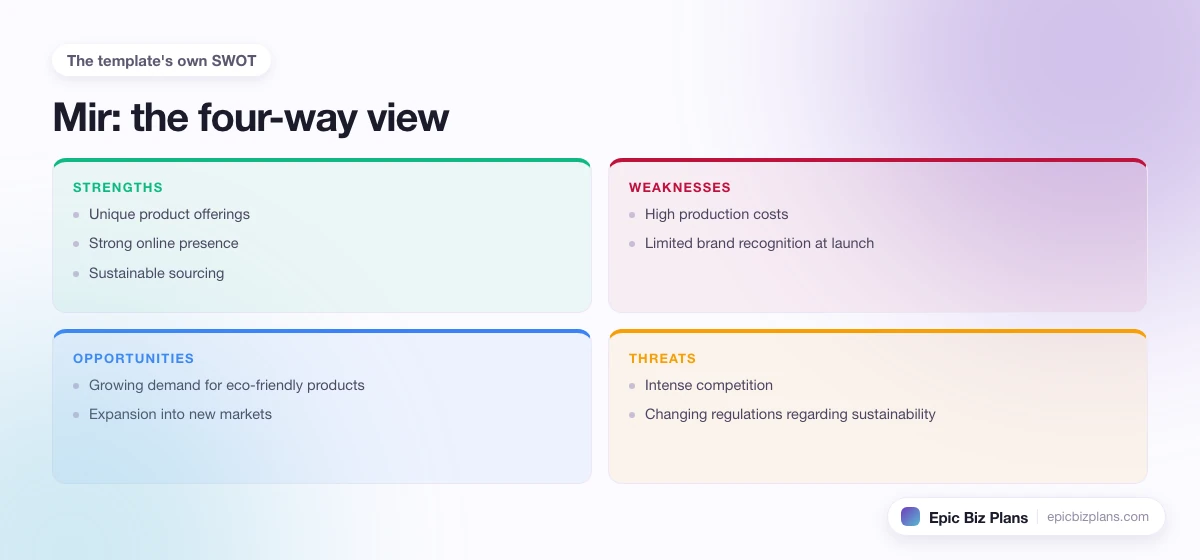
SWOT Analysis
- Strengths: Unique product offerings, strong online presence, sustainable sourcing.
- Weaknesses: High production costs, limited brand recognition at launch.
- Opportunities: Growing demand for eco-friendly products, expansion into new markets.
- Threats: Intense competition, changing regulations regarding sustainability.
Mir Business Name Ideas
Website
Shopify is the recommended platform for this type of product business, providing a complete e-commerce solution with payment processing, inventory management, and a broad selection of customizable storefronts. A well-designed product page with clear photography, material descriptions, and sourcing information builds credibility with sustainability-focused buyers who research before purchasing.
Marketing Details
SEO through Semrush will identify search terms used by buyers looking for sustainable alternatives in specific product categories, targeting these precisely drives qualified traffic rather than broad awareness. Email campaigns through HubSpot nurture leads and keep existing customers informed about new products and sustainability initiatives.
TikTok content showing the sourcing process, production methods, and the environmental impact of choosing sustainable products connects with younger consumers who factor brand values into their purchasing decisions. Businesses in the green product space can find additional frameworks in our green and eco business plan template.
Industry Trends
Demand for eco-friendly products has moved well beyond early adopters: mainstream consumers now expect brands to demonstrate environmental responsibility rather than simply claim it. Regulatory pressure in several markets is accelerating the shift toward sustainable materials and packaging standards. Businesses that build genuine sustainability credentials into their supply chain will be better positioned as these standards tighten. Our sustainable fashion business plan explores how sustainability credentials translate into premium pricing power across product categories.
Competitor Information
The eco-friendly product market includes established brands with significant marketing budgets, as well as smaller direct-to-consumer operations competing on authenticity. Differentiation comes from genuine sourcing transparency, product quality, and customer education, buyers in this space research claims carefully and reward brands that back them up with verifiable information. Building a strong online community around shared values creates loyalty that generic competitors cannot easily replicate.
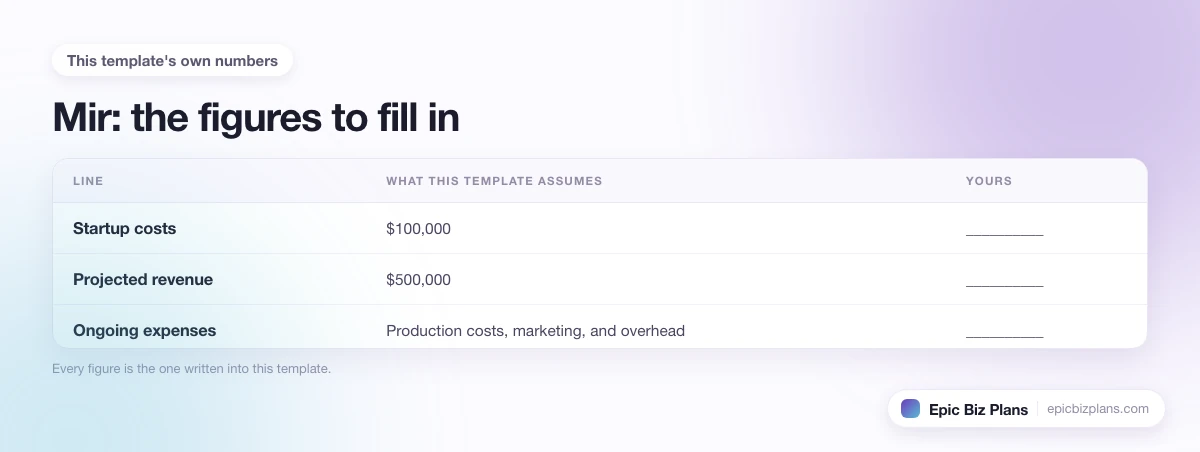
Financial Information
Startup costs are projected at approximately $100,000, covering product development, initial inventory, marketing, and operational setup. First-year revenue is targeted at $500,000, with a gross margin of 40%. Ongoing expenses will include production costs, marketing, and overhead. A detailed cash flow statement should be built out as product pricing and sales volume projections become clearer.
Legal and Compliance
Business registration and relevant permits are the baseline requirements. Sustainability claims used in marketing must be accurate and defensible: greenwashing carries legal and reputational risks that can seriously damage a young brand. Intellectual property protection for unique product designs is worth pursuing early, particularly for any proprietary materials or formulations. Our home and lifestyle business plan template covers compliance considerations for businesses selling physical lifestyle products.
The words you may no longer use in Europe
For a brand whose name carries its environmental promise, this is the largest compliance item in the plan, and the date has already passed. Rules under the EU directive on help consumers for the green transition apply to traders from 27 September 2026. Member states had to write them into national law by 27 March 2026, and there is no transition period for stock already on the market, so packaging and product pages that were already live had to comply on day one.
Three practices are now prohibited outright. A generic environmental claim, the sort of wording that says a product is eco-friendly or green without more, is banned unless you can demonstrate recognised excellent environmental performance. Displaying a sustainability label that is not based on a recognised certification scheme is banned, so a self-made badge is no longer an option. And presenting a claim about one aspect of a product as though it covered the whole product or the whole business is prohibited. Product-level carbon-neutral claims resting on offsets are blacklisted.
What survives is specific and measurable: a named material, a stated percentage of recycled content, a certification from a scheme that exists independently of you, a figure you can show the working for. Rewrite the marketing copy against that test before it is read for you. The green and eco business plan template covers the retail channel for the same products.
Operational Plan
Key operations include sourcing sustainable materials, managing inventory, and fulfilling orders accurately and on time. Establishing reliable supplier partnerships with documented sustainability standards ensures the supply chain matches the brand's claims. Logistics planning should account for packaging materials, eco-friendly packaging reinforces the brand message and meets buyer expectations in this market segment.
-
 SemrushSemrush is a platform with literally any online tool you will need to promote your business. Spy on your competitors, get search traffic, keyword research, social info, ad copies and much more. Used by most of the top online companies in the world. Besides all its tools, Semrush also has many available integrations possible with many other tools that will make your work even better.
 -
 Surfer SEOSurfer SEO is an incredibly smart AI tool that will give you exact explanations what to do in order to make your website rank better. They use hundreds of parameters, check your competitors and decide on the best course of action. Whether it be inner links, bold text, paragraphs, headers, images and much more. Surfer is a must-have in 2026.
Contingency Planning
Supply chain disruptions and shifts in consumer preferences are the primary risks for a product-focused business. Diversifying the supplier base reduces dependency on single sources, while maintaining a flexible product line allows the business to adapt when specific materials become unavailable or cost-prohibitive. Regular market analysis keeps the product roadmap aligned with evolving buyer priorities.
Building Your Mir Business
A well-executed eco-friendly product business can build lasting competitive advantages: brand trust, community loyalty, and pricing power that generic alternatives lack. Buyers in this space make deliberate purchasing decisions and tend to remain loyal to brands that consistently deliver on their values.
Types of Businesses to Explore
Sustainable lifestyle product businesses range from small artisan operations to direct-to-consumer e-commerce brands shipping nationally and internationally. The category includes home goods, personal care products, food and beverage, and fashion accessories: any product where materials, sourcing, and production methods can be a genuine point of differentiation.
Stay Flexible and Adapt
Update this plan as your product line evolves, your customer base grows, and sustainability standards in your industry develop. Different market segments, pricing tiers, and sales channels will emerge as the business matures: treat this plan as a living document that reflects where the business is headed, not just where it started.
Ready to Take the Next Step?
Your Mir business plan is 100% free: with unlimited edits, unlimited downloads, and unlimited chances to get it right.
