
Integrated Business Plan Template
-
 ShopifyPut your brand on Shopify. Launch your online store with tools designed for growth and success. Ready to turn your idea into profit? Start building your e-commerce business today.
 -
 SquarespaceShowcase your brand with Squarespace’s sleek designs. Build a professional online presence with ease. Start with a template that already looks finished.
 -
 WixBring your ideas to life with Wix. Customize every aspect of your site with unmatched flexibility. Start creating your unique online space and let your creativity shine.
 -
 ElementorCraft captivating websites effortlessly with Elementor. Enjoy complete creative control without coding. Make your site stand out to your audience. Start turning your vision into reality now.
- Executive Summary
- Business Info
- SWOT Analysis
- Integrated Business Name Ideas
- Website
- Marketing Details
- Industry Trends
- Competitor Information
- Financial Information
- Legal and Compliance
- How the revenue lands, and why lenders ask
- Operational Plan
- Contingency Planning
- Common Mistakes to Avoid
- Build the Business, Not Just the Plan
- Adapt and Evolve
- Use Your Plan Effectively
An Integrated business plan covers the kind of business that sells solutions rather than products: typically software platforms, service bundles, or technology systems that bring multiple components together for a client. These businesses serve other businesses, which means your plan needs to address sales cycles, contract structures, and service delivery in ways that a retail or consumer product plan does not.
Getting an integrated solutions business right requires a plan that connects every part of the operation: sales, onboarding, delivery, support, and retention. Your plan is the document that shows investors, partners, and your own team how those pieces fit together and why the business model works.
Executive Summary
Our mission is to provide integrated solutions that address the operational needs of our clients while maintaining a strong commitment to quality and measurable outcomes. We aim to become a recognized name in the integrated solutions market by delivering a value proposition built around client satisfaction and dependable ongoing support.
Financial targets include reaching $1 million in revenue within the first two years, with profitable margins maintained through efficient operations and targeted customer acquisition. The subscription model we are building provides predictable recurring revenue that supports long-term planning.
Business Info
We will offer a range of integrated services designed to reduce operational complexity for businesses of all sizes. Our primary target market is small to medium-sized enterprises that need efficiency improvements but lack the internal resources to build custom solutions. We operate on a subscription model, allowing clients to select the services they need on monthly or annual terms. Businesses building within the broader technology solutions space should review the technology solutions business plan for a complementary framework covering product architecture, client acquisition, and the SaaS pricing models that work best at the SMB level.
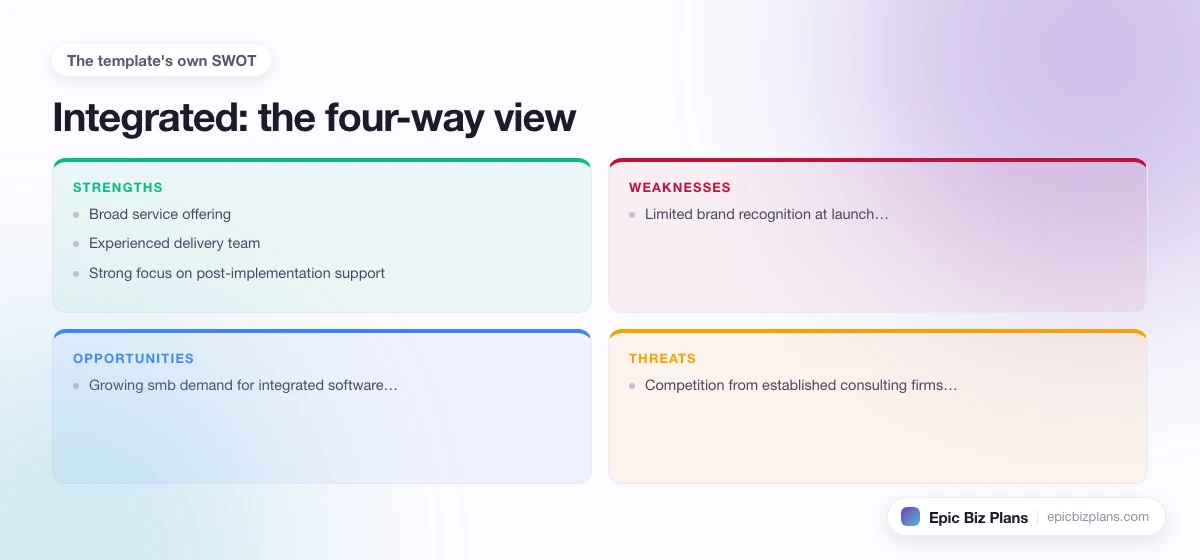
SWOT Analysis
- Strengths: Broad service offering, experienced delivery team, strong focus on post-implementation support.
- Weaknesses: Limited brand recognition at launch; technology-dependent model requires consistent maintenance investment.
- Opportunities: Growing SMB demand for integrated software solutions; potential for strategic partnerships with technology providers.
- Threats: Competition from established consulting firms and well-funded SaaS startups; rapid technology changes requiring continuous product adaptation.
Integrated Business Name Ideas
Website
We will build our website on Shopify or Squarespace depending on the balance between product sales and service presentation. For a primarily subscription-based service business, Squarespace offers clean templates that communicate credibility well. If product add-ons or digital downloads are part of the mix, Shopify's commerce infrastructure handles that more efficiently.
Marketing Details
Our marketing strategy targets decision-makers at small and mid-sized businesses through a combination of organic search, email campaigns, and social advertising. Semrush will guide SEO targeting around keywords that reflect our customers' operational pain points, not just product category terms. HubSpot will manage email nurture sequences that move prospects from awareness to evaluation to purchase over a structured timeline. For founders building parallel offerings around enterprise software workflows, the ERP software business plan outlines pricing, deployment, and onboarding patterns that often translate well to integrated service models.
TikTok ads can reach founders and operators in the younger entrepreneur demographic, particularly effective for awareness content that explains a problem the audience may not have named yet. This type of top-of-funnel content builds the case for integrated solutions before a prospect is actively searching.
Industry Trends
The integrated solutions market is being shaped by the rapid adoption of automation and AI-assisted workflows. Businesses that previously required custom builds are now finding viable off-the-shelf solutions, which raises the bar for integrated solution providers to deliver genuine customization and hands-on support. The growing shift toward remote and distributed teams has also increased the demand for software that unifies communication, project management, and data in a single platform. For entrepreneurs building within the data and analytics layer of integrated solutions, the data management business plan provides a focused framework for that product category.
Competitor Information
Primary competitors include traditional consulting firms that offer implementation services, and newer technology startups entering the integrated solutions space with venture backing. Our differentiation comes from a client-centric delivery model, we tailor solutions to specific client needs rather than selling a one-size-fits-all platform. Post-implementation support is where we expect to build the strongest loyalty, since most competitors underinvest in this phase. Integrated businesses that also offer advisory and consulting services alongside their technical solutions should also review the strategy consulting business plan for a model covering retainer structures, proposal development, and client relationship management.
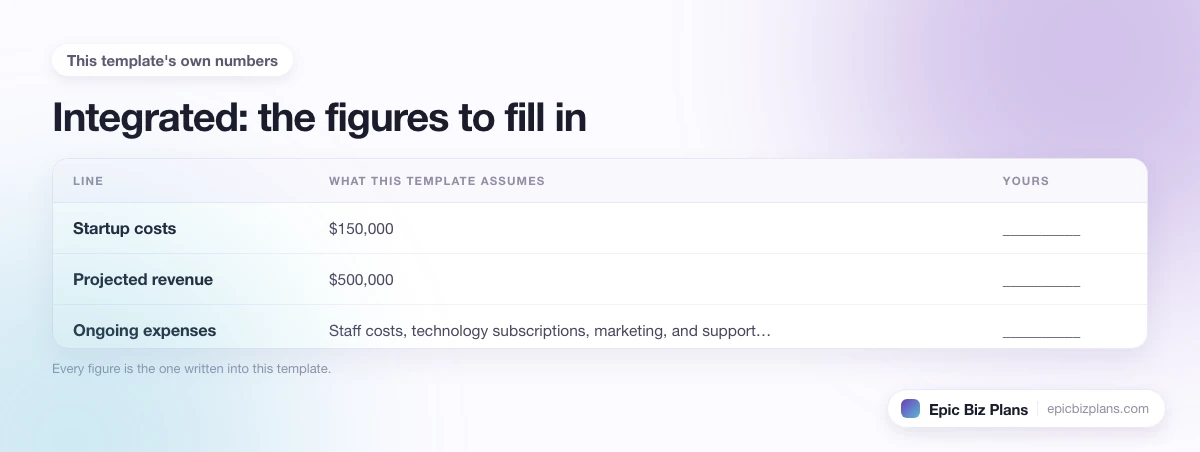
Financial Information
Startup costs are estimated at $150,000, covering technology infrastructure, marketing, initial salaries, and operational setup. Year-one revenue is projected at $500,000, with 20% annual growth expected as client retention compounds over time. Ongoing expenses include staff costs, technology subscriptions, marketing, and support overhead. A subscription revenue model provides predictable monthly cash flow, which we will track closely alongside customer acquisition cost and lifetime value to keep unit economics healthy.
Legal and Compliance
The business will register with all relevant authorities and secure appropriate licenses for our service categories. Intellectual property protection (including trademarks for the brand and copyright registration for any proprietary software or methodology) will be addressed before launch. Client contracts will include clear terms around data handling, service level agreements, and intellectual property ownership.
How the revenue lands, and why lenders ask
For a business selling bundled solutions, the accounting question decides what your plan is allowed to show. Under the revenue standard you first identify the separate performance obligations in a contract, then allocate the price to each by its standalone selling price. The pivot for an integrated seller is whether implementation is distinct from the software. If the implementation work significantly customises or modifies the platform, the two combine into a single obligation and revenue is recognised across the whole delivery. If the setup is standard work any qualified third party could do, it is distinct and recognised on its own as it completes.
That one judgement can move a large first contract from this year's revenue into the next three, which is the difference between a plan a lender believes and one it queries. Decide it before you sign, document the reasoning, and have your accountant confirm it. Price every element as if it were sold alone, because that is the number the allocation runs on.
Client contracts still need clear terms on data handling, service levels and who owns the intellectual property in bespoke work. Adjacent models are covered in the ERP software business plan template and the CRM consulting business plan template.
-
 SemrushSemrush is a platform with literally any online tool you will need to promote your business. Spy on your competitors, get search traffic, keyword research, social info, ad copies and much more. Used by most of the top online companies in the world. Besides all its tools, Semrush also has many available integrations possible with many other tools that will make your work even better.
 -
 Surfer SEOSurfer SEO is an incredibly smart AI tool that will give you exact explanations what to do in order to make your website rank better. They use hundreds of parameters, check your competitors and decide on the best course of action. Whether it be inner links, bold text, paragraphs, headers, images and much more. Surfer is a must-have in 2026.
Operational Plan
Core operations cover project delivery, client onboarding, ongoing support, and product development. We will build structured onboarding processes that get new clients operational quickly, since time-to-value is a key driver of early retention. Technology partnerships with established providers will extend our capability without requiring us to build everything in-house. Client feedback loops will be built into quarterly reviews to ensure the service remains aligned with evolving needs. For businesses that want to add IT support and infrastructure management to their integrated services offering, the IT solution business plan covers that operational model in detail.
Contingency Planning
Key risks include client churn from unmet expectations, technology partner disruptions, and rapid market shifts driven by new entrants. We will manage these risks by maintaining a pipeline of at least three months of new business at all times, diversifying the technology stack to avoid single-vendor dependency, and conducting regular strategic reviews to stay ahead of competitive changes.
Common Mistakes to Avoid
Founders building integrated solutions businesses often underestimate the gap between selling a tool and selling an outcome. Clients are not buying software features; they are buying a transformation in how their business operates. Pitching feature lists rather than measurable client outcomes is the most common reason early deals stall.
A second mistake is underpricing initial engagements to win early logos. While reference clients matter, signing contracts that do not cover delivery cost creates margin problems that compound as the team grows. Set pricing at sustainable levels from day one and offer non-monetary concessions (extended onboarding, faster response times) to close the gap when needed. The integration business plan covers contract structuring patterns that help avoid this trap.
Build the Business, Not Just the Plan
An integrated solutions business succeeds when every function (sales, delivery, support, and product) works as one system. Your business plan is the document that maps how that system operates and why each part is necessary. Whether you are targeting local SMBs, a specific industry vertical, or a distributed customer base served entirely online, the fundamentals are the same: solve a real operational problem, price it sustainably, and deliver on what you promise.
Adapt and Evolve
Your integrated business plan will need updates as you learn which customer segments convert best, which services drive the highest retention, and where the margins are strongest. Treating the plan as a working document (not a one-time deliverable) keeps it useful as a management tool throughout the business lifecycle.
Use Your Plan Effectively
Your integrated business plan can serve as a pitch document for investors, a framework for a bank loan application, an onboarding guide for early hires, or a strategic reference for your own decision-making. Each of these uses requires a plan that is specific, honest about risks, and grounded in realistic financial projections.
Your integrated business plan is 100% free: with unlimited edits, unlimited downloads, and unlimited chances to get it right. Start with the version that reflects where you are today, and build from there.
