
Inclusive Business Plan Template
-
 ShopifyPut your brand on Shopify. Launch your online store with tools designed for growth and success. Ready to turn your idea into profit? Start building your e-commerce business today.
 -
 SquarespaceShowcase your brand with Squarespace’s sleek designs. Build a professional online presence with ease. Start with a template that already looks finished.
 -
 WixBring your ideas to life with Wix. Customize every aspect of your site with unmatched flexibility. Start creating your unique online space and let your creativity shine.
 -
 ElementorCraft captivating websites effortlessly with Elementor. Enjoy complete creative control without coding. Make your site stand out to your audience. Start turning your vision into reality now.
- Executive Summary
- Business Info
- Business Model Overview
- SWOT Analysis
- Business Name Ideas
- Website
- Marketing Details
- Industry Trends
- Competitor Information
- Financial Information
- Legal and Compliance
- What the law actually requires of your website
- Operational Plan
- Contingency Planning
- Embrace Your Creative Purpose
- Explore Your Business Options
- Stay Agile and Adaptable
- Put Your Plan to Work
An inclusive business is one designed from the ground up to serve customers who are routinely underserved: people with disabilities, individuals from marginalized communities, and anyone who has found mainstream retail options inaccessible or unrepresentative. The business case for inclusion is straightforward: these are large markets with real purchasing power and significant unmet demand. This template helps you build the operational and strategic foundation for a business that genuinely serves them.
Inclusive businesses face some unique planning challenges: product sourcing from suppliers who share your values, website and in-store accessibility requirements, and marketing that authentically reflects diverse communities without performative gestures. This plan addresses each of those areas specifically, so you can build something substantive rather than symbolic. A narrower version of the same market is set out in our special needs business plan. For a closely related angle, see our LGBTQ business plan template.
Executive Summary
We will build an inclusive retail and services platform that prioritizes accessibility, representation, and genuine utility for underserved customer segments. Our mission is to ensure that every customer (regardless of ability, background, or identity) can find products and services designed with their needs in mind. Our value proposition is not diversity as a marketing angle but as a design principle: every product we carry, every page of our website, and every service interaction will be built to be genuinely accessible. We are targeting revenue of $300,000 in year one, with break-even by month 18, and sustained growth as our community-focused reputation builds organically.
Business Info
Our product and service selection will be curated around three specific customer needs: adaptive products for people with physical disabilities, culturally diverse goods underrepresented in mainstream retail, and affordable accessibility tools for low-income households. Our target market spans multiple demographics but is unified by the experience of not seeing themselves reflected in typical retail offerings. We will operate via e-commerce as the primary channel, with a physical community space in our target market for consultations, events, and product demonstrations. For businesses structuring around community service values, a community center business plan provides a useful operational reference.
Business Model Overview
Revenue will come from direct product sales, a subscription membership offering early access to new products and community events, and a small consulting arm for other businesses seeking to improve their accessibility practices. The membership model aligns our financial incentives with genuine community investment: members who feel genuinely served will renew; those who do not, will not. This keeps us honest about whether our inclusion claims are substantive.
SWOT Analysis
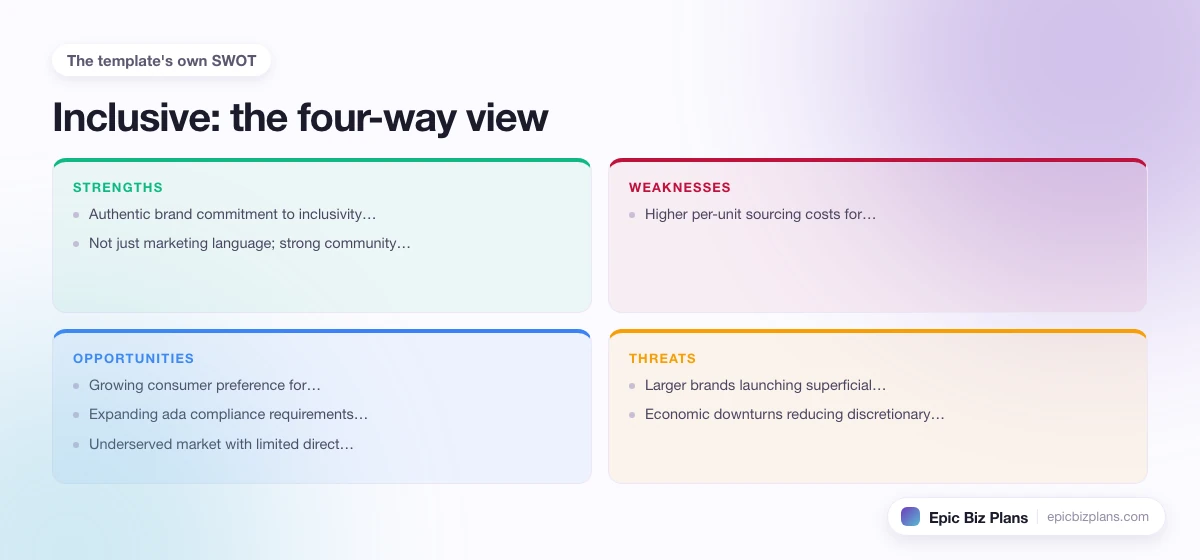
- Strengths: Authentic brand commitment to inclusivity backed by product design decisions, not just marketing language; strong community loyalty potential.
- Weaknesses: Higher per-unit sourcing costs for specialized adaptive products and longer customer acquisition timeline due to trust-building requirements in this market.
- Opportunities: Growing consumer preference for values-aligned brands, expanding ADA compliance requirements creating demand for adaptive product expertise, and underserved market with limited direct competition.
- Threats: Larger brands launching superficial "inclusive" lines that crowd the messaging space without genuine commitment, and economic downturns reducing discretionary spending in target demographics.
Business Name Ideas
1. Inclusive Emporium
2. Diverse Alliances
3. Access Point
4. Unity Bazaar
5. Community Marketplace
6. Equitable Goods
7. The Mosaic Shop
8. AllWelcome
9. Together We Shop
10. Empathy Exchange
-
 SemrushSemrush is a platform with literally any online tool you will need to promote your business. Spy on your competitors, get search traffic, keyword research, social info, ad copies and much more. Used by most of the top online companies in the world. Besides all its tools, Semrush also has many available integrations possible with many other tools that will make your work even better.
 -
 Surfer SEOSurfer SEO is an incredibly smart AI tool that will give you exact explanations what to do in order to make your website rank better. They use hundreds of parameters, check your competitors and decide on the best course of action. Whether it be inner links, bold text, paragraphs, headers, images and much more. Surfer is a must-have in 2026.
Website
Our website must meet WCAG 2.1 AA accessibility standards at minimum. This is not optional; it is foundational to our brand promise. We will build on Shopify, which supports accessibility-focused themes and has a solid app ecosystem for screen reader optimization, alt text management, and color contrast compliance. All product images will include detailed alt text. Checkout flow will be keyboard-navigable. We will conduct an accessibility audit using axe DevTools before launch and quarterly afterward. For brands also serving international communities, Squarespace provides multilingual capabilities as an alternative platform consideration.
Marketing Details
Our marketing will be built on community credibility, not reach. We will partner with disability advocacy organizations, community groups, and cultural organizations before we launch: these partnerships are both ethical validation and the most effective customer acquisition strategy available to us. Semrush will guide our SEO content strategy around high-intent search terms for adaptive products and inclusive retail. HubSpot will manage our email list with segmentation by product interest and community affiliation.
Social media will prioritize authentic community representation: content featuring real customers from our target communities, user-generated stories, and educational content on accessibility and inclusion. TikTok and Instagram will reach younger demographics; Facebook groups focused on disability and community advocacy will reach higher-intent audiences. Paid advertising will be tested conservatively until we understand which channels our community actually uses. Businesses in the social enterprise space should also review a diversity business plan for complementary marketing frameworks.
Industry Trends
Consumer demand for authentic inclusivity is growing across every retail category. Brands that make genuine product and service decisions based on inclusive design (rather than updating marketing imagery) are winning disproportionate loyalty. ADA compliance enforcement is increasing, creating both regulatory pressure on businesses to improve accessibility and market demand for adaptive products. The disability market alone represents over $490 billion in disposable income annually in the US, making it one of the most underserved large markets in retail. AI-driven personalization tools are making it technically feasible to serve diverse customer needs without scaling cost proportionally.
Competitor Information
Direct competitors are limited: few businesses have built genuinely inclusive models rather than inclusive marketing. Indirect competitors include mainstream retailers with token diversity efforts, Amazon's long-tail catalog (which has accessible products but no curated discovery experience), and niche disability-focused e-commerce sites with limited product breadth. Our competitive advantage is curation: we do the research to identify genuinely high-quality, accessible, and representative products so our customers do not have to. Nonprofit organizations with retail components may also operate in adjacent space: a nonprofit business plan provides useful context on mission-aligned business structures.
Financial Information
Startup costs are estimated at $150,000: $60,000 for initial inventory (300 SKUs across adaptive, cultural, and accessibility categories), $25,000 for website development and accessibility audit, $35,000 for marketing and community partnership outreach in months 1 to 3, and $30,000 in operating reserves. Year-one revenue target of $300,000 assumes a 2.5% conversion rate from organic and community-referred traffic. Annual operating costs of $100,000 include fulfillment, platform fees, part-time staff, and marketing maintenance. P&L statements will be reviewed monthly, with customer acquisition cost and repeat purchase rate as the primary KPIs.
Legal and Compliance
The business will be registered as an LLC. We will have our website reviewed against WCAG 2.1 Level AA before launch and take legal advice on our exposure under Title III of the ADA, which sets a general duty rather than a numbered technical standard for private businesses. All product safety certifications will be verified before listing: particularly for adaptive products used by people with disabilities, where safety standards are especially important. We will trademark our brand name before launching marketing activities.
What the law actually requires of your website
There is a point worth getting right here, because most guidance states it wrongly. The Justice Department has never issued a rule naming a technical accessibility standard for private businesses under Title III of the ADA. The 2024 rule that names WCAG 2.1 Level AA applies to Title II entities, meaning state and local government. Title III still has no codified standard, which is why web accessibility claims against retailers are argued on the statute's general effective-communication duty rather than on a numbered requirement.
That does not make the exposure smaller. WCAG 2.1 Level AA is the benchmark cited in Title III demand letters, settlements and consent decrees, because it is the same standard the government adopted for itself. So build to it, but understand you are managing litigation risk rather than ticking a regulatory box, and brief your lawyer in those terms.
If you sell to customers in the European Union, the position is different and harder. The European Accessibility Act became enforceable on 28 June 2025 and covers e-commerce, with EN 301 549 as the benchmark, which itself incorporates WCAG 2.1 Level AA. It reaches businesses outside the EU that serve EU consumers, so a shop that ships to Europe is in scope whether or not it has a European entity. For the adjacent service model, see the developmental disabilities business plan template.
-
ShopifyPut your brand on Shopify. Launch your online store with tools designed for growth and success. Ready to turn your idea into profit? Start building your e-commerce business today.
-
SquarespaceShowcase your brand with Squarespace’s sleek designs. Build a professional online presence with ease. Start with a template that already looks finished.
-
WixBring your ideas to life with Wix. Customize every aspect of your site with unmatched flexibility. Start creating your unique online space and let your creativity shine.
-
ElementorCraft captivating websites effortlessly with Elementor. Enjoy complete creative control without coding. Make your site stand out to your audience. Start turning your vision into reality now.
Operational Plan
Product sourcing will prioritize suppliers who employ people with disabilities, are certified women- or minority-owned, or can demonstrate genuine alignment with our values through their own business practices, not just marketing claims. We will carry a minimum viable initial catalog of 300 SKUs, expanding based on community feedback rather than trend-chasing. Fulfillment will use a third-party logistics provider with accessible packaging options. Customer service will be offered via multiple channels including email, chat, and video relay for customers who are Deaf or hard of hearing. A adaptive business plan provides additional operational frameworks for businesses serving customers with specific accessibility needs.
Contingency Planning
The primary risks are slow initial community trust-building (this market is appropriately skeptical of new entrants making inclusion claims) and supply chain challenges with specialized adaptive product suppliers who may have limited production capacity. We will manage trust risk by being radically transparent about our sourcing decisions, openly publishing our supplier criteria, and engaging community advisory input before launch. Supply risk will be managed by qualifying multiple suppliers per product category and maintaining a 60-day inventory buffer on high-velocity SKUs. A financial reserve covering 90 days of fixed costs provides runway during any slow growth period.
Embrace Your Creative Purpose
Inclusive businesses succeed when inclusion is a design principle rather than a positioning strategy. That means every product decision, every hiring decision, and every marketing choice is evaluated against whether it genuinely serves the communities you say you are building for. The companies that get this right build extraordinary loyalty. The ones that get it wrong face justified criticism. Use this plan to make sure you are building the former.
Explore Your Business Options
The inclusive retail space spans a wide range of viable models: adaptive apparel, culturally diverse beauty products, accessible home goods, community marketplaces, and professional services designed for underserved demographics. Each has a different cost structure and customer acquisition approach. A women community business plan offers a closely related model for businesses centering specific community groups.
Stay Agile and Adaptable
Your inclusive business plan is a living document. Revisit it quarterly: community needs evolve, new product categories emerge, and the competitive landscape shifts. The most important feedback you will receive is from your customers; build formal mechanisms to collect and act on it from day one.
Put Your Plan to Work
Use this business plan when pitching to impact investors, applying for community development grants, or presenting to potential retail or nonprofit partners. A detailed plan that demonstrates genuine operational commitment to inclusion (not just marketing language) will distinguish you from the many brands that claim these values without backing them up.
Inclusive businesses operating in the fashion sector should also review the plus size clothes business plan to understand how this model compares. Your Inclusive business plan is 100% free: with unlimited edits, unlimited downloads, and unlimited revisions as your community and business grow.
