
Graze Business Plan Template
-
 ShopifyPut your brand on Shopify. Launch your online store with tools designed for growth and success. Ready to turn your idea into profit? Start building your e-commerce business today.
 -
 SquarespaceShowcase your brand with Squarespace’s sleek designs. Build a professional online presence with ease. Start with a template that already looks finished.
 -
 WixBring your ideas to life with Wix. Customize every aspect of your site with unmatched flexibility. Start creating your unique online space and let your creativity shine.
 -
 ElementorCraft captivating websites effortlessly with Elementor. Enjoy complete creative control without coding. Make your site stand out to your audience. Start turning your vision into reality now.
- Executive Summary
- Business Info
- SWOT Analysis
- Graze Business Name Ideas
- Website
- Marketing Details
- Industry Trends
- Competitor Information
- Financial Information
- Legal and Compliance
- The four-hour clock on a grazing table
- Operational Plan
- Contingency Planning
- Startup Cost Breakdown
- Build a Graze Business Worth Investing In
- Adapt as You Grow
- Practical Uses for Your Plan
A solid Graze business plan is the foundation you need to enter a growing market for curated food experiences, healthy snack boxes, and event grazing services. Whether you're setting up a wholesale distribution operation, an online subscription snack service, or a grazing table business for events and catering, your plan needs to address the practical realities of food sourcing, food safety compliance, and customer acquisition. The grazing industry rewards businesses that combine quality ingredients with a consistent, visually appealing presentation.
Your Graze business plan should be specific about who you're serving and how you'll reach them. A health-focused snack box targeting corporate offices requires a very different marketing and logistics approach than a weekend event grazing table service. Getting that clarity upfront will save significant time and money when you move from planning to operations.
Executive Summary
We will establish a business focused on providing high-quality grazing products that meet growing consumer demand for nutritious, convenient, and visually distinctive food options. Our mission is to offer curated grazing platters and snack products made from fresh, organic ingredients that accommodate a range of dietary preferences. Our vision is to become the preferred choice for health-conscious individuals, event planners, and corporate clients seeking raise snacking experiences.
Our value proposition rests on ingredient quality, dietary inclusivity, and presentation: offering vegan, gluten-free, and paleo-friendly options alongside classic selections. Financially, we aim to reach profitability within the first two years, with revenues scaling as we expand through both direct-to-consumer channels and wholesale partnerships.
Business Info
We will offer a range of grazing products, including assorted cheese, meats, nuts, fruits, and vegetables, presented in aesthetically pleasing platters. Our target market includes health-conscious individuals, busy professionals, event planners, and social gatherings. Our business model will focus on direct-to-consumer sales through an online platform and partnerships with local cafes and grocery stores. Entrepreneurs building adjacent food businesses may also benefit from reviewing a farmers market business plan for guidance on local sourcing and community sales channels.
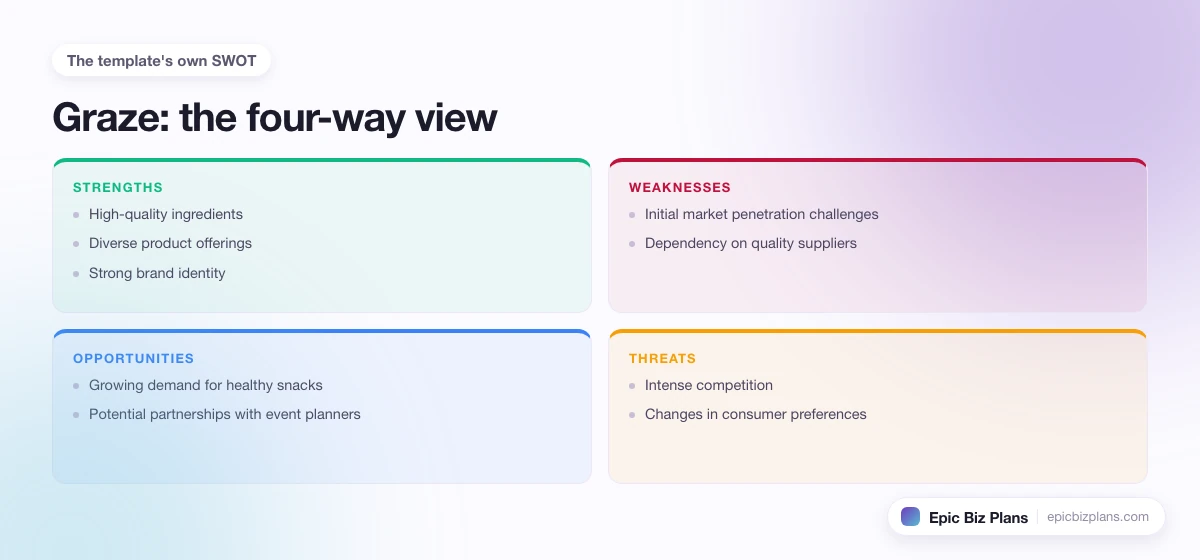
SWOT Analysis
- Strengths: High-quality ingredients, diverse product offerings, strong brand identity.
- Weaknesses: Initial market penetration challenges, dependency on quality suppliers.
- Opportunities: Growing demand for healthy snacks, potential partnerships with event planners.
- Threats: Intense competition, changes in consumer preferences.
Graze Business Name Ideas
Website
We will build our website on Shopify, which gives us solid e-commerce infrastructure for managing orders, subscriptions, and inventory without requiring custom development. Shopify's subscription apps also make it straightforward to offer recurring delivery options, which are central to our revenue model. We will also evaluate Squarespace as a complementary option for brand-focused content pages and event booking.
Our website will feature detailed product descriptions, subscription options for regular deliveries, and a blog to share healthy eating tips, supporting SEO and customer engagement over time.
Marketing Details
Our marketing strategy will combine search engine optimization, email marketing, and social media to build audience across channels. We will use Semrush to identify high-intent keywords around healthy snacking and grazing products, ensuring our site captures organic search traffic from people actively looking for what we offer. HubSpot will manage our email campaigns, including onboarding sequences for new subscribers and promotional campaigns tied to seasonal events.
TikTok ads will target younger demographics with short-form content showcasing our product assembly, ingredient quality, and event setups. Video content in the food space consistently drives strong engagement when it highlights the visual appeal and craftsmanship behind the product.
Industry Trends
Consumer demand for health-conscious food options continues to grow, with increasing preference for products that are both convenient and nutritionally transparent. The event catering sector is also seeing a shift toward experiential food presentations, where grazing tables and curated platters have replaced traditional buffet formats at weddings, corporate events, and private gatherings. Delivery and subscription models have expanded the reach of food businesses well beyond local markets. Businesses that combine strong visual branding with clear nutritional credentials are best positioned to capture this demand. For related food product positioning, a home-made food business plan provides a useful reference for artisan food sourcing and compliance.
Competitor Information
Direct competitors include local health food stores offering pre-packaged snacks, gourmet catering services, and online health snack subscription boxes. Indirect competition comes from supermarket deli sections and meal kit delivery services. Our differentiation will come from the quality and sourcing transparency of our ingredients, the customization options we offer for dietary needs, and the visual quality of our presentations, all elements that commodity competitors struggle to replicate at scale. For a related model, see our grazing box business plan template.
Financial Information
Startup costs will cover initial product sourcing and packaging materials, Shopify setup and design, early marketing spend, and operating reserves. First-year revenue will grow as subscription numbers and event bookings increase through targeted marketing. Ongoing costs include ingredient procurement, fulfillment, and digital marketing spend. Monthly cash flow reviews will track actual performance against projections, with P&L statements prepared quarterly.
Legal and Compliance
Operating a food business requires compliance with local health and food safety regulations, including product labeling, allergen disclosures, and commercial kitchen licensing if producing at scale. We will register the business and obtain all required permits before launch. For businesses offering subscription boxes with perishable items, cold chain logistics compliance will also need to be addressed in our operational setup.
The four-hour clock on a grazing table
A grazing table is food requiring time and temperature control, served at room temperature by design, so the rule that governs it is the one allowing time instead of temperature as the control. Under the four-hour option the food must leave temperature control at 41F or below, or 135F or above, be marked or otherwise identified with the time it has to go, and be cooked and served, served at any temperature if ready to eat, or discarded within four hours. No temperature monitoring is needed during that window, because the limit is the clock, not the thermometer. Once the clock has started the food may not go back into temperature control.
Two practical consequences for the plan. You need written procedures prepared in advance, kept on file and available to the inspector, which is a document to draft before your first booking rather than during it. And because leftovers cannot be recovered, food cost has to be modelled with planned waste in it per event, not as an exception.
-
 SemrushSemrush is a platform with literally any online tool you will need to promote your business. Spy on your competitors, get search traffic, keyword research, social info, ad copies and much more. Used by most of the top online companies in the world. Besides all its tools, Semrush also has many available integrations possible with many other tools that will make your work even better.
 -
 Surfer SEOSurfer SEO is an incredibly smart AI tool that will give you exact explanations what to do in order to make your website rank better. They use hundreds of parameters, check your competitors and decide on the best course of action. Whether it be inner links, bold text, paragraphs, headers, images and much more. Surfer is a must-have in 2026.
The rulebook itself moved recently. The Food and Drug Administration issued the 2026 edition of the Food Code on 17 September 2026. It adds a definition for a mobile food establishment, revises the food establishment definition, and makes a written employee illness policy an express documentation requirement, covering reporting of symptoms, exclusion and reinstatement, and clean-up after a vomiting or diarrhoeal incident. Most food-business guidance still cites the 2022 edition, so check which edition your state has adopted. The grazing board business plan template and the charcuterie business plan template cover closely related formats.
Operational Plan
Our operations will center on reliable ingredient sourcing from qualified local and regional suppliers who can meet our quality standards consistently. Supply chain diversity will be built in from the start to reduce exposure to single-supplier risk. Fulfillment logistics will be designed to handle both direct consumer orders and bulk event orders without requiring separate workflows. Inventory management will be tracked closely to minimize waste given the perishable nature of our products.
Contingency Planning
Primary risks include ingredient supply disruptions, seasonal demand fluctuations, and shifts in consumer dietary preferences. Mitigation strategies include maintaining a diverse supplier network, building flexible product offerings that can adapt to ingredient availability, and developing a six-week cash reserve before launch. Regular market research will keep us informed about trend shifts so we can adjust our product mix before demand patterns change significantly. Businesses facing similar food supply challenges can also reference a seafood business plan for supply chain risk management frameworks applicable to perishable goods.
Startup Cost Breakdown
Accurate cost planning is essential for a food business where margins are directly tied to sourcing quality and packaging efficiency. Below is a representative cost breakdown for launching a Graze business.
- Initial ingredient inventory: $3,000 to $6,000 depending on product range and order minimums
- Packaging and presentation materials: $1,500 to $3,000 for branded boards, boxes, and wrapping
- Ecommerce platform setup: $500 to $1,200 including Shopify plan and subscription app
- Food safety certifications and permits: $500 to $1,500 depending on jurisdiction
- Marketing launch budget: $1,500 to $3,000 for paid social and SEO groundwork
- Operating reserve (3 months): $4,000 to $8,000
Total estimated startup investment ranges from $11,000 to $22,700. Those building related healthy food brands can also review the gluten-free food box business plan for a comparable ecommerce food subscription cost model.
Build a Graze Business Worth Investing In
The most successful grazing businesses are built on consistency: consistent quality, consistent presentation, and consistent customer experience. Whether you're serving a corporate luncheon or shipping a monthly snack subscription, the expectation your brand sets must be met every time. Your business plan is the document that ensures your team, your suppliers, and your investors understand exactly what that standard is and how you intend to maintain it.
Adapt as You Grow
Your Graze business plan should evolve as you collect real data from customers and operations. Pricing models that make sense at launch may need revision once you understand your actual cost per order. New product categories, seasonal offerings, or expanded geographic reach may become realistic as your brand gains recognition. Revisit your plan quarterly and update it to reflect where the business actually stands.
Practical Uses for Your Plan
Use this plan to present to potential wholesale partners, event venues, or investors. A clear financial model and operational overview gives partners the confidence that your business can fulfill commitments at scale. It also serves as an internal reference document that keeps your team aligned on priorities and targets.
Your Graze business plan is 100% free: with unlimited edits, unlimited downloads, and unlimited chances to get it right. Build something worth growing.
