
Cross-border Business Plan Template
-
 ShopifyPut your brand on Shopify. Launch your online store with tools designed for growth and success. Ready to turn your idea into profit? Start building your e-commerce business today.
-
 SquarespaceShowcase your brand with Squarespace’s sleek designs. Build a professional online presence with ease. Start with a template that already looks finished.
-
 WixBring your ideas to life with Wix. Customize every aspect of your site with unmatched flexibility. Start creating your unique online space and let your creativity shine.
-
 ElementorCraft captivating websites effortlessly with Elementor. Enjoy complete creative control without coding. Make your site stand out to your audience. Start turning your vision into reality now.
- Executive Summary
- Business Info
- SWOT Analysis
- Cross-border Business Name Ideas
- Website
- Marketing Details
- Industry Trends
- Competitor Information
- Financial Information
- Legal and Compliance
- Duty, VAT and product safety rules for cross-border sellers
- Operational Plan
- Contingency Planning
- The Power of Your Cross-Border Business Plan
- Business Opportunities Await
- Adapting as You Grow
- Practical Applications
Ready to take your brand global? Your Cross-border business plan is the blueprint to seizing opportunities in fast-moving markets that stretch across borders and cultures. It's time to create a strategy that not only defines your goals but also reflects the spirit of your brand and resonates with your audience. Get your business ready to scale like never before.
This Cross-border business plan isn’t just a set of bullet points; it’s your road map to thriving in a diverse and dynamic environment. Tapping into the potential of international markets comes with its challenges, but the rewards? They are substantial. Amplify your reach and showcase your brand's unique value to a world craving fresh ideas and products.
Executive Summary
Our mission is to create a smooth cross-border trading experience that bridges markets and helps businesses to expand. We envision a world where international trade is accessible and efficient for all types of businesses, regardless of their size or industry. Our value proposition lies in providing tailored solutions that simplify cross-border transactions, reduce costs, and enhance customer satisfaction. Our financial goals include achieving operational profitability within the first two years while establishing a strong brand presence in key international markets.
Business Info
We will offer a platform that facilitates cross-border e-commerce transactions, targeting small to medium-sized enterprises (SMEs) engaged in international trade. Our business model will operate on a commission structure, charging fees based on transaction volume and additional premium services such as currency conversion and logistics management.
SWOT Analysis
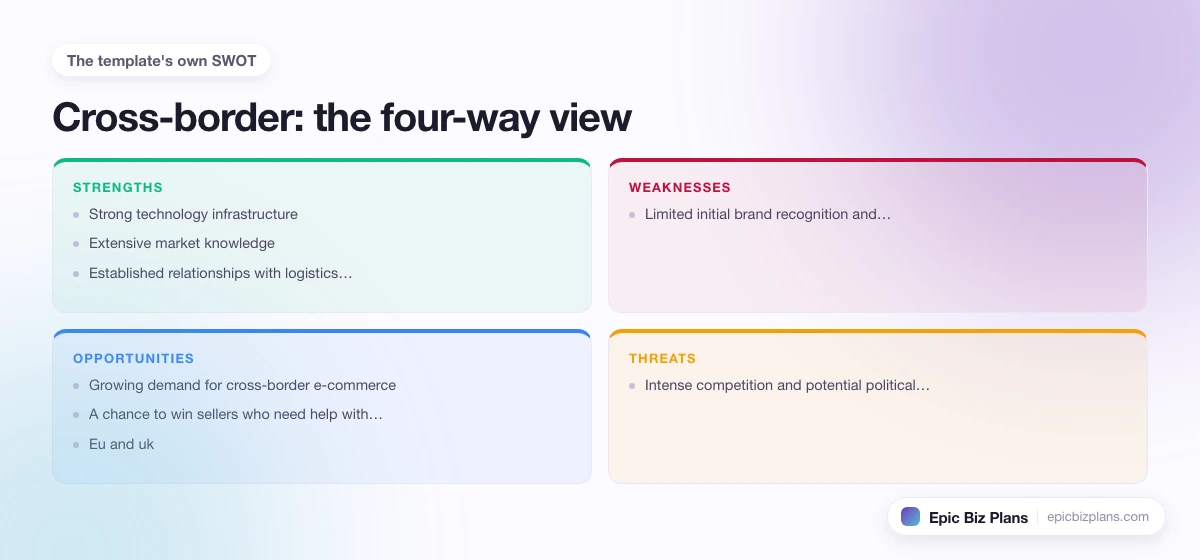
- Strengths: Strong technology infrastructure, extensive market knowledge, and established relationships with logistics suppliers.
- Weaknesses: Limited initial brand recognition and potential regulatory challenges in various regions.
- Opportunities: Growing demand for cross-border e-commerce, and a chance to win sellers who need help with the new duty and VAT rules on small parcels in the US, EU and UK.
- Threats: Intense competition and potential political or economic instability affecting trade agreements.
Cross-border Business Name Ideas
Website
We will build our website on Shopify to cater to our e-commerce functionalities, enabling us to manage transactions and customer interactions effectively. Shopify's strong features will allow us to easily scale as our business grows. We will also consider Squarespace as an option since it offers excellent design capabilities and functionality for our premium services section.
Marketing Details
Our marketing strategy will incorporate a strong digital marketing approach that includes using Semrush for search engine optimization to enhance our online visibility. We will implement HubSpot for our email marketing campaigns to nurture leads and engage customers effectively.
In addition, we will use TikTok ads to reach younger demographics, promoting our platform's advantages and encouraging engagement through interactive content.
Industry Trends
The cross-border e-commerce sector is witnessing significant technological advancements, particularly in payment processing and logistics. Automation, Artificial Intelligence (AI), and Blockchain technologies are simplifying operations, enhancing security, and providing better customer experiences. Trade rules for small parcels have tightened sharply: the United States suspended duty-free de minimis entry for every country on 29 August 2025, and the EU began charging customs duty on parcels under €150 on 1 July 2026, so cross-border sellers now need to price duty into every order rather than assume small shipments clear for free. De minimis thresholds (the value below which goods enter duty-free) still vary by country, but the biggest markets are scrapping them: the US suspended its $800 threshold in 2025, the EU replaced its €150 duty relief with a flat €3 duty from July 2026, and the UK plans to remove its £135 duty relief by March 2029.
Competitor Information
We will analyze our main competitors, including established platforms that offer similar services and niche players who cater to specific regions. Our strategy to differentiate ourselves will focus on providing superior customer service, localized solutions, similar to the approach outlined in our export and import business plan template, and a user-friendly interface that enhances the overall experience of cross-border transactions.
Financial Information
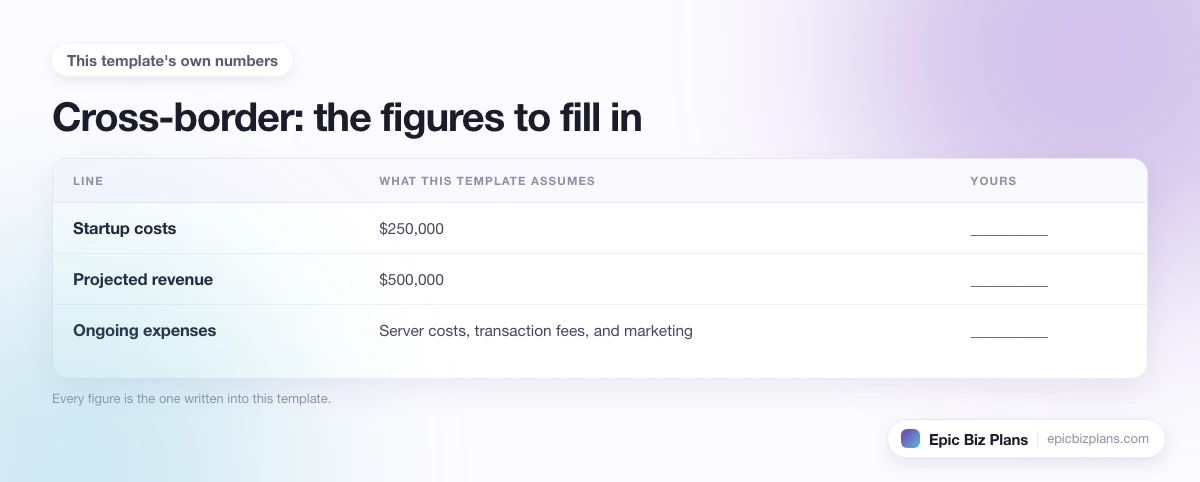
Our startup costs are projected at $250,000, allocated as follows: $100,000 for platform development (multi-currency checkout, API integrations with carriers and payment processors), $60,000 for legal setup across target jurisdictions, $50,000 for launch marketing in three initial markets, and $40,000 as working capital for the first six months. In our first year, we anticipate a revenue of $500,000, which we expect to grow by 30% annually as we build our customer base and enhance our service offerings.
Ongoing expenses will primarily comprise server costs, transaction fees, and marketing. We will establish cash flow statements to monitor our financial health regularly, alongside profit and loss statements to evaluate our operational performance.
Legal and Compliance
We will comply with all legal requirements, including business registration in relevant jurisdictions. Protecting intellectual property will be essential, so we will explore trademark registrations for our brand and technology safeguards to prevent unauthorized use.
Duty, VAT and product safety rules for cross-border sellers
Small parcels no longer cross the biggest borders duty-free. The United States suspended its $800 de minimis exemption for every country on 29 August 2025, kept the suspension in place after the Supreme Court's tariff ruling of 20 February 2026, and repeals it in law for commercial shipments from 1 July 2027. In the European Union, Council Regulation 2026/382 ended the €150 customs duty relief on 1 July 2026, replacing it with a temporary flat duty of €3 per item category in a parcel until 1 July 2028. VAT on EU parcels up to €150 can still be collected at checkout through the IOSS scheme.
The UK has charged VAT at the point of sale on parcels of £135 or less since 1 January 2021, and the government plans to end the matching customs duty relief by March 2029 at the latest. Canada is more generous for North American goods: courier shipments of US or Mexican origin pay no duty up to C$150 and no sales tax up to C$40 under the CUSMA rules.
Product safety rules travel with the goods. Since 13 December 2024 the EU General Product Safety Regulation, 2023/988, has required every consumer product sold to EU buyers to have a responsible business established in the EU, named on the product or its packaging. Appoint one before your first EU sale. The international trading business plan template and the freight broker business plan template cover two businesses cross-border sellers rely on.
-
 SemrushSemrush is a platform with literally any online tool you will need to promote your business. Spy on your competitors, get search traffic, keyword research, social info, ad copies and much more. Used by most of the top online companies in the world. Besides all its tools, Semrush also has many available integrations possible with many other tools that will make your work even better.
-
 Surfer SEOSurfer SEO is an incredibly smart AI tool that will give you exact explanations what to do in order to make your website rank better. They use hundreds of parameters, check your competitors and decide on the best course of action. Whether it be inner links, bold text, paragraphs, headers, images and much more. Surfer is a must-have in 2026.
Operational Plan
Our operations will center around a strong supply chain that connects manufacturers, freight forwarding partners, and payment processors. We will ensure reliable shipping and logistics partnerships to facilitate efficient shipments and timely deliveries, contributing to customer satisfaction.
Contingency Planning
To address potential risks, we will implement a thorough risk management strategy. This will include regular market assessments, compliance reviews, and contingency plans to manage disruptions caused by economic shifts or regulatory changes. Our team will remain agile and adaptive to handle challenges as they arise.
The Power of Your Cross-Border Business Plan
Imagine building a life where your passions shape your identity and your creativity fuels your freedom. A cross-border business plan gives you the freedom to explore cultures, extend your influence, and redefine your lifestyle. When you step into this world, you're not just a business owner; you’re a creator of connections: bridging borders, cultural gaps, and creating a unique space in the market.
Business Opportunities Await
Your niche might encompass e-commerce ventures, arts and crafts making their way across international lines, or even local services catering to diverse communities. Whether you envision a small boutique or a large-scale online marketplace, the opportunities are endless. Businesses that source products from overseas manufacturers and sell domestically can use our imported goods business plan template for a more product-focused approach.
Adapting as You Grow
As you scale your business, don't forget the vital importance of updating your cross-border business plan. Tailor it for different audiences, pricing strategies, products, and even new regions or sales channels. This document is not just a one-time tool; it's a living, breathing guide that will evolve with you.
Practical Applications
Use your cross-border business plan for many purposes, whether presenting to potential partners, planning a successful launch, securing essential funding, or clarifying your overall strategy. It's the roadmap that will guide you through uncharted territories and toward success.
Your cross-border business plan is 100% free with unlimited edits and downloads. Complete each section with your specific market research, regulatory requirements, and financial projections, then use it to guide conversations with logistics partners, payment processors, and potential investors.
