
Cheetah Business Plan Template
-
 ShopifyPut your brand on Shopify. Launch your online store with tools designed for growth and success. Ready to turn your idea into profit? Start building your e-commerce business today.
 -
 SquarespaceShowcase your brand with Squarespace’s sleek designs. Build a professional online presence with ease. Start with a template that already looks finished.
 -
 WixBring your ideas to life with Wix. Customize every aspect of your site with unmatched flexibility. Start creating your unique online space and let your creativity shine.
 -
 ElementorCraft captivating websites effortlessly with Elementor. Enjoy complete creative control without coding. Make your site stand out to your audience. Start turning your vision into reality now.
- Executive Summary
- Business Info
- SWOT Analysis
- Business Name Ideas
- Website
- Marketing Details
- Industry Trends
- Competitor Information
- Financial Information
- Legal and Compliance
- Operational Plan
- Growth Milestones
- Contingency Planning
- Build a Business That Matches Your Speed
- Many Paths Work in This Market
- Adapt Your Plan as You Go
- Your Cheetah Business Plan Is Ready
The Cheetah business plan is designed for entrepreneurs who want to move quickly and build a business with clear structure from day one. Speed without direction leads to wasted resources, so this plan gives you both. Whether you're entering the e-commerce market or launching a product-based brand for young professionals, having a documented strategy makes every decision faster and more consistent.
Your Cheetah business plan should be specific about what you sell, who buys it, and how you make money. It's not enough to say your product solves a problem. Your plan needs to show the numbers behind that claim and the steps that get you there. For comparable product business models aimed at young professionals, the gadgets business plan template is worth reviewing.
Executive Summary
Our mission is to build high-quality products and services that meet the needs of our customers in a competitive market. We aim to create a brand known for consistent quality, reliable delivery, and genuine customer care. Our value proposition focuses on giving customers unique product experiences while maintaining operational efficiency. Financially, we plan to break even in year one and reach a 20% net profit margin by the end of year three.
Business Info
We will offer a range of products aimed at young professionals and entrepreneurs who prioritize efficiency in their daily work and personal lives. Our business model centers on e-commerce, selling directly through our website, with selective retail partnerships to build physical presence where it makes sense. Founders who want to start without holding inventory can compare this approach against a dropshipping business plan template before committing capital to stock.
SWOT Analysis
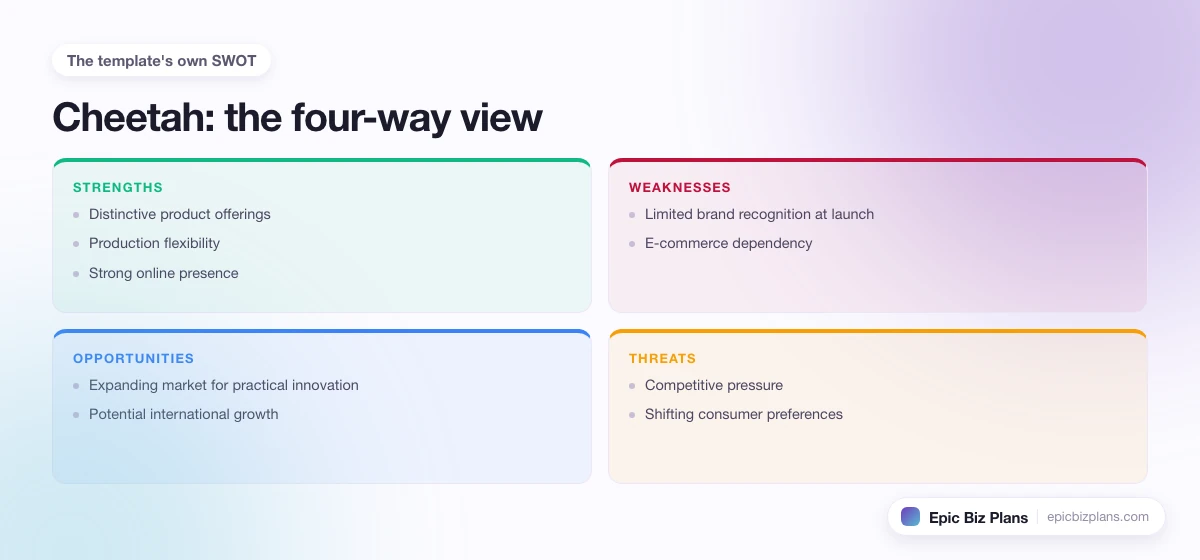
- Strengths: Distinctive product offerings, production flexibility, strong online presence.
- Weaknesses: Limited brand recognition at launch, e-commerce dependency.
- Opportunities: Expanding market for practical innovation, potential international growth.
- Threats: Competitive pressure, shifting consumer preferences.
Business Name Ideas
Website
We will build our website on Shopify, which suits our e-commerce strategy well. Shopify's design templates and sales tools let us build a clean, professional store without a large development budget. If we expand into service offerings, we will evaluate Squarespace as an alternative for its stronger content presentation capabilities.
Marketing Details
Our marketing strategy will focus on digital channels: Semrush for SEO to grow organic search traffic, and HubSpot for targeted email campaigns that nurture leads and retain existing customers. TikTok ads will be our primary paid channel for reaching younger buyers, with content showing our products in practical, real-life use cases. Product demonstrations drive conversions far better than static ads in this demographic.
Industry Trends
The market we are entering is shaped by rapid technology changes, growing e-commerce adoption, and a consumer preference for brands that deliver convenience through digital channels. Staying current with what customers expect, such as faster delivery, easier returns, and better product information, is as important as product quality itself. Our operational approach is built around meeting those expectations consistently.
Competitor Information
We will analyze both direct and indirect competitors targeting similar demographics. The goal is not just to identify what they offer, but to find the gaps: the frustrations and unmet needs that their products don't fully address. We will build our differentiation around those gaps: better customer experience, more useful product features, or clearer communication about what makes our products worth the price.
Financial Information
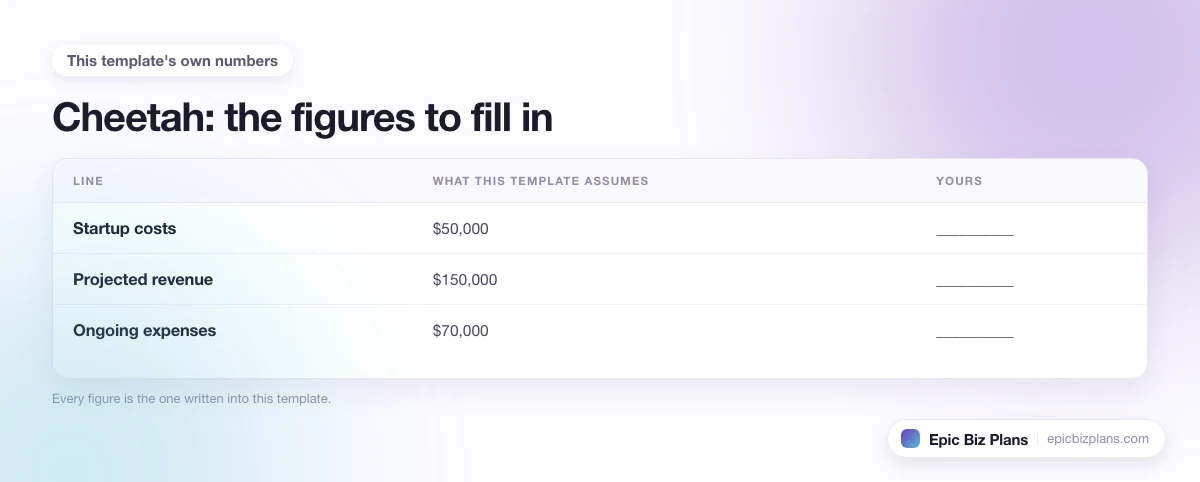
Startup costs are estimated at $50,000, covering product development, website setup, and initial marketing. First-year revenue is projected at $150,000, with ongoing expenses around $70,000, resulting in a positive cash flow after year one. A detailed profit and loss statement will be maintained monthly to track financial performance and identify trends early.
Legal and Compliance
We will meet all legal requirements, including business registration, appropriate licensing, and e-commerce regulations compliance. Intellectual property protection for our product designs and branding will be pursued before we launch publicly.
Operational Plan
Our operations will center on product development, inventory management, logistics, and customer service. A reliable supply chain is non-negotiable, since late deliveries and out-of-stock products damage new brands faster than almost any other issue. We will partner with proven logistics providers to maintain on-time delivery rates that support our reputation from the start. For businesses managing physical inventory at growing order volumes, the fulfillment business plan template offers useful operational guidance.
Growth Milestones
A fast-moving business still needs checkpoints. We will set quarterly milestones tied to revenue, repeat-purchase rate, and average order value, so growth is measured rather than assumed. Early targets include reaching 500 paying customers, a 30% returning-customer rate, and a positive contribution margin on our top three products. Founders who plan to widen their catalog can study how a broader ecommerce business plan template sequences product expansion against cash flow, and those testing recurring revenue can review a subscription box business plan template for retention modeling.
Contingency Planning
We recognize risks including market volatility and supply chain disruptions. Our response plan includes maintaining backup supplier relationships, keeping an agile operational structure that can adjust to changes quickly, and conducting regular strategy reviews to confirm we're on track to meet our financial targets.
Build a Business That Matches Your Speed
Starting a product-based e-commerce business takes preparation, but it also rewards action. The Cheetah business plan gives you the structure to move confidently without second-guessing every decision. Whether you're starting with a single flagship product or launching a full product line, the fundamentals here apply: know your customer, control your costs, and deliver what you promise.
Many Paths Work in This Market
Product businesses in this space range from one-person online stores to multi-SKU brands with retail distribution. You can start with direct-to-consumer e-commerce and add wholesale or retail later. You can start with a single product and expand based on what sells, much like the approach in a tech gadget business plan template built around a flagship product. The shape of the business evolves with your customer relationships and cash flow.
-
 SemrushSemrush is a platform with literally any online tool you will need to promote your business. Spy on your competitors, get search traffic, keyword research, social info, ad copies and much more. Used by most of the top online companies in the world. Besides all its tools, Semrush also has many available integrations possible with many other tools that will make your work even better.
 -
 Surfer SEOSurfer SEO is an incredibly smart AI tool that will give you exact explanations what to do in order to make your website rank better. They use hundreds of parameters, check your competitors and decide on the best course of action. Whether it be inner links, bold text, paragraphs, headers, images and much more. Surfer is a must-have in 2026.
Adapt Your Plan as You Go
Your Cheetah business plan is a working document. Update it as your product range changes, as your target audience shifts, or as new sales channels open up. A plan that stays current with your actual business keeps your team aligned and your decisions grounded in reality. For entrepreneurs building out a broader product portfolio, the electronic accessories business plan template offers a comparable scaling model worth reviewing.
Your Cheetah Business Plan Is Ready
Your Cheetah business plan is 100% free, with unlimited edits, unlimited downloads, and unlimited chances to get it right. Start now and build the fast, customer-focused business you've been planning.
