
CCTV Business Plan Template
-
 ShopifyPut your brand on Shopify. Launch your online store with tools designed for growth and success. Ready to turn your idea into profit? Start building your e-commerce business today.
 -
 SquarespaceShowcase your brand with Squarespace’s sleek designs. Build a professional online presence with ease. Start with a template that already looks finished.
 -
 WixBring your ideas to life with Wix. Customize every aspect of your site with unmatched flexibility. Start creating your unique online space and let your creativity shine.
 -
 ElementorCraft captivating websites effortlessly with Elementor. Enjoy complete creative control without coding. Make your site stand out to your audience. Start turning your vision into reality now.
- Executive Summary
- Business Info
- SWOT Analysis
- CCTV Business Name Ideas
- Website
- Marketing Details
- Industry Trends
- Competitor Information
- Financial Information
- Legal and Compliance
- Operational Plan
- Contingency Planning
- Monitoring and Maintenance Services
- Building a CCTV Business That Lasts
- Types of Opportunities in the CCTV Niche
- Adapt and Evolve Your CCTV Business Plan
- Put Your Plan to Practical Use
The CCTV security industry is one of the more reliable niches to enter as a small business owner. Demand for surveillance systems has grown steadily across both residential and commercial markets, driven by falling hardware costs, rising crime awareness, and the proliferation of smart home technology. A well-structured CCTV business plan gives you the roadmap to enter this market professionally, price your services correctly, and build a client base through referrals rather than cold outreach.
What separates successful CCTV businesses from short-lived ones is rarely technical skill - most operators are competent at installation. The difference is business fundamentals: how you handle quotes, what your service agreements cover, how you manage warranty claims, and whether your customers trust you enough to recommend you to their neighbors. This plan addresses all of it.
Executive Summary
Our mission is to provide reliable CCTV security solutions for homes and businesses, with a focus on quality equipment and consistent installation standards. We are targeting a revenue milestone of $500,000 within the first three years of operation. Our edge in the market is not pricing - it's service: fast response times, clear communication, and ongoing technical support that most local competitors don't offer. The business will operate through direct sales and installation contracts, with recurring revenue from monitoring agreements and annual maintenance plans.
Business Info
We sell and install advanced CCTV systems for residential and commercial clients. Homeowners represent the entry-level market - simpler systems, faster installations, strong word-of-mouth potential. Commercial clients (retail stores, warehouses, office buildings) represent larger contracts but require more technical complexity and longer sales cycles. Our business model combines product sales with installation fees and optional monitoring subscriptions, creating both one-time and recurring revenue streams. Clients upgrading their premises often ask about entry hardware at the same time, so pairing camera installs with the products in the lock business plan template can add a natural upsell to each job.
SWOT Analysis
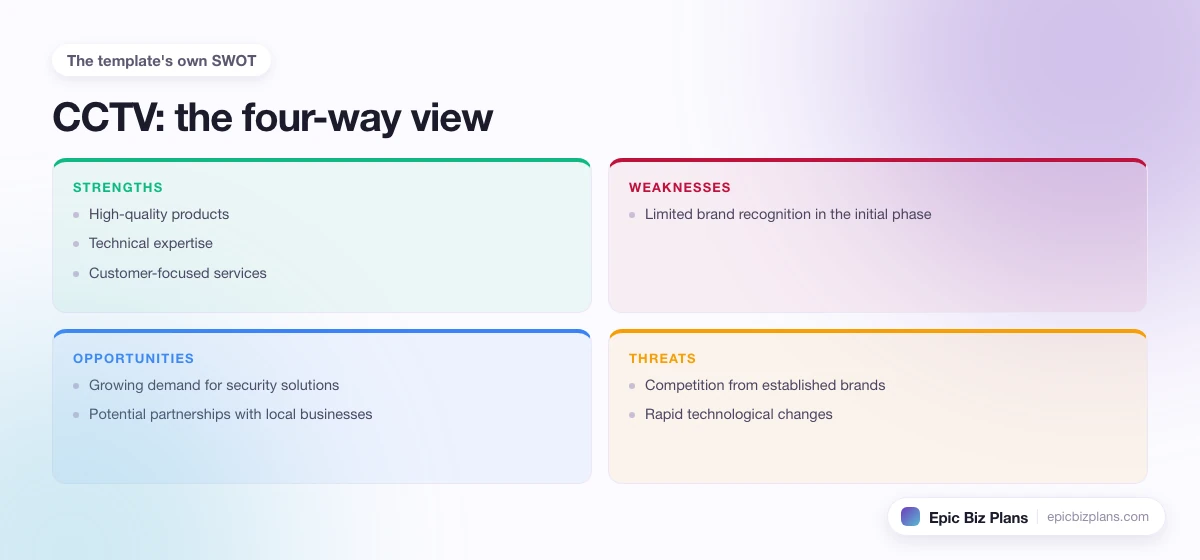
- Strengths: High-quality products, technical expertise, customer-focused services.
- Weaknesses: Limited brand recognition in the initial phase.
- Opportunities: Growing demand for security solutions, potential partnerships with local businesses.
- Threats: Competition from established brands, rapid technological changes.
CCTV Business Name Ideas
Website
Shopify is the recommended platform for the product and sales side of the business. It handles product listings for cameras, NVR systems, cables, and accessories; supports online payment; and integrates with shipping carriers if you sell equipment by mail order. For service-based inquiries - quotes, consultations, maintenance bookings - a contact form with a scheduling tool is more important than a full catalog. Squarespace works well for businesses that want a cleaner brand presentation over a shopping experience. Many CCTV operators run both: a Shopify store for product sales and a separate brand site for their installation services.
Marketing Details
SEO is the most cost-effective marketing channel for local CCTV businesses. Ranking for city-specific terms like "CCTV installation [your city]" or "security camera installer near me" puts you in front of buyers at exactly the right moment. Semrush can help identify which local keywords have enough volume to justify content investment. HubSpot's email tools handle lead nurturing for prospects who requested a quote but didn't convert immediately - automated follow-up sequences dramatically improve close rates for service businesses.
TikTok advertising works for the residential segment by running short videos demonstrating how a camera system looks after installation, or showing how easy the mobile app interface is to use. Commercial clients are harder to reach through social media and respond better to direct outreach and referral partnerships with property managers or construction firms. For businesses building out a security system business plan, multi-channel marketing from day one is worth the added complexity.
Industry Trends
AI-powered analytics - motion detection, facial recognition, license plate reading - are moving from enterprise-only features to standard options in mid-range systems. Cloud storage has largely replaced on-site DVR units for residential clients, which changes the pricing model from hardware-heavy to subscription-based. IoT integration means that CCTV systems are increasingly part of broader smart home setups rather than standalone products. Staying current with these technology shifts matters because clients will ask about them, and a business that can't speak intelligently about AI features or cloud options loses credibility quickly.
Competitor Information
National players like ADT and Ring dominate brand awareness but lose on personalization - they install standardized systems and offer call-center support rather than a local technician who knows the property. Local CCTV installers compete effectively when they offer faster response times, flexible system configurations, and direct access to the person who did the installation. The target is not to out-advertise national brands but to build strong local reputation through consistent quality. A comparable approach works in the broader security solutions business plan space where local expertise beats corporate scale.
Financial Information
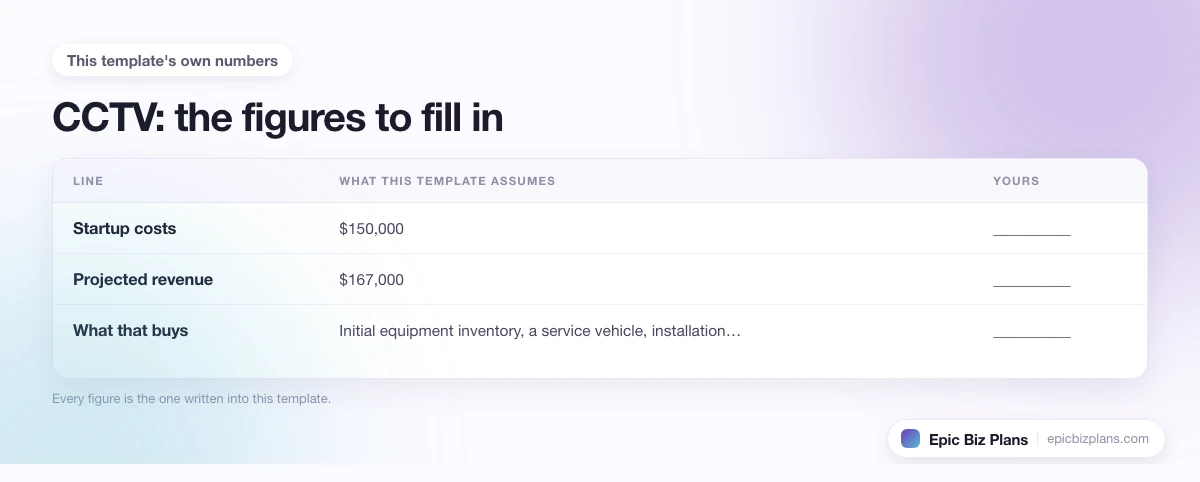
Startup costs are estimated at $150,000, covering initial equipment inventory, a service vehicle, installation tools, marketing spend, and six months of operating expenses. The $500,000 revenue target by year three breaks down to roughly $167,000 per year, which is achievable with 8–10 commercial contracts and a steady flow of residential installations. Ongoing annual costs of $150,000 cover salaries, insurance, equipment restocking, and marketing. Gross margins on equipment sales run 25–35%; installation labor margins run 50–60%, making labor the more profitable component.
Legal and Compliance
Business registration and liability insurance are the minimum requirements before starting operations. Many states and municipalities require a specific security contractor license for installing surveillance systems - check your local requirements before accepting commercial contracts. Any system that records audio may trigger additional legal obligations depending on state wiretapping laws. Data privacy compliance matters for commercial clients whose systems capture footage of employees or customers; having a clear data retention and access policy protects both the client and your business from liability.
Operational Plan
Operations center on three activities: sales and quoting, equipment procurement, and installation delivery. A standardized quoting process - site visit, written proposal, signed contract - keeps projects profitable and prevents scope creep. Supplier relationships with two or three equipment distributors provide pricing leverage and backup availability when a specific model is backordered. Installation scheduling should be managed to avoid overcommitting on timelines; a delay on a commercial job damages reputation more than turning down a project in the first place.
Contingency Planning
The primary risks for a CCTV business are equipment supply disruptions, a key employee leaving, and slow periods between large commercial contracts. Supply issues are mitigated by stocking fast-moving items and qualifying alternative suppliers before a shortage hits. Employee risk is addressed by documenting installation procedures and building client relationships at the business level rather than having them tied to one technician. Cash flow gaps are managed by requiring 50% deposits on commercial jobs and maintaining a three-month operating reserve.
Monitoring and Maintenance Services
Adding a monitoring or annual maintenance plan converts one-time installation clients into recurring revenue accounts. Monthly monitoring fees - typically $25–$75 per residential property - stack up quickly across a client base of 100+ accounts. Annual maintenance contracts give clients peace of mind and give your business predictable Q1 revenue when new installation bookings typically slow down. Documenting every system you install makes maintenance visits faster and builds the kind of institutional knowledge that competitors can't replicate. This recurring revenue model is similarly important to consider in a IT security business plan where long-term client relationships are the core asset.
Building a CCTV Business That Lasts
A CCTV business succeeds on reputation and referrals. Every installation is a marketing asset - a satisfied client in a neighborhood or office building is worth more than any ad spend, because their neighbors and colleagues will ask who did the work. Build your systems right the first time, respond quickly when something goes wrong, and the business compounds through word of mouth faster than most marketing strategies can achieve.
-
 SemrushSemrush is a platform with literally any online tool you will need to promote your business. Spy on your competitors, get search traffic, keyword research, social info, ad copies and much more. Used by most of the top online companies in the world. Besides all its tools, Semrush also has many available integrations possible with many other tools that will make your work even better.
 -
 Surfer SEOSurfer SEO is an incredibly smart AI tool that will give you exact explanations what to do in order to make your website rank better. They use hundreds of parameters, check your competitors and decide on the best course of action. Whether it be inner links, bold text, paragraphs, headers, images and much more. Surfer is a must-have in 2026.
Types of Opportunities in the CCTV Niche
The CCTV market supports several different business models: pure installation services focused on labor, product resellers who drop-ship equipment without installation, hybrid businesses combining product sales and installation, and monitoring-as-a-service operators who build recurring subscription revenue. Each has different capital requirements and risk profiles. New entrants typically start with installation services to build cash flow before investing in inventory, then expand product sales once supplier relationships are established.
Adapt and Evolve Your CCTV Business Plan
The technology in this industry moves fast. A plan written today needs to account for the fact that AI-powered cameras, cloud storage, and remote monitoring capabilities will continue shifting what clients expect from a standard installation. Review your plan annually to update pricing, service offerings, and competitive positioning. What worked in year one may be the baseline expectation in year three.
Put Your Plan to Practical Use
Use this plan to guide your pricing strategy, present to potential investors or lenders, and set measurable targets for your first 12 months. The numbers in this plan are starting assumptions - your actual results will tell you where to adjust. Track your cost per installation, your average contract value, and your close rate on quotes, and use those figures to build a more accurate plan as real data accumulates.
Your CCTV business plan is 100% free - with unlimited edits, unlimited downloads, and unlimited chances to get it right. Use it well.
