
Catfish Business Plan Template
-
 ShopifyPut your brand on Shopify. Launch your online store with tools designed for growth and success. Ready to turn your idea into profit? Start building your e-commerce business today.
 -
 SquarespaceShowcase your brand with Squarespace’s sleek designs. Build a professional online presence with ease. Start with a template that already looks finished.
 -
 WixBring your ideas to life with Wix. Customize every aspect of your site with unmatched flexibility. Start creating your unique online space and let your creativity shine.
 -
 ElementorCraft captivating websites effortlessly with Elementor. Enjoy complete creative control without coding. Make your site stand out to your audience. Start turning your vision into reality now.
- Executive Summary
- Business Info
- SWOT Analysis
- Catfish Business Name Ideas
- Website
- Marketing Details
- Industry Trends
- Competitor Information
- Financial Information
- Legal and Compliance
- Operational Plan
- Contingency Planning
- Regulatory and Food-Safety Considerations
- Conclusion: Your Path to Success Begins Now
Catfish is a high-volume, low-cost protein that appears across Southern US cuisine, West African dishes, and aquaculture operations in dozens of regions. Your Catfish business plan lays out which slice of that market you want, whether that means farming, processing, wholesale, or a customer-facing restaurant or product line. Operators leaning toward retail often pair this with the seafood business plan template. The plan should cover sourcing, food-safety compliance, pricing, and the specific cuisine or audience you serve. Putting the strategy on paper helps you brief suppliers, partners, and any future investors with consistency.
Your Catfish business plan should reflect who you are as an operator while staying grounded in unit economics. Profitability and brand identity work together, not against each other: the right cuisine direction or product format often produces better margins. The fisheries business plan template covers related supply considerations for operators sourcing from open water rather than farms. Define your niche clearly, whether that is fresh fillets for retail, frozen for export, or a signature menu for a fast-casual restaurant. Founders launching a customer-facing concept can borrow structure from the restaurant business plan template. The clearer the niche, the faster the rest of the plan comes into focus.
Executive Summary
Our mission is to provide high-quality catfish products while promoting sustainability and responsible fishing practices. We envision a thriving business that not only serves delicious catfish meals but also supports local economies and preserves aquatic ecosystems. Our value proposition focuses on freshness, taste, and community involvement, ensuring that our customers receive the best catfish experience possible. Financially, we aim to achieve profitability within the first three years and expand our reach significantly within five years.
Business Info
We will offer a range of catfish products, including fresh, frozen, and value-added options such as catfish fillets, catfish nuggets, and seasoned catfish products. Our target market includes seafood lovers, health-conscious consumers, and restaurants seeking reliable suppliers of quality fish. Our business model revolves around direct sales to consumers through an online platform and partnerships with local restaurants. Anglers in our customer base who craft their own patterns can also reference the fly tying business plan for a related product niche.
SWOT Analysis
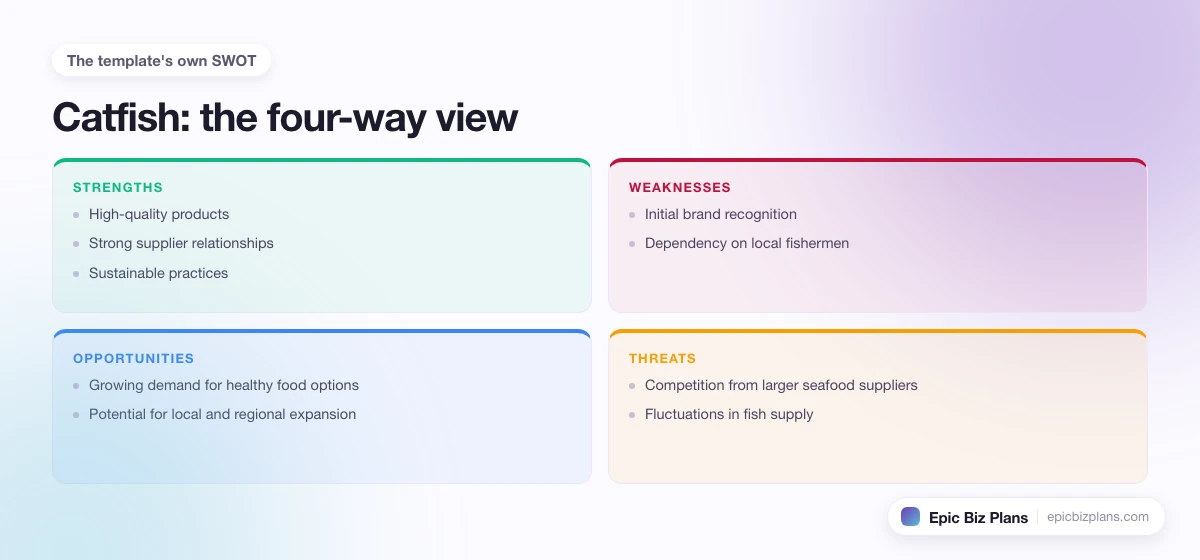
- Strengths: High-quality products, strong supplier relationships, sustainable practices.
- Weaknesses: Initial brand recognition, dependency on local fishermen.
- Opportunities: Growing demand for healthy food options, potential for local and regional expansion.
- Threats: Competition from larger seafood suppliers, fluctuations in fish supply.
Catfish Business Name Ideas
Website
We will build our website using Shopify since it offers an efficient platform for e-commerce. This will help direct sales of our products to consumers nationwide. Shopify provides user-friendly tools and templates that will simplify the process of setting up and maintaining our online store.
Marketing Details
Our marketing strategy will focus on comprehensive digital marketing initiatives, including SEO tools such as Semrush for improving our online visibility. We will also use HubSpot for managing our email campaigns to effectively reach our target audience. In addition, we will use TikTok ads to engage younger demographics and create buzz around our brand and products.
Industry Trends
There is a growing trend towards sustainable seafood consumption, with consumers increasingly seeking responsibly sourced products. Additionally, technological advancements in aquaculture and processing methods are enhancing the quality and availability of catfish, making it an attractive option for health-conscious consumers.
Competitor Information
Our main competitors include local seafood markets and larger fish suppliers that dominate the industry. We will differentiate ourselves by emphasizing our commitment to sustainability, quality, and local partnerships. Our strong focus on customer education regarding the health benefits of catfish will also provide an edge over competitors.
Financial Information
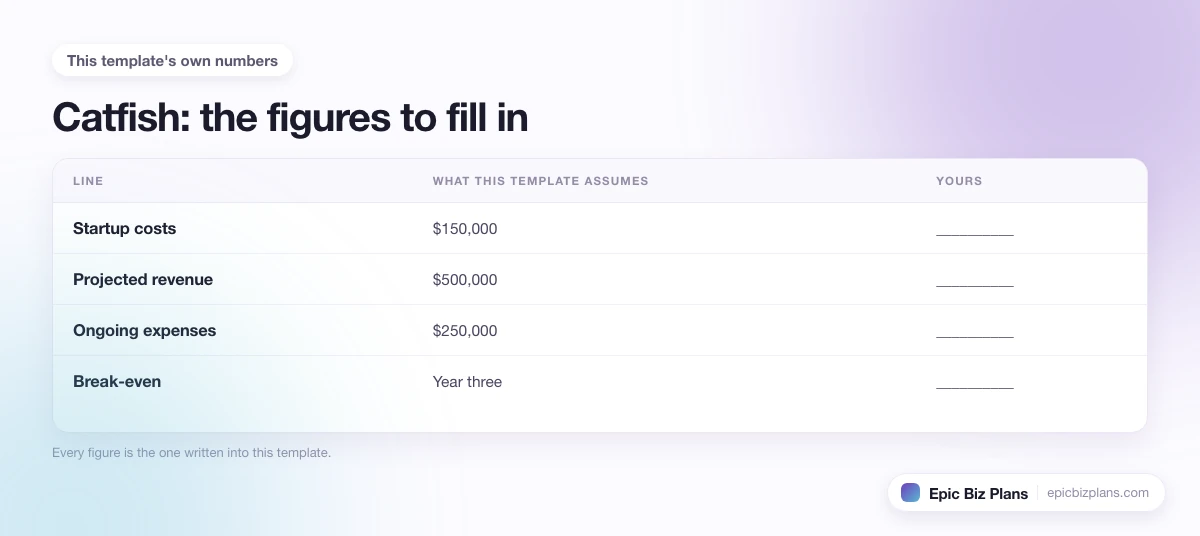
Startup costs will include equipment for processing, initial inventory, branding, and website development, projected at around $150,000. We forecast revenue to reach $500,000 in the first year, with ongoing expenses estimated at $250,000, including marketing, operations, and logistics. Our initial cash flow analysis indicates a positive trajectory towards profitability by the end of year three, with detailed P&L statements to support our financial planning.
Legal and Compliance
We will register our business according to local regulations and obtain necessary licenses for seafood processing. In addition, we will pursue intellectual property protection for our branding and any proprietary recipes to safeguard our innovations in the market.
Operational Plan
Key operations will involve sourcing catfish sustainably from local fisheries, maintaining strict quality control in processing, and efficient logistics management for distribution. We will establish partnerships with local transport companies to ensure timely deliveries to our customers. Where harvesting relies on boats and on-water equipment, keeping that gear serviced follows the same discipline as a marine service business plan.
Contingency Planning
We will identify potential risks, such as supply chain disruptions and fluctuating fish prices, implementing strategies such as maintaining good relationships with multiple suppliers and adjusting pricing strategies proactively. Regular risk assessments will help us stay prepared for any unforeseen circumstances that may impact our business operations.
Regulatory and Food-Safety Considerations
Catfish operations face stricter oversight than many other food businesses. Build compliance into the plan from day one:
- USDA FSIS inspection: in the US, catfish processing is regulated by USDA FSIS rather than the FDA. Plan for inspector access during production hours.
- HACCP plan: any processing facility needs a written Hazard Analysis and Critical Control Point plan tailored to your operation.
- Labeling requirements: species labeling rules are enforced strictly; only Ictaluridae family fish can be marketed as "catfish" in the US.
- Aquaculture permits: farmed operations need state-level aquaculture permits, water discharge permits, and feed-source documentation.
- Cold-chain compliance: document temperature controls from harvest through delivery; a single break can trigger a recall.
Budget at least $15,000–$25,000 for initial compliance setup, including legal review and a third-party HACCP consultant if you do not have in-house expertise.
Conclusion: Your Path to Success Begins Now
Imagine immersing yourself in a world where your passions collide with purpose-a catfish business plan makes that a reality. Whether you're an entrepreneur eager to create innovative aquaculture solutions or an artist expressing culture through culinary experiences, starting a catfish business opens doors to identity, lifestyle, and creativity.
-
 SemrushSemrush is a platform with literally any online tool you will need to promote your business. Spy on your competitors, get search traffic, keyword research, social info, ad copies and much more. Used by most of the top online companies in the world. Besides all its tools, Semrush also has many available integrations possible with many other tools that will make your work even better.
 -
 Surfer SEOSurfer SEO is an incredibly smart AI tool that will give you exact explanations what to do in order to make your website rank better. They use hundreds of parameters, check your competitors and decide on the best course of action. Whether it be inner links, bold text, paragraphs, headers, images and much more. Surfer is a must-have in 2026.
The catfish niche offers a rich tapestry of possibilities. Picture a small, family-run catfish farm that's committed to sustainability, or an online e-commerce store that delivers farm-fresh catfish directly to consumers. There are also local restaurants reimagining catfish dishes and even clothing lines inspired by the unique culture surrounding catfishing. Each avenue reflects a vibrant community united by a shared passion for this unique industry.
As your vision evolves, consider revisiting your catfish business plan. Adapt it for varied audiences, explore new pricing models, and expand into different regions or sales channels. Flexibility is essential for growth; your plan should continuously reflect your business process.
use your catfish business plan as a tool for various practical applications-pitch it to potential partners, outline launch strategies, secure funding, or simply clarify your long-term strategy.
Your catfish business plan is 100% free-with unlimited edits, unlimited downloads, and unlimited chances to get it right. Embrace this opportunity and let your entrepreneurial spirit flourish.
