
Cat House Business Plan Template
-
 ShopifyPut your brand on Shopify. Launch your online store with tools designed for growth and success. Ready to turn your idea into profit? Start building your e-commerce business today.
 -
 SquarespaceShowcase your brand with Squarespace’s sleek designs. Build a professional online presence with ease. Start with a template that already looks finished.
 -
 WixBring your ideas to life with Wix. Customize every aspect of your site with unmatched flexibility. Start creating your unique online space and let your creativity shine.
 -
 ElementorCraft captivating websites effortlessly with Elementor. Enjoy complete creative control without coding. Make your site stand out to your audience. Start turning your vision into reality now.
- Executive Summary
- Business Info
- Business Model Overview
- SWOT Analysis
- Website
- Marketing Details
- Industry Trends
- Competitor Information
- Financial Information
- Legal and Compliance
- Operational Plan
- Daily and Weekly Routines
- Contingency Planning
- Common Mistakes to Avoid
- Conclusion
- Adapt and Evolve
- Practical Applications
Building a strong Cat House business plan sets the foundation for success in a growing pet care industry. Cat ownership has been climbing steadily, and pet-centric businesses continue to see strong demand from owners who treat their cats like family. Your business plan goes beyond financial projections - it captures your vision and clarifies how your brand will connect with customers. A clear plan also makes it easier to spot gaps in your model before you commit serious money.
This is where your creativity should show through. Think bold, think fun, and think outside the litter box. Your Cat House business plan should highlight what makes your venture unique, setting you apart from local shelters, pet boutiques, and online retailers. The cats may be in charge of the vibe, but you're the one steering this ship.
Executive Summary
We will establish a Cat House business that provides a safe, nurturing environment for cats while offering a memorable experience for cat lovers in our community. Our mission is to create a space where cats can thrive and visitors can enjoy spending time with them. Our vision is to promote animal welfare, educate the public about responsible pet ownership, and create a meaningful impact in our local area.
Our value proposition is built on quality care for the cats and an engaging experience for guests. We aim for steady financial growth with healthy profit margins through smart pricing of our services, including cat adoptions, merchandise, and educational workshops.
Business Info
Our Cat House serves as both a sanctuary for stray and abandoned cats and a community space that promotes adoption. Our target market includes pet lovers, families looking to adopt, and individuals interested in learning more about cat care. Owners who instead want to board cats overnight can plan that side with our cat hotel business plan. For a related angle on adoption-focused models, see our pet adoption business plan template.
Business Model Overview
Our business model generates revenue through multiple channels:
- Cat adoptions
- Merchandise sales (cat supplies, toys, etc.)
- Workshops and educational programs
- Event hosting
SWOT Analysis
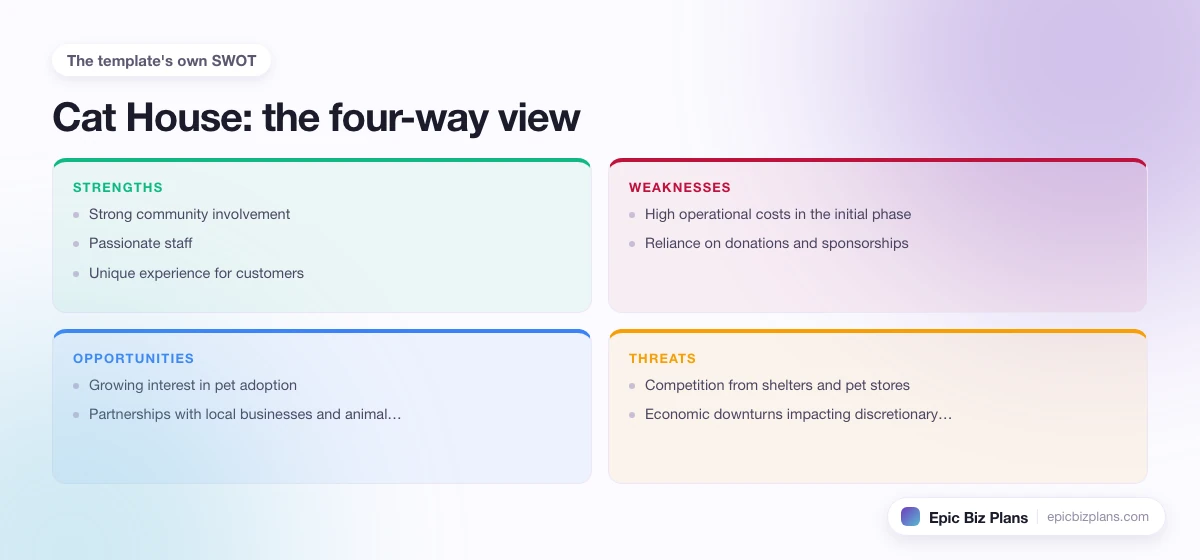
- Strengths: Strong community involvement, passionate staff, unique experience for customers.
- Weaknesses: High operational costs in the initial phase, reliance on donations and sponsorships.
- Opportunities: Growing interest in pet adoption, partnerships with local businesses and animal organizations.
- Threats: Competition from shelters and pet stores, economic downturns impacting discretionary spending.
Website
We will build our website using Shopify, which works well for e-commerce, or Squarespace for a clean visual design. Both platforms support selling cat-related merchandise and event tickets, which fits our planned product mix. If you also plan to expand into care services later, our cat sitter business plan template covers that side of the market.
Marketing Details
Our marketing approach combines digital channels with social media. We plan to use Semrush for SEO research to grow organic visibility, and HubSpot for email campaigns to keep adopters and donors informed. Our content calendar will include weekly newsletters, adoption spotlights, and event announcements.
For social media, we will run TikTok ads aimed at younger audiences, showcasing the cats and their personalities to draw potential adopters and visitors. Short videos of new arrivals and "before and after" rescue stories tend to perform well in this niche.
Industry Trends
We have observed a growing trend toward animal welfare and adoption, with more people choosing to adopt rather than purchase pets. Digital platforms are also becoming central to promoting and facilitating adoptions. We will align our operations with these trends through online listings, social campaigns, and community partnerships.
Competitor Information
Our main competitors include local animal shelters, pet adoption agencies, and pet supply stores. To differentiate, we focus on a unique on-site experience through interactive workshops, community events, and strong customer service that makes both cats and visitors comfortable. Operators looking at related models may also find our pet shelter business plan template helpful for comparison.
Financial Information
Our startup costs include leasehold improvements, furnishing the Cat House, initial inventory, marketing, and early operational costs. Projections show a steady revenue stream with anticipated growth as community awareness builds.
We will track ongoing expenses such as utilities, staffing, and supplies to maintain healthy cash flow. Profit and loss statements will be reviewed quarterly to identify areas for financial improvement.
Legal and Compliance
We will follow all local regulations, including business registration and animal welfare laws. We will also look into trademark protection for our brand name and any proprietary materials we create for our educational programs.
Operational Plan
Our operational plan focuses on key partnerships with local veterinarians, suppliers, and animal welfare organizations. Day-to-day logistics center on inventory management, cleaning routines, and a smooth visitor experience from check-in through participation in any workshop or event.
-
 SemrushSemrush is a platform with literally any online tool you will need to promote your business. Spy on your competitors, get search traffic, keyword research, social info, ad copies and much more. Used by most of the top online companies in the world. Besides all its tools, Semrush also has many available integrations possible with many other tools that will make your work even better.
 -
 Surfer SEOSurfer SEO is an incredibly smart AI tool that will give you exact explanations what to do in order to make your website rank better. They use hundreds of parameters, check your competitors and decide on the best course of action. Whether it be inner links, bold text, paragraphs, headers, images and much more. Surfer is a must-have in 2026.
Daily and Weekly Routines
Each morning, staff will complete feeding, litter cleaning, and a quick health check on every cat. Weekly tasks include deep cleaning of common areas, inventory restocking, and a short team huddle to review adoption pipeline and any medical issues. Posting weekly updates on featured cats also keeps our social audience engaged between events.
Contingency Planning
We have identified potential risks such as shifts in community interest or economic downturns, and we have mitigation plans including diversified revenue streams and tighter expense control. Regular reviews will help us adapt without disrupting the cats' care.
Common Mistakes to Avoid
Many new Cat House operators underestimate ongoing veterinary costs, especially for senior cats and rescues with chronic conditions. Setting aside a monthly medical reserve from day one prevents tough trade-offs later. Another common error is overcrowding the space to take in more cats than the facility can humanely support, which damages both animal welfare and your reputation.
Skipping a clear adoption screening process is another pitfall. A short application, a brief interview, and a follow-up call after the adoption protect the cats and reduce returns. Our animal business plan template covers similar screening and operational standards across animal-focused businesses.
Conclusion
Starting a Cat House business is a chance to build something centered on creativity, passion, and identity. For many founders, it's about creating a haven for feline friends while expressing personal style and values. This niche is more than a business - it's a community where custom cat furniture, local boutiques, and online stores all serve cat lovers. Whether you focus on cat condos, unique toys, or subscription boxes, the possibilities are wide and rewarding.
Adapt and Evolve
Your work is just beginning, and as you grow, plan to revisit your Cat House business plan regularly. Your audience, pricing, product mix, and local market will change over time, and your plan should reflect those shifts. Regular updates help you stay aligned with customer needs and react quickly to new opportunities.
Practical Applications
This Cat House business plan can serve as your working tool for pitching potential partners, planning a launch, securing funding, and clarifying strategic direction. Treat it as the working core of your business, not a one-time document.
Your Cat House business plan is 100% free - with unlimited edits, unlimited downloads, and unlimited chances to refine it. Take clear steps, stay close to your customers, and keep improving as you go.
