
Cashmere Business Plan Template
-
 ShopifyPut your brand on Shopify. Launch your online store with tools designed for growth and success. Ready to turn your idea into profit? Start building your e-commerce business today.
 -
 SquarespaceShowcase your brand with Squarespace’s sleek designs. Build a professional online presence with ease. Start with a template that already looks finished.
 -
 WixBring your ideas to life with Wix. Customize every aspect of your site with unmatched flexibility. Start creating your unique online space and let your creativity shine.
 -
 ElementorCraft captivating websites effortlessly with Elementor. Enjoy complete creative control without coding. Make your site stand out to your audience. Start turning your vision into reality now.
- Executive Summary
- Business Info
- SWOT Analysis
- Cashmere Business Name Ideas
- Website
- Marketing Details
- Industry Trends
- Competitor Information
- Financial Information
- Legal and Compliance
- Operational Plan
- Contingency Planning
- Building Your Cashmere Business
- Choose Your Format
- Keep Your Cashmere Business Plan Evolving
- Your Next Steps
A Cashmere business plan sets out how you will source, brand, and sell a premium fiber product to customers who pay for quality. Cashmere carries high raw-material costs and a strong luxury association, so your plan has to justify a premium price with provenance, craftsmanship, and a clear brand story. This template walks through sourcing, pricing, and channels so you can see whether the margins hold. It also doubles as the document you show to suppliers and high-end retail partners.
The luxury knitwear market rewards brands that prove their quality rather than just claim it. Your plan should explain where your cashmere comes from, how you verify grade and ethics, and why a shopper chooses you over an established house. Define your customer, your price point, and your repeat-purchase strategy with real numbers. The sections below give you a structure to fill in, from the executive summary through operations and contingency planning.
Executive Summary
We will establish a business focused on the production and sale of cashmere products, emphasizing quality, sustainability, and ethical practices. Our vision is to become a leading brand recognized for premium cashmere garments and accessories. Our value proposition lies in offering luxurious, sustainable cashmere products that cater to environmentally conscious consumers. Our financial goal is to achieve a revenue of $500,000 within the first two years of operation.
Business Info
Our primary products will include cashmere sweaters, scarves, and shawls. We will target affluent consumers aged 25-55 who prioritize quality and sustainability in their fashion choices, the same buyers who often explore our rental clothing business plan template for access-based luxury. Our business model will revolve around direct-to-consumer sales through e-commerce, supplemented by select high-end retail partnerships.
SWOT Analysis
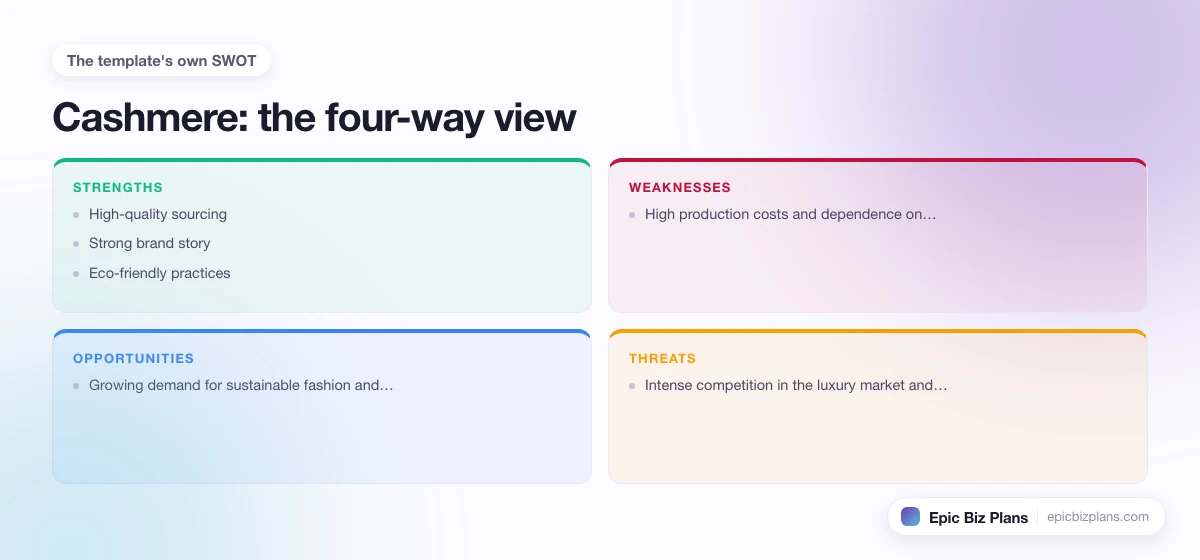
- Strengths: High-quality sourcing, strong brand story, and eco-friendly practices.
- Weaknesses: High production costs and dependence on premium pricing.
- Opportunities: Growing demand for sustainable fashion and expanding online sales channels.
- Threats: Intense competition in the luxury market and fluctuations in raw cashmere prices.
Cashmere Business Name Ideas
Website
We will build our website using Shopify, as it offers an intuitive platform ideal for e-commerce businesses. Shopify allows for easy management of inventory and smooth transactions, ensuring we provide a smooth shopping experience for our customers.
Marketing Details
We will implement a marketing strategy to build brand awareness and drive sales. This strategy will include digital marketing efforts such as using Semrush for search engine optimization to improve our online visibility. For our email campaigns, we will use HubSpot to engage our customers and promote our latest products.
We will also focus on social media marketing, particularly through TikTok ads to reach younger demographics. This approach will help us create content that connects with potential customers and encourages brand loyalty.
Industry Trends
The cashmere industry is witnessing a shift towards sustainability, with consumers increasingly seeking ethically sourced products, a trend we cover further in our sustainable fashion business plan template. Technology is also reshaping how these brands sell, as e-commerce continues to grow and digital marketing becomes more sophisticated. Innovations in cashmere processing and production techniques are anticipated to enhance quality while also reducing environmental impact. Cashmere brands seeking wool-blend sourcing strategies should review our wool business plan for provenance documentation and fiber procurement approaches.
Competitor Information
Our competitors include established luxury cashmere brands and newer sustainable fashion labels. Main competitors focus on premium quality and brand heritage, an approach we examine in our luxury business plan template, while indirect competitors may offer lower-priced synthetic alternatives. To differentiate our business, we will emphasize our commitment to sustainability, transparent sourcing, and superior customer experience.
Financial Information
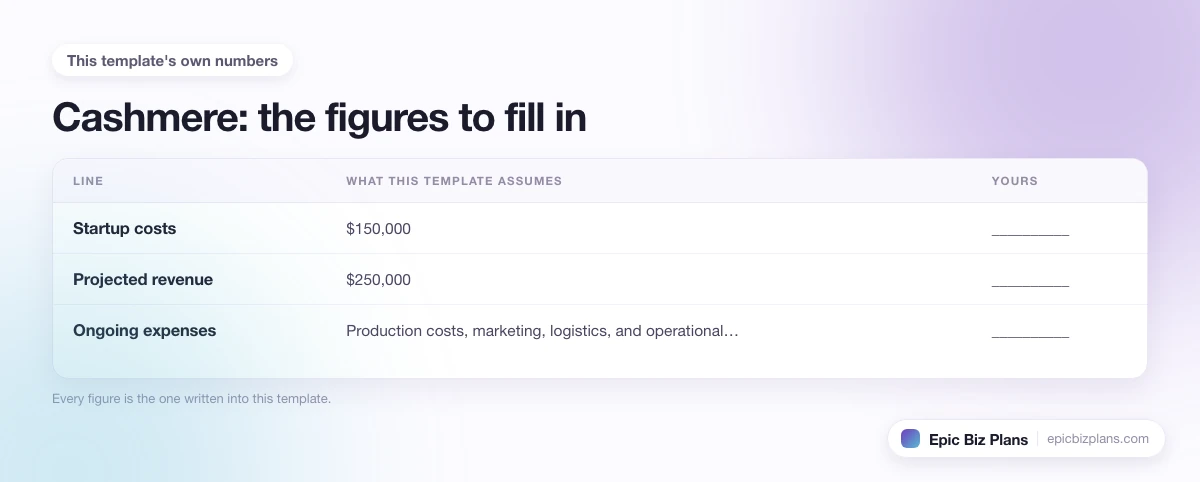
We project initial startup costs to be approximately $150,000, primarily linked to product sourcing, inventory, and e-commerce setup. Our goal for the first year is to achieve a revenue of $250,000, growing to $500,000 by year two. Ongoing expenses will include production costs, marketing, logistics, and operational overhead.
Legal and Compliance
We will ensure compliance with all legal requirements, including business registration, product safety standards, and intellectual property protection. Securing trademarks for our brand name and logo will be fundamental in establishing our identity in the market.
Operational Plan
Key operations will include procurement of cashmere, production, and distribution. We will establish strong relationships with suppliers to ensure high-quality materials and reliable sourcing. Logistics will be managed through a combination of in-house warehousing and third-party logistics partners to simplify shipping and fulfillment processes.
Contingency Planning
In light of potential risks, such as supply chain disruptions or shifts in consumer demand, we will develop mitigation strategies. This includes diversifying our supplier base and implementing agile marketing strategies to adapt to changing market conditions.
Building Your Cashmere Business
A cashmere business succeeds on quality control and a credible brand story, not just on the product itself. You might launch a boutique that sells handcrafted cashmere goods or an online store with a tighter, curated range. Either way, the plan sets the foundation: where you source fiber, how you price it, and how you reach buyers who pay for premium knitwear. A collection that reflects a clear point of view will outsell a generic one every time.
Choose Your Format
The cashmere niche supports several formats, each with different cash and inventory demands. An online store can reach buyers nationwide with strong photography and reviews, while a small artisan shop builds a loyal local following. Some brands focus on classic sweaters, others on scarves, shawls, or custom accessories, a range our ladies accessories business plan template covers in more detail. If hand-finished pieces are your edge, our crochet and knitting business plan template covers the craft side in more detail.
-
 SemrushSemrush is a platform with literally any online tool you will need to promote your business. Spy on your competitors, get search traffic, keyword research, social info, ad copies and much more. Used by most of the top online companies in the world. Besides all its tools, Semrush also has many available integrations possible with many other tools that will make your work even better.
 -
 Surfer SEOSurfer SEO is an incredibly smart AI tool that will give you exact explanations what to do in order to make your website rank better. They use hundreds of parameters, check your competitors and decide on the best course of action. Whether it be inner links, bold text, paragraphs, headers, images and much more. Surfer is a must-have in 2026.
Keep Your Cashmere Business Plan Evolving
As you grow, revisit and refine your cashmere business plan on a set schedule. New audiences, product lines, or pricing models often appear as the business matures. Updating the plan keeps it aligned with the market and with your actual costs. Use it to present to partners, plan a launch, apply for funding, or clarify your strategy. For brands leading with provenance and ethics, our ethical business plan template offers a useful companion.
Your Next Steps
Your cashmere business plan is 100% free, with unlimited edits, unlimited downloads, and unlimited chances to refine it. Start with the format that fits your idea, then adjust the numbers as your first orders come in.
