
Caroline Business Plan Template
-
 ShopifyPut your brand on Shopify. Launch your online store with tools designed for growth and success. Ready to turn your idea into profit? Start building your e-commerce business today.
 -
 SquarespaceShowcase your brand with Squarespace’s sleek designs. Build a professional online presence with ease. Start with a template that already looks finished.
 -
 WixBring your ideas to life with Wix. Customize every aspect of your site with unmatched flexibility. Start creating your unique online space and let your creativity shine.
 -
 ElementorCraft captivating websites effortlessly with Elementor. Enjoy complete creative control without coding. Make your site stand out to your audience. Start turning your vision into reality now.
- Executive Summary
- Business Info
- Business Model Overview
- SWOT Analysis
- Caroline Business Name Ideas
- Website
- Marketing Details
- Industry Trends
- Competitor Information
- Financial Information
- Legal and Compliance
- Operational Plan
- Contingency Planning
- Choosing the Right Plan Format for Your Stage
- Make the Most of Your Caroline Business Plan
- Explore Your Options
- Update the Plan as You Grow
- Put Your Plan to Work
Your Caroline business plan is more than a paper formality. It is the working document that defines what you sell, who you serve, and how you intend to grow. The strongest plans tie every section back to a clear brand identity and a specific customer, so the reader understands your direction within the first page. Treat this as the blueprint you will actually run the business from, not a file you write once and forget.
As you set out your position in a competitive market, the details carry the weight. A useful Caroline business plan states your objectives plainly, names your strengths honestly, and explains the edge that sets you apart from similar businesses. Done well, it sets the tone for everything that follows: hiring, pricing, marketing, and the way you measure progress.
Executive Summary
Our mission is to provide high-quality, practical products that improve the daily lives of our customers. We see a future where our brand is associated with reliable quality and strong customer service. Our value proposition rests on combining sustainability with affordability, two things shoppers usually have to choose between. Financially, we aim for $500,000 in revenue during our first year of operations, with steady growth of 10% annually after that.
Business Info
We specialize in eco-friendly consumer products built for shoppers who care about their environmental footprint. Our range covers reusable household items, personal care products, and sustainable fashion accessories. If your plan centers on apparel rather than household goods, the sustainable fashion business plan template maps the same model onto a clothing-first catalog.
Business Model Overview
Our model pairs direct-to-consumer sales through an e-commerce platform with selective partnerships with local retailers. We focus on sustainable sourcing and low-impact production so the product line stays true to the brand promise. Founders working a broader green concept can compare structures in the green and eco business plan template, which lays out the same trade-offs in more detail.
SWOT Analysis
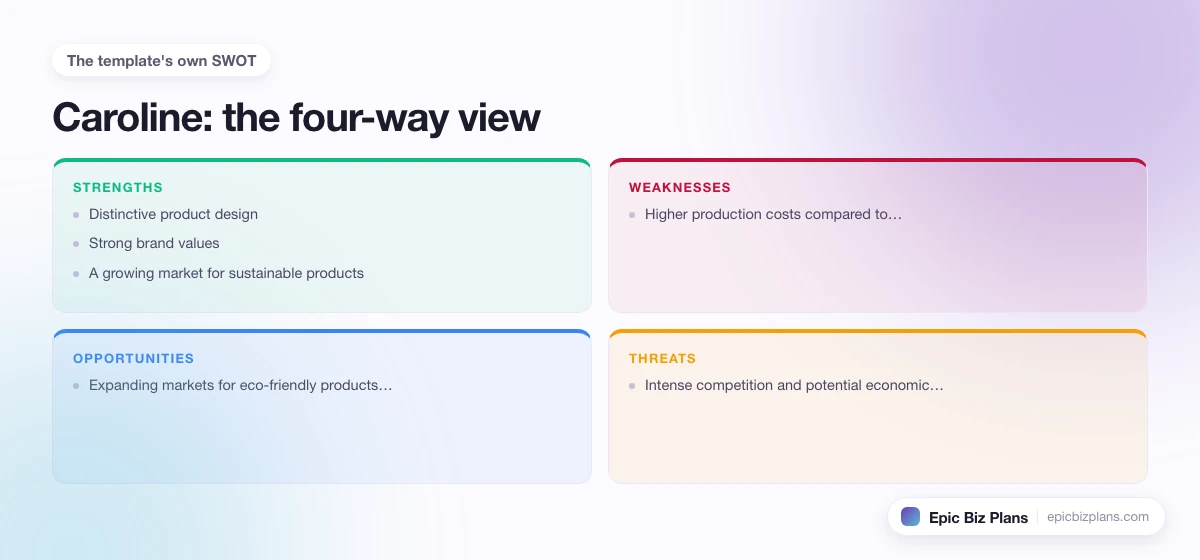
- Strengths: Distinctive product design, strong brand values, and a growing market for sustainable products.
- Weaknesses: Higher production costs compared to traditional products and the necessity for consumer education.
- Opportunities: Expanding markets for eco-friendly products and increasing consumer awareness.
- Threats: Intense competition and potential economic downturns affecting consumer spending.
Caroline Business Name Ideas
Website
We will build our store on Shopify, which fits our product range and makes online sales and inventory management straightforward. Its features suit a catalog of eco-friendly goods and let us present each product clearly. If you want to weigh platform choices before committing, the Shopify business plan template walks through setup costs and merchandising in more depth. We may also use Squarespace for the brand-story pages, where a more visual layout helps.
Marketing Details
Our marketing centers on digital channels, starting with search engine optimization through Semrush to improve visibility for the terms our buyers actually search. We will run email campaigns in HubSpot to stay in touch with existing customers and encourage repeat orders. The general ecommerce business plan template covers the funnel from first visit to repeat purchase if you want a wider view.
Social media will carry real weight, especially TikTok ads aimed at younger shoppers. We will produce short, useful content that shows the products in use and explains why sustainable choices matter.
Industry Trends
The eco-friendly product market continues to grow, helped by better sustainable materials and cleaner manufacturing methods. Shoppers increasingly prefer brands that can prove their ethical and environmental commitments rather than just claim them. That shift makes it important for us to track changes in materials, pricing, and consumer expectations, and to adjust the product line as those expectations move.
Competitor Information
Our main competitors include established eco-friendly brands and a steady stream of new startups. We plan to stand apart through distinctive product offerings, dependable customer service, and clear branding built around sustainability. The aim is a loyal customer base that shares our values and returns because the products and the experience hold up.
Financial Information
Initial startup costs are estimated at $150,000, covering product development, website setup, and marketing. We project $500,000 in first-year revenue, with ongoing expenses for production, marketing, and day-to-day operations. Careful cash flow management matters here, supported by a Profit and Loss statement so we can watch financial health and catch problems early.
Legal and Compliance
We will register the business and obtain the licenses our category requires. Intellectual property protection will come through trademarks on the brand name and logo. Meeting environmental regulations is a priority, both as a legal duty and as proof of the standards we market.
Operational Plan
Core operations cover product sourcing, quality control, and logistics that get orders out on time. We will build relationships with sustainable suppliers and run an efficient supply chain that backs up the eco-friendly promise. Clear processes here keep costs predictable as order volume climbs.
Contingency Planning
The main risks are supply chain disruptions, shifts in consumer preferences, and tougher competition. To limit the damage, we will line up backup suppliers, keep the product range flexible, and stay close to customer feedback so we can react before small issues grow. A short list of trigger points tells us when to act rather than waiting.
Choosing the Right Plan Format for Your Stage
Not every founder needs the same depth of plan on day one. A solo maker testing demand can start lean and expand the document as the business proves itself, while anyone seeking outside funding will want every section filled in before the first meeting. Match the format to your goal: a pitch to investors reads differently from an internal operating guide. If sustainability sits at the core of your concept, the green business plan template offers a structure tuned for that focus, and you can borrow the sections that fit your stage.
-
 SemrushSemrush is a platform with literally any online tool you will need to promote your business. Spy on your competitors, get search traffic, keyword research, social info, ad copies and much more. Used by most of the top online companies in the world. Besides all its tools, Semrush also has many available integrations possible with many other tools that will make your work even better.
 -
 Surfer SEOSurfer SEO is an incredibly smart AI tool that will give you exact explanations what to do in order to make your website rank better. They use hundreds of parameters, check your competitors and decide on the best course of action. Whether it be inner links, bold text, paragraphs, headers, images and much more. Surfer is a must-have in 2026.
Make the Most of Your Caroline Business Plan
Picture a business that reflects your identity, runs on your effort, and gives you room to make the calls that matter. The path to ownership is about more than revenue; it is about building something that carries your stamp. A Caroline business plan helps you work through the practical decisions, whether you are opening a local boutique, an online store, or a creative agency.
Explore Your Options
Within your niche the choices are wide open. You can think big or start small, lean creative or lean analytical. From artisan shops to large marketplaces, every business takes on its own character. Each direction changes how you reach customers and what they expect from you.
Update the Plan as You Grow
Your Caroline business plan is a living document. As the business changes, revisit it, test different pricing models, and try new sales channels. Staying flexible is what keeps the plan useful instead of stale.
Put Your Plan to Work
This plan is a tool, not a trophy. Use it to brief partners, prepare a launch, support a funding request, or clarify your longer-term strategy. Steady progress starts with a clear picture of where you are headed, and your Caroline business plan gives you that.
Your Caroline business plan is 100% free, with unlimited edits, unlimited downloads, and unlimited chances to get it right.
