
Carolina Business Plan Template
-
 ShopifyPut your brand on Shopify. Launch your online store with tools designed for growth and success. Ready to turn your idea into profit? Start building your e-commerce business today.
 -
 SquarespaceShowcase your brand with Squarespace’s sleek designs. Build a professional online presence with ease. Start with a template that already looks finished.
 -
 WixBring your ideas to life with Wix. Customize every aspect of your site with unmatched flexibility. Start creating your unique online space and let your creativity shine.
 -
 ElementorCraft captivating websites effortlessly with Elementor. Enjoy complete creative control without coding. Make your site stand out to your audience. Start turning your vision into reality now.
- Executive Summary
- Business Info
- Business Model Overview
- SWOT Analysis
- Carolina Business Name Ideas
- Website
- Marketing Details
- Industry Trends
- Competitor Information
- Financial Information
- Legal and Compliance
- Operational Plan
- Contingency Planning
- Tapping Into the Local Carolina Advantage
- Wholesale and Retail Partnerships
- Building a Real Carolina Business
- Stay Adaptive and Evolve
- Use Your Plan for Real Decisions
Your Carolina business plan is the blueprint for building a real, working company in a region where small business activity has been growing steadily for years. This is your chance to define a clear identity that fits the local market and reflects what your brand actually stands for. A strong Carolina business plan is not just about numbers; it is about turning a regional opportunity into a working operation that real customers can find and trust.
As you write your Carolina business plan, treat it as a working document, not a one-time pitch. It should outline goals, financials, and the steps that get you from idea to launch. Build your strategy around what the local market actually wants, then let the plan act as the playbook that turns ambition into a real, operating business.
Executive Summary
We are committed to providing eco-friendly consumer products that meet the needs of our target market in the Carolina region. Our mission is to improve the quality of daily life for our customers through well-made, sustainable products while keeping the business itself sustainable financially. Our vision is to become a recognized regional brand, known for product quality and consistent customer service. We aim for steady financial growth with a target of increasing revenue by 15% annually over the next five years.
Business Info
Our business will focus on eco-friendly consumer products designed for sustainability-minded individuals and families across North and South Carolina. Our primary target market is environmentally conscious consumers aged 25 to 45 who care about product quality, sourcing, and packaging. Secondary customers include local gift shops and boutique retailers who want to carry a regional line.
Business Model Overview
We will use a direct-to-consumer sales model, running both online and brick-and-mortar channels to reach our audience. This setup lets us keep close relationships with customers and offer personalized service while also building a wholesale arm for local stockists. For founders who want a deeper template on the online side, our ecommerce business plan template walks through the full DTC setup.
SWOT Analysis
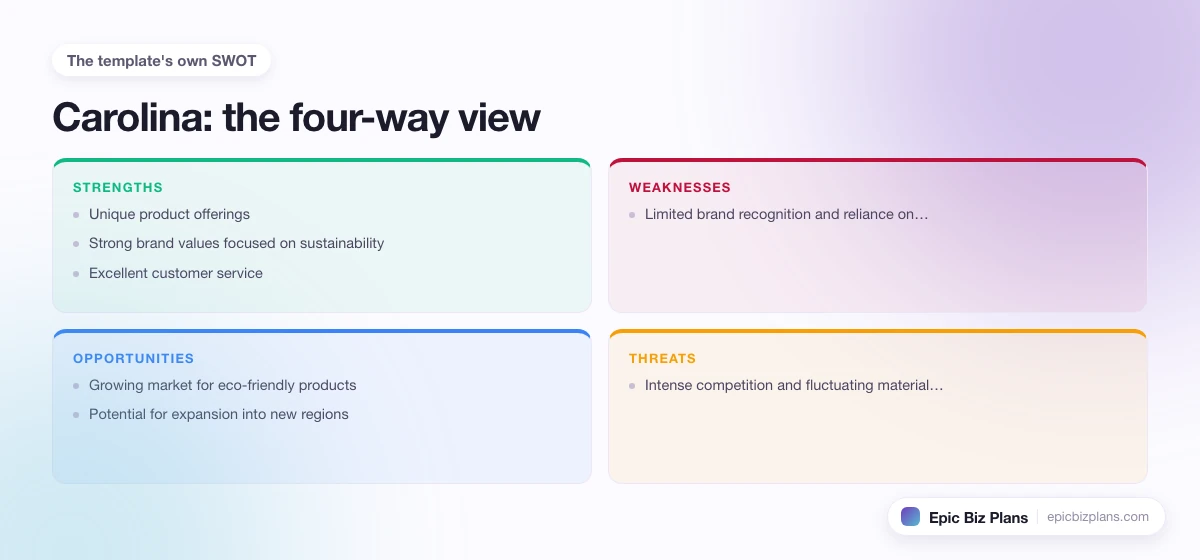
- Strengths: Unique product offerings, strong brand values focused on sustainability, and excellent customer service.
- Weaknesses: Limited brand recognition and reliance on supply chain sustainability.
- Opportunities: Growing market for eco-friendly products, potential for expansion into new regions.
- Threats: Intense competition and fluctuating material costs.
Carolina Business Name Ideas
Website
We will build our website using Shopify, which is well-suited for e-commerce and lets us manage inventory, payments, and shipping in one place. Shopify's user-friendly interface makes day-to-day store management approachable for a small team. As an alternative, Squarespace is worth considering for its design templates and tighter integration with social media platforms.
Marketing Details
Our marketing strategy will focus on digital outreach. We will use Semrush for SEO research and HubSpot for email marketing campaigns that nurture leads and keep existing customers engaged. We will also run TikTok ads to reach younger demographics with short product demos and behind-the-scenes content. Local press, regional gift guides, and partnerships with North and South Carolina lifestyle bloggers will round out the strategy. For an eco-leaning angle, our green business plan covers messaging that resonates with sustainability-focused buyers.
Industry Trends
The eco-friendly product industry continues to grow as more consumers think about the environmental impact of what they buy. Advances in sustainable manufacturing and lower-impact materials are shifting product design, opening clear opportunities for smaller brands to differentiate on sourcing and transparency. Refill systems, plastic-free packaging, and locally sourced inputs are becoming standard expectations, not premium features.
Competitor Information
We will face both direct and indirect competitors in the eco-friendly product market. Direct competitors include other businesses focused on sustainable consumer goods, while indirect competitors include traditional retailers offering similar but non-eco products. Our differentiation strategy will rely on product quality, customer service, and a clear, verifiable brand commitment to sustainability. Founders considering a broader eco angle can also look at our ecommerce green business plan for positioning ideas.
Financial Information
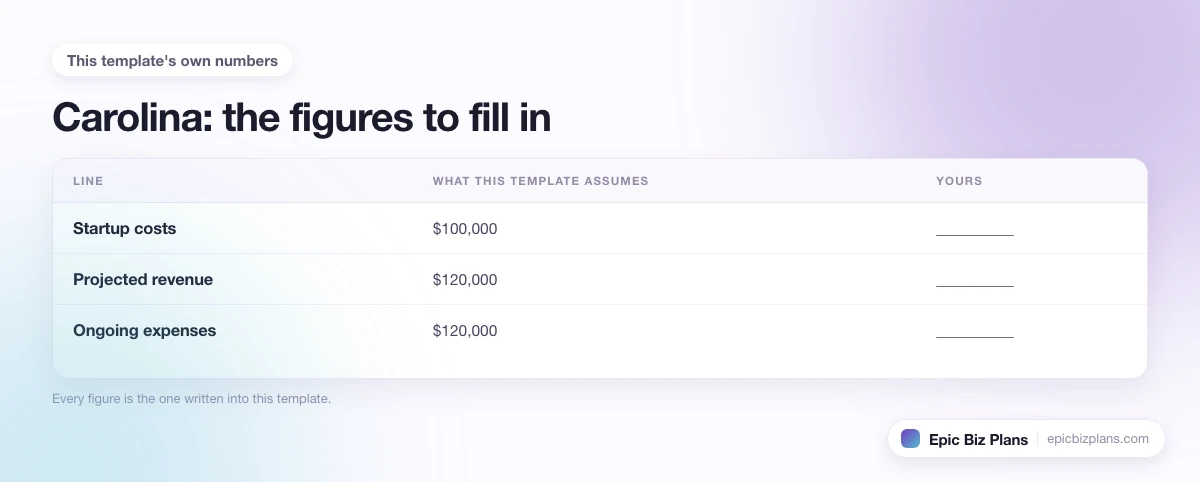
Our initial startup costs are projected at around $100,000, which includes inventory, website development, marketing, and operational expenses. We anticipate generating $200,000 in revenue during the first year, with ongoing expenses estimated at $120,000 annually. Cash flow management will be central to staying profitable, so we will produce monthly P&L statements to monitor financial health and catch issues early.
Legal and Compliance
We will meet all legal requirements, including business registration in North Carolina and adherence to consumer product safety standards. We will also seek trademark protection for our brand to safeguard our intellectual property. Sales tax registration in both North and South Carolina will be set up early, since DTC shipping crosses state lines.
Operational Plan
Our operations will include supplier relationships, inventory management, and logistics. We will partner with suppliers that share our commitment to sustainability and put inventory tracking systems in place to manage stock levels accurately. Shipping logistics will be handled through a mix of local distribution and third-party partners to improve delivery times and lower costs.
Contingency Planning
We recognize risks such as supply chain disruptions and shifts in consumer behavior. To mitigate these risks, we will build a contingency plan that includes backup supplier options and a flexible marketing strategy to adapt to demand changes. Regular risk reviews will keep us proactive instead of reactive when challenges arise.
Tapping Into the Local Carolina Advantage
Carolina-based brands have a real advantage when they actively highlight their roots. Local farmers' markets in cities like Asheville, Charleston, and Raleigh remain strong product testing grounds for new physical products. Partnerships with Carolina-based makers, photographers, and small distributors keep costs lower and stories more authentic than working with out-of-state agencies. The state's growing population, especially in the Research Triangle and Charlotte metro, gives early-stage brands a sizable home market before they have to push national. Founders weighing the broader local-business angle can take cues from our cool small business plan for fresh structural ideas.
Wholesale and Retail Partnerships
Reaching customers through other people's shelves is often the fastest way to grow a Carolina consumer-goods brand. Independent gift shops, boutique grocers, garden centers, and visitor-center retailers all stock regional products and pay relatively quickly for a wholesale channel. Build a clean line sheet, set MOQs that work for small stores, and offer simple net-30 terms once you have proven yourself. Over time, the wholesale arm can stabilize revenue between marketing pushes on the DTC side.
-
 SemrushSemrush is a platform with literally any online tool you will need to promote your business. Spy on your competitors, get search traffic, keyword research, social info, ad copies and much more. Used by most of the top online companies in the world. Besides all its tools, Semrush also has many available integrations possible with many other tools that will make your work even better.
 -
 Surfer SEOSurfer SEO is an incredibly smart AI tool that will give you exact explanations what to do in order to make your website rank better. They use hundreds of parameters, check your competitors and decide on the best course of action. Whether it be inner links, bold text, paragraphs, headers, images and much more. Surfer is a must-have in 2026.
Building a Real Carolina Business
Every solid business starts with a clear vision rooted in identity, market knowledge, and a willingness to do the work. When you build a business around your Carolina business plan, you are not just creating a company; you are shaping an operation that fits your goals and the region you live in. From local boutiques that highlight Carolina art to e-commerce ventures that celebrate regional products, the room here is wide. Whether you are an artisan, a tech-focused entrepreneur, or a creative professional, your Carolina business plan sets the path for the first few years.
Stay Adaptive and Evolve
As you move forward, keep your Carolina business plan flexible. As your goals shift, update your plan to target new audiences, test new pricing models, add product lines, or open new sales channels. Adaptation is what keeps a small business relevant in a fast-changing market.
Use Your Plan for Real Decisions
Your Carolina business plan is a working tool. Use it to present your ideas to partners, plan your launch with detail, apply for funding, or clarify the overall strategy. This document should guide each phase of the venture rather than sitting in a drawer.
Your Carolina business plan is 100% free, with unlimited edits, unlimited downloads, and unlimited chances to get it right. The time to start is now. Build the plan, then build the business.
