
Carnival Business Plan Template
-
 ShopifyPut your brand on Shopify. Launch your online store with tools designed for growth and success. Ready to turn your idea into profit? Start building your e-commerce business today.
 -
 SquarespaceShowcase your brand with Squarespace’s sleek designs. Build a professional online presence with ease. Start with a template that already looks finished.
 -
 WixBring your ideas to life with Wix. Customize every aspect of your site with unmatched flexibility. Start creating your unique online space and let your creativity shine.
 -
 ElementorCraft captivating websites effortlessly with Elementor. Enjoy complete creative control without coding. Make your site stand out to your audience. Start turning your vision into reality now.
- Executive Summary
- Business Info
- Business Model Overview
- SWOT Analysis
- Carnival Business Name Ideas
- Website
- Marketing Details
- Industry Trends
- Competitor Information
- Financial Information
- Legal and Compliance
- Operational Plan
- Contingency Planning
- Build Something the Community Looks Forward To
- Explore Your Options
- Grow and Adapt
A carnival business brings together rides, games, food, and live entertainment to create event experiences that families return to year after year. The economics of a well-run carnival operation are solid - high foot traffic, diverse revenue streams, and strong community demand for live entertainment. But the operational complexity is real: managing ride safety, vendor relationships, permitting, staffing, and weather-dependent scheduling requires structured planning before your first event opens.
This business plan template covers the key components of a carnival operation - from financial projections and legal requirements to marketing strategy and contingency planning. Use it to present a credible case to investors, venue partners, or municipal permit offices, and to ensure your own team understands the operational framework before equipment starts moving.
Executive Summary
Our mission is to create memorable community carnival experiences that bring families and local organizations together through quality entertainment. We are building a carnival operation that prioritizes safety, variety, and consistent execution - the combination that generates repeat attendance and strong word-of-mouth. Our value proposition includes a diverse attraction lineup, transparent vendor partnerships, and a community-engagement focus that makes us a preferred event partner for municipalities and schools. We aim to achieve return on investment within the first two years while growing revenue each subsequent year.
Business Info
We specialize in organizing and operating temporary carnival events that include rides such as a Ferris wheel, inflatable attractions, skill games, live performances, and curated food vendors. Our target market includes families with children, young adults, and community organizations looking for a structured entertainment option. Event planners and municipalities seeking unique programming for community days, holidays, and fundraisers are an important secondary customer segment.
Business Model Overview
Revenue will come from ticket sales, vendor booth fees, and event sponsorships from local businesses. Special event packages for birthday parties, school field trips, and corporate gatherings will provide additional revenue streams at higher per-attendee margins, an approach also detailed in our Jamboree business plan for community gatherings. We will partner with local vendors for food and specialty concessions rather than owning these operations in-house, which reduces our overhead while expanding the guest experience.
SWOT Analysis
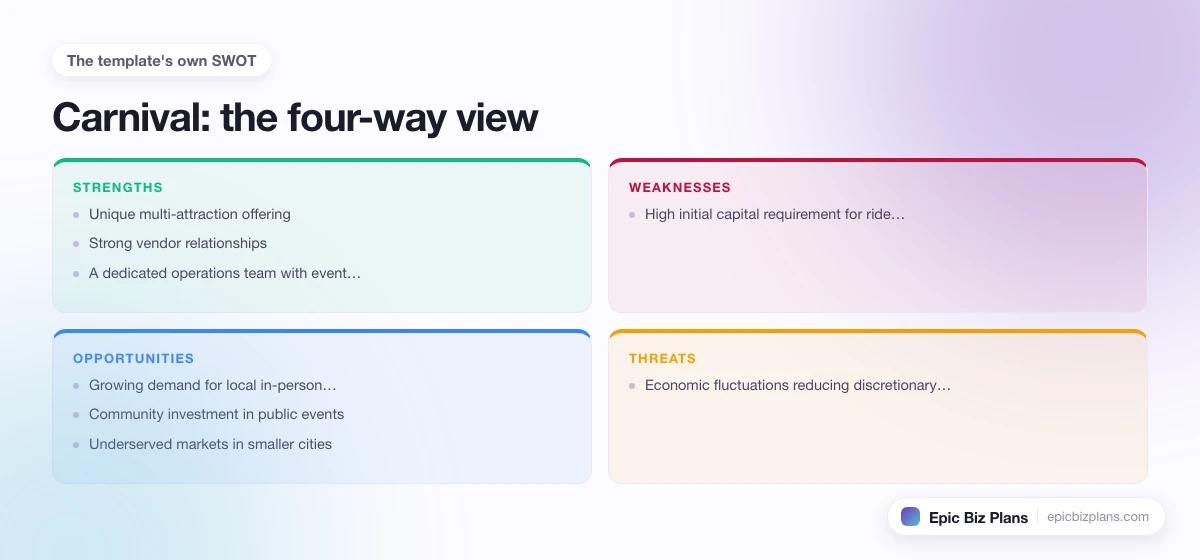
- Strengths: Unique multi-attraction offering, strong vendor relationships, and a dedicated operations team with event management experience.
- Weaknesses: High initial capital requirement for ride equipment and infrastructure; seasonal revenue concentration.
- Opportunities: Growing demand for local in-person entertainment, community investment in public events, and underserved markets in smaller cities.
- Threats: Economic fluctuations reducing discretionary entertainment spending; competition from established amusement (see also our theme park business plan) parks and community festivals.
Carnival Business Name Ideas
Website
We will build our primary web presence on Wix, which gives us the event scheduling, ticketing integration, and photo gallery features we need without requiring custom development. The site will showcase our attraction lineup, upcoming event dates, ticket purchase options, and vendor partnership inquiry forms. We will also maintain a Squarespace landing page for our premium event packages targeting corporate and school clients, with a separate contact flow designed for bulk bookings.
Marketing Details
Our marketing strategy combines digital visibility with direct community engagement. We will use Semrush to identify the local search terms families use when looking for community events and entertainment options in our target cities, optimizing our website and local listings for those queries. HubSpot will manage email campaigns to our attendee database, promoting upcoming events and early-bird ticket packages. Operators planning a smaller travelling setup can reference a funfair business plan for a community-event model.
TikTok and Instagram will carry visual content from active events - rides in motion, games being won, food being enjoyed - which performs well organically and creates social proof that paid advertising alone cannot replicate. Local media relationships, community board partnerships, and school outreach programs will supplement our digital channels with targeted in-person visibility. For those planning related entertainment businesses, a party rental business plan and a party entertainment business plan cover overlapping event logistics and vendor management strategies.
Industry Trends
Mobile ticketing systems have become standard at live events, reducing cash handling overhead and providing better attendance data for future planning. Virtual reality and simulation attractions are being incorporated into premium carnival setups, particularly for urban events where space is limited but attendees expect high novelty value. Eco-friendly practices - compostable packaging, reduced single-use plastic, and generator alternatives - are increasingly expected by municipalities when issuing event permits and by environmentally conscious attendees.
Competitor Information
Our primary competitors include established carnival operators with long-standing relationships in our target regions, as well as local festivals and fairs that offer similar entertainment options. Amusement parks and operators following a rollercoaster business plan template compete for the same entertainment dollar but require travel and a full-day commitment, which positions our community-based carnival as a more accessible alternative for families with younger children. Organizers tying an event to a national theme, like a Brazilian carnival, can also use our Brazilian business plan template for cultural and market context. Operators building a permanent attraction may instead want a roller coaster business plan. Snack vendors who specialize in kettle corn as a primary product should review the kettle corn business plan for event vendor strategy, seasonal planning, and flavor differentiation guidance.
We will differentiate through event quality consistency, safety record transparency, and genuine community involvement - sponsoring local causes and hiring locally where possible. Those planning large-scale corporate entertainment events alongside carnival operations may also benefit from a corporate events business plan for structuring that client segment separately.
Financial Information
Startup costs include ride and equipment acquisition or leasing, permitting and insurance, initial marketing, and working capital for the first season. We will project revenue based on a realistic estimate of ticket sales volume, vendor fees, and sponsorship income across our planned events. Operating expenses include equipment maintenance, staffing, fuel, and venue fees.
Cash flow is seasonally concentrated, which means building adequate reserves during peak season to cover off-season overhead is a critical financial discipline. We will prepare detailed cash flow projections by month and use them to determine our minimum viable revenue per event before committing to venue contracts.
Legal and Compliance
We will obtain all required event permits, public liability insurance, and ride safety certifications before any event opens to the public. Ride inspections will be conducted by licensed inspectors at intervals required by state regulation and after any equipment transport. We will establish clear vendor contracts that assign liability for food safety compliance to the individual vendor operators, with proof of their own insurance required before they set up at any event.
Operational Plan
Our operational plan covers the full event cycle: site selection, vendor coordination, equipment transport and setup, staffing, event execution, and teardown. We will build a checklist-based operations manual covering every phase, which allows new staff to execute consistently even on their first event. Equipment maintenance schedules will be documented and followed strictly - ride safety incidents are the single largest reputational and legal risk in this business.
-
 SemrushSemrush is a platform with literally any online tool you will need to promote your business. Spy on your competitors, get search traffic, keyword research, social info, ad copies and much more. Used by most of the top online companies in the world. Besides all its tools, Semrush also has many available integrations possible with many other tools that will make your work even better.
 -
 Surfer SEOSurfer SEO is an incredibly smart AI tool that will give you exact explanations what to do in order to make your website rank better. They use hundreds of parameters, check your competitors and decide on the best course of action. Whether it be inner links, bold text, paragraphs, headers, images and much more. Surfer is a must-have in 2026.
Contingency Planning
Weather is the most significant uncontrollable variable in outdoor event operations. All contracts with venues and vendors will include clear force majeure and weather cancellation clauses with defined refund and rescheduling procedures. Liability insurance will cover cancellation costs where applicable. For equipment breakdowns during an event, we maintain relationships with regional ride rental suppliers who can provide temporary replacements on short notice.
Build Something the Community Looks Forward To
A well-run carnival creates the kind of community experience that people talk about and return to. The business model rewards operators who prioritize safety, variety, and consistent quality - because reputation in the live events industry travels fast in both directions. Build your operation on a foundation of operational discipline and genuine community engagement, and you will have a business that municipalities and schools want to partner with year after year.
Explore Your Options
Carnival businesses can evolve in several directions: adding permanent seasonal locations, developing corporate event packages, building a food and merchandise brand around the carnival identity, or franchising the operational model to other markets. Each represents a distinct growth path with different capital requirements. Your business plan should reflect the specific model you're launching, with a clear vision of which expansion path makes the most sense given your resources and market.
Grow and Adapt
Update this plan as you learn from your first events - which attractions drove the most revenue, which vendor arrangements worked best, and which marketing channels delivered the most ticket sales. A live event business has a short feedback loop compared to most industries, which means you can iterate quickly and build a significantly better operation in year two than you had in year one.
Your Carnival business plan is 100% free - with unlimited edits, unlimited downloads, and unlimited chances to get it right.
