
Carer Business Plan Template
-
 ShopifyPut your brand on Shopify. Launch your online store with tools designed for growth and success. Ready to turn your idea into profit? Start building your e-commerce business today.
-
 SquarespaceShowcase your brand with Squarespace’s sleek designs. Build a professional online presence with ease. Start with a template that already looks finished.
-
 WixBring your ideas to life with Wix. Customize every aspect of your site with unmatched flexibility. Start creating your unique online space and let your creativity shine.
-
 ElementorCraft captivating websites effortlessly with Elementor. Enjoy complete creative control without coding. Make your site stand out to your audience. Start turning your vision into reality now.
- Executive Summary
- Business Info
- SWOT Analysis
- Carer Business Name Ideas
- Website
- Marketing Details
- Industry Trends
- Competitor Information
- Financial Information
- Legal and Compliance
- The Overtime Question That Decides Your Margin
- Operational Plan
- Contingency Planning
- Build a Carer Business That Earns Trust
- Consider the Range of Service Models
- Keep Your Plan Current
- Use It Actively
Your Carer business plan gives you a structured foundation for building a caregiving operation that genuinely improves the lives of the people it serves. The demand for professional in-home and community care services is growing steadily as populations age and families seek reliable support for elderly and disabled relatives. A well-constructed Carer business plan helps you enter this market with clarity about your service model, target clients, staffing requirements, and financial expectations.
Building a successful carer business means getting both the compassionate and the operational sides right. Clients and their families are placing a significant amount of trust in you, and that trust is earned through consistent service quality, transparent communication, and a well-trained team. Your Carer business plan should address both the human dimensions of this work and the practical business requirements in equal measure.
Executive Summary
Our mission is to provide compassionate and reliable care services that improve the quality of life for our clients. We envision building an operation where every individual receives personalized support tailored to their specific needs and circumstances. Our value proposition rests on highly trained staff, a genuine commitment to trust and respect, and strong community relationships in the areas we serve. Financially, we aim for sustainable growth with a projected 15% annual revenue increase over the next five years.
Business Info
We provide A thorough range of caregiving services including elderly care, disability support, and companionship for those requiring assistance with daily activities. Our target market includes families seeking dependable in-home care for elderly relatives and individuals who need regular support to maintain independence. Our business model focuses on personalized care plans with a flexible pricing structure to serve clients across a range of budget levels. Operators who want to understand how a larger institutional care model compares to in-home services should review an aged care business plan to understand the regulatory and staffing differences between the two approaches.
SWOT Analysis
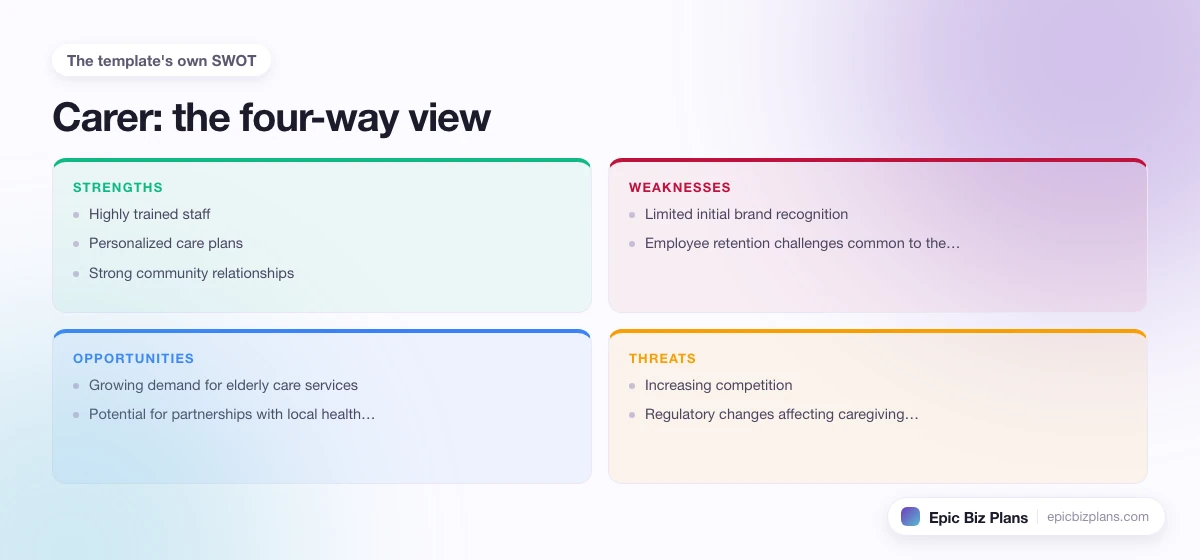
- Strengths: Highly trained staff, personalized care plans, strong community relationships
- Weaknesses: Limited initial brand recognition, employee retention challenges common to the caregiving sector
- Opportunities: Growing demand for elderly care services, potential for partnerships with local health organizations
- Threats: Increasing competition, regulatory changes affecting caregiving service standards
Carer Business Name Ideas
Website
We will build our website using Wix, which offers an accessible interface suitable for managing a service-oriented business without requiring advanced technical expertise. This platform will allow us to clearly present our services and reach potential clients. For more complex needs, we will consider WordPress with Cloudways hosting and Elementor for design flexibility. Regardless of platform, the website must communicate trustworthiness immediately: care businesses are judged heavily on their online presence before families make initial contact.
Marketing Details
Our marketing strategy will combine digital and community-based outreach. We will use Semrush for SEO to improve our visibility in local search results, where most care clients begin their research. HubSpot will manage email marketing to maintain engagement with existing clients and referral partners. On social media, TikTok content addressing caregiving challenges and solutions will help reach family members who may be researching care options for aging relatives. Referral partnerships with local hospitals, GP practices, and social services departments are often the highest-value lead source for care businesses and should be developed early.
Industry Trends
The caregiving industry is seeing accelerated adoption of telehealth and remote monitoring technologies, which allow carers to provide oversight support for clients who do not require full-time in-person attendance. Care management software is improving coordination between care workers, families, and medical providers, raising client expectations for visibility and communication. Demographic trends in most developed markets point to significant growth in demand for elderly care services over the next decade. Entrepreneurs building senior-focused care operations should also review a senior care business plan for detailed planning frameworks specific to that client segment.
Competitor Information
We will analyze both direct competitors providing similar in-home care services and indirect alternatives such as residential care facilities. Differentiation will come from the quality and consistency of our care, the responsiveness of our management team, and our ability to build genuine long-term relationships with clients and families. In a sector where word-of-mouth referrals drive the majority of new business, reputation for reliability is the most valuable competitive asset.
Financial Information
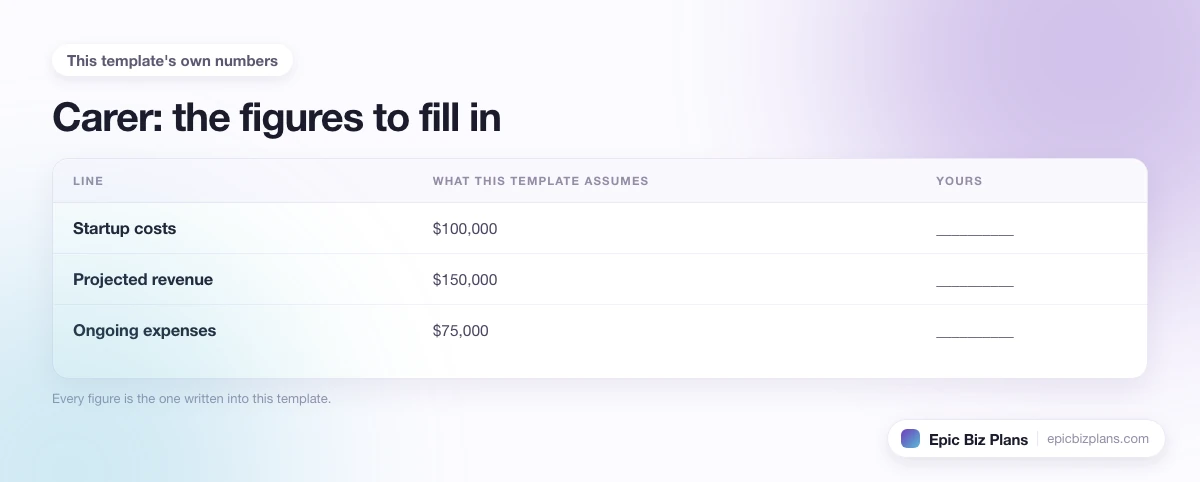
Startup costs, including staff training, marketing, and operational setup, are estimated at $100,000. Projected first-year revenue is $150,000, with annual ongoing expenses of approximately $75,000. A detailed cash flow analysis and P&L statement will be maintained to monitor financial health and inform staffing and expansion decisions. Understanding your break-even point per care hour is fundamental to pricing the service correctly from the start.
Legal and Compliance
We will register our business and obtain all necessary permits and operating licenses for caregiving services in our jurisdiction. Compliance with relevant worker screening requirements, including background checks and reference verification for all care staff, is non-negotiable in this sector. We will trademark our brand name and logo and maintain appropriate liability insurance coverage for all service activities.
The federal wage position for home care agencies is genuinely unsettled right now, and it is the largest single variable in the financial plan, so it needs stating carefully rather than assumed away. The Department of Labor's 2013 final rule stopped third-party employers such as home care agencies from claiming the Fair Labor Standards Act exemptions for companionship services and live-in domestic workers, and narrowed what companionship services means. On 2 July 2025 the Department proposed rescinding those provisions. On 25 July 2025 the Wage and Hour Division issued Field Assistance Bulletin 2025-4, telling its investigators to discontinue enforcement of the 2013 rule, including in open cases, and not to investigate or take action against third-party employers claiming those exemptions.
Read what that Bulletin actually says before you build a payroll model on it. It states that it is intended solely as internal guidance and as notice of the division's enforcement position, that it does not create any legally enforceable rights or obligations, and that it does not alter any statutory or regulatory requirements. The 2013 rule remains the regulation until a final rule takes effect. The Bulletin also carves out trained personnel: registered nurses and licensed practical nurses are not affected by it and are not to be treated as exempt even when providing companionship services. State wage and hour law is separate again and may be stricter.
The Overtime Question That Decides Your Margin
Budget overtime as though the 2013 rule applies. The reason is not caution for its own sake: a federal agency's decision about where to spend its investigators does not change what a court will apply if one of your caregivers sues, and a private action under the Fair Labor Standards Act is not governed by the Department's enforcement priorities. A plan that prices every hour at straight time because of an enforcement bulletin is carrying an unfunded liability for the whole period the bulletin is in force, which is precisely the period it covers.
What that means for the operating model:
- Price the schedule, not the hour. Live-in and long-shift arrangements are where the exposure concentrates, because that is where weekly hours run past 40. Know which of your care packages do that before you quote them.
- Clinical staff are a separate line. Nurses sit outside the exemption question entirely, so a package with nursing hours has a different cost structure from a companionship package. Do not blend them into one average hourly cost.
- Watch the state layer. Several states regulate home care wages and hours independently of the federal position, and the stricter rule governs. Your rates should be set per state you operate in, not nationally.
- Put the uncertainty in the plan. Model the margin both ways. A lender or an investor will think better of a plan that shows it understands the open question than one that picks the convenient answer silently.
Everything else in this business follows from staffing, which is the real constraint. Demand is steady and growing as populations age, but you can only serve the clients you have carers for, and turnover is the industry's defining problem. Recruitment, training, scheduling and retention are not back-office functions here, they are the operation, and a plan that treats carer supply as a given is describing a different business from the one you will run.
-
 SemrushSemrush is a platform with literally any online tool you will need to promote your business. Spy on your competitors, get search traffic, keyword research, social info, ad copies and much more. Used by most of the top online companies in the world. Besides all its tools, Semrush also has many available integrations possible with many other tools that will make your work even better.
-
 Surfer SEOSurfer SEO is an incredibly smart AI tool that will give you exact explanations what to do in order to make your website rank better. They use hundreds of parameters, check your competitors and decide on the best course of action. Whether it be inner links, bold text, paragraphs, headers, images and much more. Surfer is a must-have in 2026.
Trust is the other one. Families are admitting a stranger to a vulnerable relative's home, so screening, continuity of carer, and how you handle a complaint are the product as much as the care itself. Service models differ more than people expect: the companionship business plan, the nursing home business plan and the developmental disabilities business plan each carry a different staffing ratio, regulatory footprint and capital requirement, and are worth comparing before you settle on one.
Operational Plan
Our operations will center on recruiting and training qualified caregivers, maintaining accurate client records, and delivering reliable, scheduled service. Staff scheduling must balance continuity of care (ensuring clients see familiar faces) with operational flexibility to cover absences. Supply chain management for consumables and care equipment will be handled through reliable wholesale relationships. Logistics for client service delivery will be organized to minimize travel time between appointments, improving both cost efficiency and staff satisfaction.
Contingency Planning
Key risks include staff turnover, regulatory changes, and disruptions caused by health emergencies. We will maintain a pool of trained backup carers to ensure service continuity during absences, and keep an emergency reserve fund for unexpected operational costs. Diversifying service offerings across elderly care, disability support, and companionship services reduces revenue concentration risk in any single client segment.
Build a Carer Business That Earns Trust
A carer business built on consistent quality and genuine care for clients is also a business with strong word-of-mouth growth potential. Families talk to other families, and a reputation for reliability in this sector is worth far more than any advertising spend. Your Carer business plan gives you the structure to build that kind of operation from the ground up.
Consider the Range of Service Models
Care businesses range from sole-operator services to multi-care-worker agencies with regional coverage. Some focus exclusively on elderly clients, while others build competency across elderly care, disability support, and post-surgical recovery. Understanding which model fits your skills, local market, and capital position will sharpen your strategy considerably before you commit resources.
Keep Your Plan Current
As your business grows, update your Carer business plan to reflect changes in staffing levels, service expansion, new care technology, and shifts in your client mix. A business plan that accurately reflects current operations is a far better management tool than one frozen at the point of initial launch.
Use It Actively
Your carer business plan is a practical resource for loan applications, partnership discussions, accreditation submissions, and team briefings. It demonstrates organizational maturity to the health authorities, investors, and referral partners whose support you need to grow.
Your carer business plan is 100% free: with unlimited edits, unlimited downloads, and unlimited chances to get it right. Start building the foundation this business requires.
