
Cardio Business Plan Template
-
 ShopifyPut your brand on Shopify. Launch your online store with tools designed for growth and success. Ready to turn your idea into profit? Start building your e-commerce business today.
 -
 SquarespaceShowcase your brand with Squarespace’s sleek designs. Build a professional online presence with ease. Start with a template that already looks finished.
 -
 WixBring your ideas to life with Wix. Customize every aspect of your site with unmatched flexibility. Start creating your unique online space and let your creativity shine.
 -
 ElementorCraft captivating websites effortlessly with Elementor. Enjoy complete creative control without coding. Make your site stand out to your audience. Start turning your vision into reality now.
- Executive Summary
- Business Info
- Business Model Overview
- SWOT Analysis
- Cardio Business Name Ideas
- Website
- Marketing Details
- Industry Trends
- Competitor Information
- Financial Information
- Legal and Compliance
- Operational Plan
- Contingency Planning
- Build Your Cardio Business with a Clear Plan
- Types of Cardio Businesses
- Keep Your Cardio Business Plan Flexible
- Practical Uses for Your Plan
The chance to build your own cardio business plan is here, and now is a good time to step into a growing industry. As health and fitness take a bigger role in daily life, a cardio business plan that fits your brand and speaks to your audience is essential, not optional. The cardio market holds real potential; it is a space where genuine interest in fitness meets a clear path to profit, and the right strategy sets you up to grow.
Building your cardio business plan starts with knowing what makes your brand distinct and how it fits the needs of health-conscious consumers. This venture is about more than numbers; it is about culture, community, and helping others build a stronger fitness habit. Your cardio business plan is the roadmap that lays out your vision, whether that is a boutique fitness studio, a wellness app, or training programs built for different audiences. Let's get to work.
Executive Summary
Our mission is to provide high-quality cardiovascular fitness products and services that help people lead healthier lives. We picture a market where fitness is accessible to everyone, and our value proposition centers on useful products and community engagement. Our financial goals include steady revenue growth of 20% annually within the first five years, and profitability by year two. Owners planning around equipment can also review a fitness equipment business plan.
Business Info
We offer a range of products, including advanced cardio machines, fitness accessories, and online workout programs built for various fitness levels. Our target market is health-conscious individuals aged 18 to 45 who want to improve their fitness through cardiovascular exercise. This audience overlaps closely with a broader health and fitness business plan.
Business Model Overview
Our business runs on a direct-to-consumer model, selling through an e-commerce platform as well as brick-and-mortar locations. This lets us reach a wider audience and provide tailored customer support. We will also offer subscriptions for our online workout programs to give customers ongoing value.
SWOT Analysis
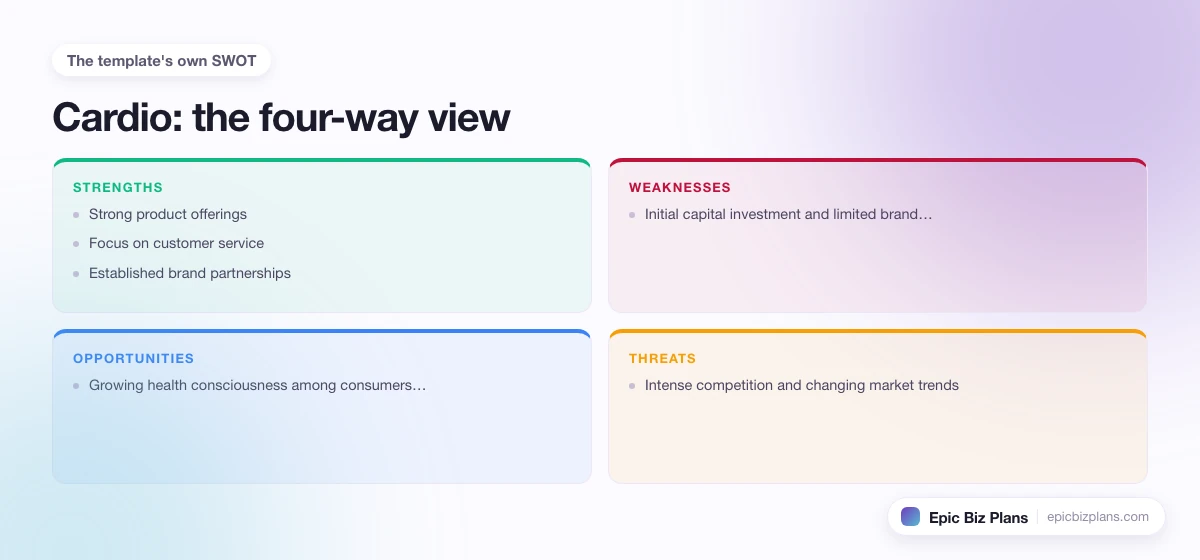
- Strengths: Strong product offerings, focus on customer service, and established brand partnerships.
- Weaknesses: Initial capital investment and limited brand recognition in the market.
- Opportunities: Growing health consciousness among consumers and potential for e-commerce expansion.
- Threats: Intense competition and changing market trends.
Cardio Business Name Ideas
Website
We will build our website using Shopify for its e-commerce features, which let us manage sales, inventory, and customer data efficiently. Shopify's user-friendly interface will help us create an engaging online shopping experience. If we add services beyond product sales, we will also evaluate Squarespace for its strong design templates.
Marketing Details
Our marketing strategy will use digital platforms, focusing on social media and search engine optimization. We will use Semrush for SEO to improve our online visibility and HubSpot for email marketing campaigns that keep customers engaged. Studios that also run classes can borrow ideas from a spin studio business plan.
We will also run TikTok ads to reach a younger audience that follows health and wellness trends. The platform's short-form format helps us connect with our target market in a direct way.
Industry Trends
The fitness industry is growing, with progress in wearable devices and online coaching leading the way. The rise of virtual workouts and fitness apps has changed how people approach exercise, so we need to keep improving our offerings to stay current.
Competitor Information
We will study both direct and indirect competitors in the cardiovascular equipment market. Our primary competitors will include established fitness brands, while indirect competition will come from local gyms and online fitness programs. Owners weighing a coaching angle can also consult a fitness trainer business plan.
To set our business apart, we will build a community around our brand, offer strong customer service, and provide useful content that promotes healthy living beyond just selling products.
Financial Information
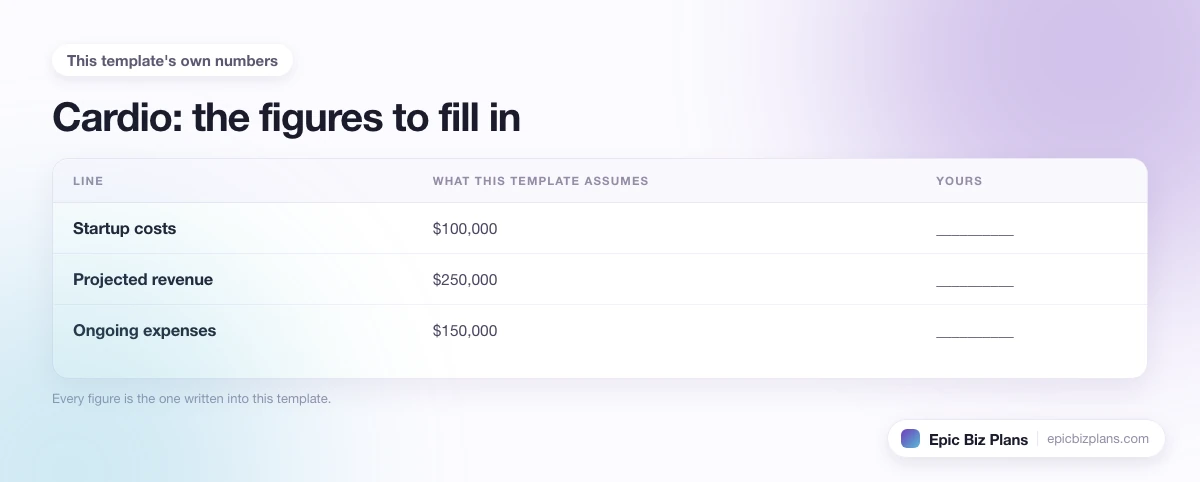
We estimate initial startup costs at roughly $100,000, covering product inventory, marketing, website development, and operating expenses. Our projected revenue should reach $250,000 in the first year, with ongoing expenses estimated at $150,000, leading to positive cash flow by the end of year two. A detailed profit and loss statement will be established to track our financial performance.
Legal and Compliance
We will comply with all legal requirements to operate, including registering our business name, obtaining necessary licenses, and securing our intellectual property. Regular legal reviews will help maintain compliance and protect our brand.
Operational Plan
Our operations will involve sourcing products from reliable manufacturers, managing inventory through an efficient supply chain, and keeping logistics timely for order fulfillment. We will apply efficient processes to improve operations while maintaining product quality.
Contingency Planning
We will identify risks, such as market fluctuation and supply chain disruptions, and develop mitigation strategies. This will include diversifying our suppliers and keeping a financial buffer to manage unexpected challenges. Regular assessments will help us adapt our strategies and stay resilient.
-
 SemrushSemrush is a platform with literally any online tool you will need to promote your business. Spy on your competitors, get search traffic, keyword research, social info, ad copies and much more. Used by most of the top online companies in the world. Besides all its tools, Semrush also has many available integrations possible with many other tools that will make your work even better.
 -
 Surfer SEOSurfer SEO is an incredibly smart AI tool that will give you exact explanations what to do in order to make your website rank better. They use hundreds of parameters, check your competitors and decide on the best course of action. Whether it be inner links, bold text, paragraphs, headers, images and much more. Surfer is a must-have in 2026.
Build Your Cardio Business with a Clear Plan
The drive to start a business often comes from identity and genuine interest. Starting your own cardio business can be a creative outlet, one that can also reshape your lifestyle and help others build a healthier routine. Whether you plan to open a small, community-focused gym, an ecommerce store selling quality athletic gear, or a fitness app, your cardio business plan is the foundation that turns these ideas into reality.
Types of Cardio Businesses
In the cardio niche, you have many options. From local fitness studios offering fresh classes to online platforms running virtual workout sessions, your choices are as varied as your vision. Consider producing instructional videos or launching a subscription box filled with gear and nutrition guides; each can reach different audiences eager to invest in their health. A related sports and fitness business plan can add ideas here.
Keep Your Cardio Business Plan Flexible
As you start out, remember your cardio business plan is a living document. Update and adapt it as you grow, whether that means speaking to different audiences, testing new pricing models, expanding product lines, or moving into new sales channels. Staying flexible keeps you aligned with the market and the needs of your customers.
Practical Uses for Your Plan
Your cardio business plan can matter in many situations, from presenting to potential partners and planning a launch to securing funding and clarifying your strategy. It is more than a guide; it is your blueprint for building the business.
Step confidently into this chapter. Your cardio business plan is 100% free, with unlimited edits, unlimited downloads, and unlimited chances to get it right.
