
Card Holder Business Plan Template
-
 ShopifyPut your brand on Shopify. Launch your online store with tools designed for growth and success. Ready to turn your idea into profit? Start building your e-commerce business today.
 -
 SquarespaceShowcase your brand with Squarespace’s sleek designs. Build a professional online presence with ease. Start with a template that already looks finished.
 -
 WixBring your ideas to life with Wix. Customize every aspect of your site with unmatched flexibility. Start creating your unique online space and let your creativity shine.
 -
 ElementorCraft captivating websites effortlessly with Elementor. Enjoy complete creative control without coding. Make your site stand out to your audience. Start turning your vision into reality now.
- Executive Summary
- Business Info
- Business Model Overview
- SWOT Analysis
- Card Holder Business Name Ideas
- Website
- Marketing Details
- Industry Trends
- Competitor Information
- Financial Information
- Legal and Compliance
- Operational Plan
- Contingency Planning
- Why Start a Card Holder Business?
- Types of Card Holder Businesses
- Keep Your Plan Current
- Practical Applications for Your Plan
- Your Plan Starts Here
Starting a Card Holder business puts you at the intersection of two durable consumer demands: organization and style. People carry cards everywhere, including credit cards, business cards, transit passes, and loyalty cards, and they want something that holds them without adding bulk. That is a genuine problem you can build a business around.
When building your Card Holder business plan, stay specific about what makes your product different. Mass-market options already crowd the market, so your plan needs to clearly articulate your design philosophy, your materials, and why your target customer would choose your brand over Amazon's house brands or fast fashion accessories. Specificity wins here, not broad aspirational language.
Executive Summary
We will establish a business focused on providing well-designed, high-quality card holders. Our mission is to create products that balance look and function, items people reach for every day because they work well and look good doing it. Our vision is to build a recognized brand in the card holder market, known for consistent quality, thoughtful design, and responsive customer service.
Our value proposition centers on offering card holders that combine durability, RFID-blocking protection, and materials that age well. By focusing on sustainable sourcing and designs that fit real pockets and bags, we aim to earn a meaningful share of the growing accessories market. Our financial goal is to reach profitability within the first two years and expand the product range from there.
Business Info
We will offer a range of card holders, including slim minimalist designs, RFID-blocking options, and customizable versions for corporate gifting or personal expression. Our primary customers are professionals aged 18 to 45 who want a cleaner alternative to bulky wallets, people who appreciate well-made everyday carry items.
Business Model Overview
Our core channel is direct-to-consumer e-commerce. We will drive traffic through organic search, social content, and paid digital ads, then convert through our online store. Over time, we will add select retail partnerships to get physical products in front of shoppers who prefer to touch before buying. This hybrid approach keeps margins healthy while building brand visibility.
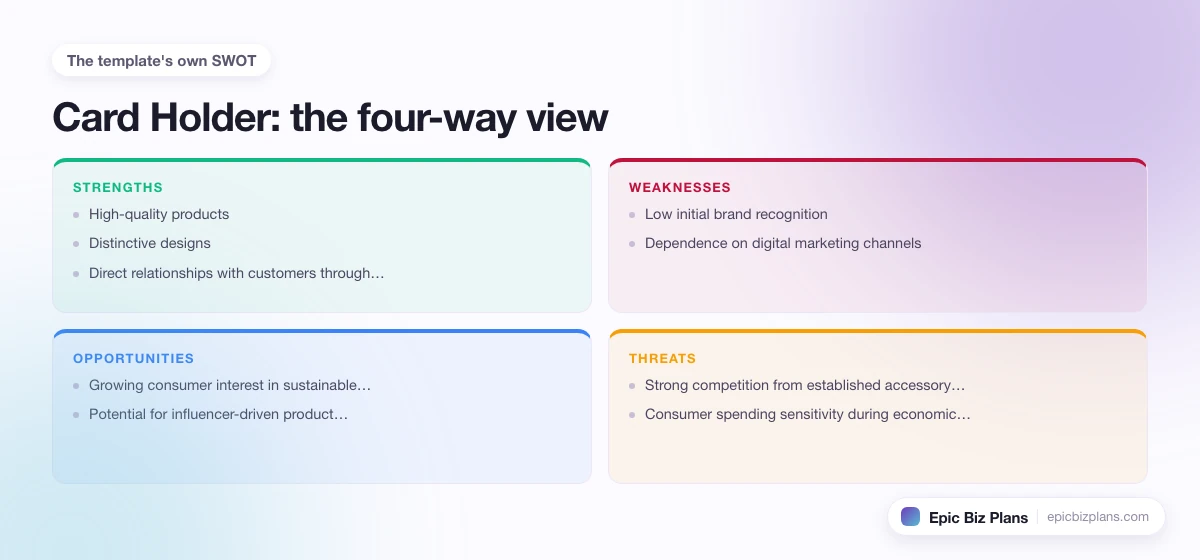
SWOT Analysis
- Strengths: High-quality products, distinctive designs, direct relationships with customers through our online store.
- Weaknesses: Low initial brand recognition, dependence on digital marketing channels.
- Opportunities: Growing consumer interest in sustainable materials, potential for influencer-driven product discovery.
- Threats: Strong competition from established accessory brands, consumer spending sensitivity during economic slowdowns.
Card Holder Business Name Ideas
Website
We will build on Shopify, which gives us the e-commerce tools we need from day one: inventory management, payment processing, abandoned cart recovery, and a wide selection of themes that present physical products well. As we grow, Shopify's app ecosystem lets us add loyalty programs, review systems, and wholesale portals without rebuilding from scratch.
Marketing Details
Our marketing plan centers on organic search and paid social. We will use Semrush to identify the keywords buyers actually search when looking for slim wallets, RFID card holders, and minimalist accessories, then build content and product pages around those terms. For email, HubSpot will handle segmented campaigns covering new arrivals, restocks, and seasonal promotions to keep past buyers engaged.
On social, we will focus TikTok ads on a younger demographic with short videos showing the product in real use: pulling it from a pocket, tapping through a turnstile, presenting a business card at a meeting. Visual proof of function converts better than lifestyle imagery alone for this product category. For related accessories businesses, see our wallet business plan template and our guide to starting a handmade bag business.
Industry Trends
Sustainable materials are moving from niche preference to mainstream expectation in the accessories market. Customers increasingly check what a product is made from before buying, which means brands that can speak clearly about their sourcing have a real advantage. RFID-blocking technology has become a standard feature rather than a premium add-on, since most customers now expect it. The shift toward mobile payments is gradually reducing how many cards people carry, which pushes brands to design for smaller capacity while keeping a sense of quality.
Competitor Information
The card holder market includes mass-market players selling on Amazon and Temu at low price points, mid-tier brands on their own DTC sites, and premium leather goods makers who charge a significant premium for heritage craftsmanship. Our positioning sits in the mid-tier: better materials and design than the discount brands, priced accessibly enough that someone does not need to deliberate for a week before buying. We will set ourselves apart through product photography, clear material descriptions, and a return policy that removes purchase risk. The gift card business plan template shows how a focused product can compete against larger sellers.
Financial Information
Startup costs will cover initial inventory, website setup, product photography, and first-month marketing spend. We expect to be conservative in the first year, since building organic traffic takes time, with revenue growing as our SEO rankings mature and repeat customer rates increase. We will track gross margin per SKU closely, since material costs vary significantly between our product tiers. Quarterly P&L reviews will flag any unit economics problems before they compound. For additional perspective on building an accessories business financial model, review our electronic accessories business plan template.
Legal and Compliance
We will register the business as an LLC and file for trademark protection on our brand name early, before we have built traffic that makes the name worth copying. We will also register any distinctive design elements we develop. E-commerce compliance requirements include GDPR-friendly privacy policies, accessible checkout flows, and accurate product descriptions that do not overstate RFID protection capabilities.
Operational Plan
Sourcing will rely on two to three pre-vetted manufacturers so we are not dependent on a single factory. Quality control inspections happen before goods ship, not after they arrive. Order fulfillment will start with a 3PL to keep overhead low before we consider a warehouse of our own. Clear reorder points for each SKU will prevent stockouts during peak gift-buying periods.
Contingency Planning
If one supplier goes offline, our secondary manufacturer relationships allow us to shift production without a multi-month gap. If a particular product line underperforms, we can reposition it as a gift bundle or discontinue it cleanly without carrying excess inventory. Marketing spend can scale down quickly if revenue targets slip, protecting cash reserves while we diagnose the issue.
-
 SemrushSemrush is a platform with literally any online tool you will need to promote your business. Spy on your competitors, get search traffic, keyword research, social info, ad copies and much more. Used by most of the top online companies in the world. Besides all its tools, Semrush also has many available integrations possible with many other tools that will make your work even better.
 -
 Surfer SEOSurfer SEO is an incredibly smart AI tool that will give you exact explanations what to do in order to make your website rank better. They use hundreds of parameters, check your competitors and decide on the best course of action. Whether it be inner links, bold text, paragraphs, headers, images and much more. Surfer is a must-have in 2026.
Why Start a Card Holder Business?
Card holders occupy a small but dependable corner of the accessories market. The product is simple enough that a small team can design, source, and sell them without massive infrastructure. At the same time, there is genuine room for brands that take quality and design seriously, since most of what is available online is either very cheap or very expensive, with a gap in the middle that a well-positioned brand can fill.
Types of Card Holder Businesses
The market supports several distinct models. Artisan makers produce hand-stitched leather and canvas card holders in small batches, often selling through Etsy and their own sites. Mid-tier DTC brands focus on a signature material such as recycled ocean plastic, full-grain leather, or aluminum, and build a product line around it. Corporate gifting suppliers sell in bulk to companies that want branded accessories for client gifts and employee onboarding packages. Each model has different margin structures and customer acquisition costs worth modeling before you commit to one.
Keep Your Plan Current
Your business plan should reflect where you actually are, not where you were six months ago. As you learn which products sell, which marketing channels convert, and which customer segments reorder most often, update the plan to match reality. A plan that reflects current data is useful for decisions; one that has been sitting untouched for a year is mostly a formality. You might also find value in reviewing the key chain business plan template for adjacent product strategies.
Practical Applications for Your Plan
Use the plan concretely: bring it to supplier negotiations, lender meetings, and conversations with potential co-founders. A written plan that covers your numbers, your customer, and your competitive positioning is more persuasive than verbal pitches alone. It also forces clarity, since if you cannot write down how you will acquire your first 100 customers, you have not thought it through yet.
Your Plan Starts Here
Your Card Holder business plan is 100% free, with unlimited edits, unlimited downloads, and unlimited chances to get it right. Start with what you know, fill in the gaps as you learn, and build from there.
