
Capybara Business Plan Template
-
 ShopifyPut your brand on Shopify. Launch your online store with tools designed for growth and success. Ready to turn your idea into profit? Start building your e-commerce business today.
 -
 SquarespaceShowcase your brand with Squarespace’s sleek designs. Build a professional online presence with ease. Start with a template that already looks finished.
 -
 WixBring your ideas to life with Wix. Customize every aspect of your site with unmatched flexibility. Start creating your unique online space and let your creativity shine.
 -
 ElementorCraft captivating websites effortlessly with Elementor. Enjoy complete creative control without coding. Make your site stand out to your audience. Start turning your vision into reality now.
- Executive Summary
- Business Info
- SWOT Analysis
- Capybara Business Name Ideas
- Website
- Marketing Details
- Industry Trends
- Competitor Information
- Startup Costs and Revenue Streams
- Financial Information
- Legal and Compliance
- Operational Plan
- Contingency Planning
- Building a Capybara Business with Staying Power
- Exploring Your Niche
- Keeping It Fresh
- Practical Applications
The capybara niche sits at a genuinely unusual intersection of animal attraction, conservation education, and merchandise retail - and it has built a dedicated following across social media that translates into real consumer demand. A capybara business can take several forms: an encounter sanctuary, a themed café, an e-commerce store, or an educational content platform. Whatever direction you pursue, your capybara business plan is the framework that defines your model, manages your costs, and maps the path to profitability.
The most important planning decisions in this niche relate to animal welfare regulations, which vary significantly by jurisdiction and directly determine what kind of operation is legally permissible. Understand the permitting requirements in your area before committing capital. Build a plan around the format that is both viable in your location and genuinely sustainable for the animals involved.
Executive Summary
Our mission is to promote the welfare and public understanding of capybaras through hands-on experiences and conservation education. Our vision is to operate a recognized sanctuary and educational facility where visitors develop a genuine connection with these animals and leave with a better understanding of their needs and habitat. Our value proposition is the combination of unique interactive experiences with credible educational content that neither a standard zoo nor an online store can replicate. We target break-even within the first year and a 20% profit margin by the end of year two.
Business Info
Our business will offer capybara encounters, guided educational workshops, and a merchandise line of capybara-themed products. Our target market includes families with children, school groups, animal welfare advocates, and tourists seeking unusual experiences. We will combine on-site revenue from visits and events with e-commerce sales of branded merchandise to reduce dependence on any single income source.
SWOT Analysis
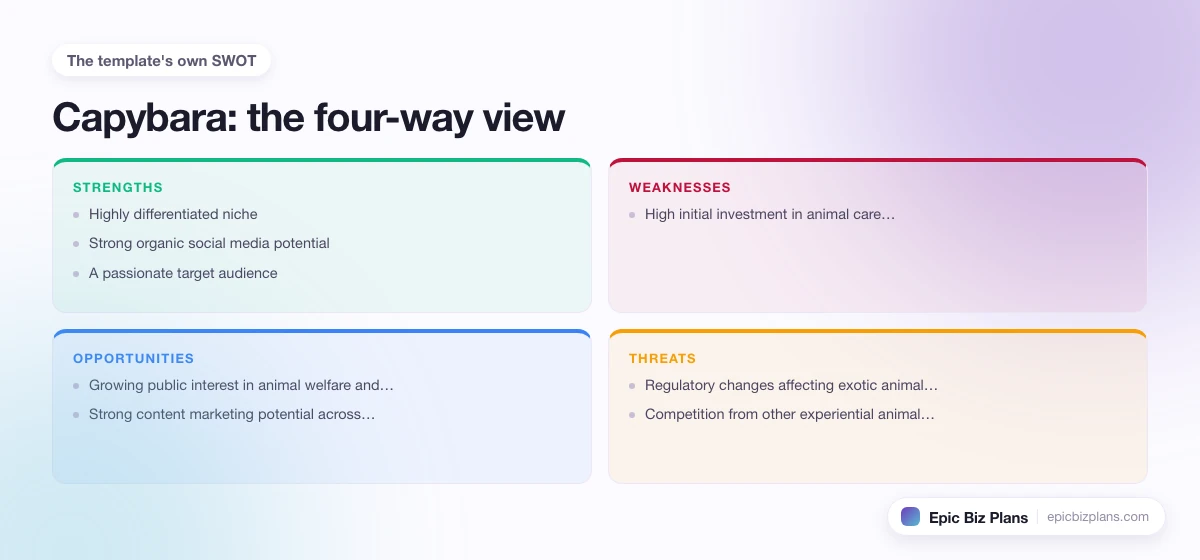
- Strengths: Highly differentiated niche, strong organic social media potential, and a passionate target audience.
- Weaknesses: High initial investment in animal care infrastructure and dependence on seasonal visitor patterns.
- Opportunities: Growing public interest in animal welfare and eco-tourism, and strong content marketing potential across platforms where capybara content performs exceptionally well.
- Threats: Regulatory changes affecting exotic animal care, and competition from other experiential animal attractions.
Capybara Business Name Ideas
Website
We will build our website using Wix or Squarespace to create a visually engaging platform that communicates the warmth and character of the sanctuary. The site will handle ticket sales for encounters and workshops, merchandise orders, and educational content. A well-maintained blog documenting daily life at the sanctuary builds organic search traffic and keeps the audience engaged between visits.
Marketing Details
Our marketing strategy will lean heavily into social media content, as capybara-focused video content consistently generates high organic engagement on TikTok, Instagram, and YouTube. Semrush will guide our SEO work so we capture search traffic from people looking for animal experiences and capybara-related content. HubSpot will manage our email list, keeping past visitors and interested followers updated on new experiences and merchandise drops.
Partnerships with school groups and local tourism boards will provide a reliable base of group bookings alongside individual visitor revenue. For related animal experience business models, see our wildlife business plan template and cat café business plan template.
Industry Trends
Consumer interest in wildlife encounters and conservation-focused experiences has grown steadily, with visitors increasingly preferring smaller, specialized operations over large commercial zoos. Social media has dramatically increased the public profile of capybaras specifically, creating an audience that actively seeks out capybara experiences. Educational animal experiences are also being adopted by schools as alternatives to traditional classroom-based learning, opening a B2B revenue stream alongside the consumer market.
Animal welfare standards are rising, and businesses that demonstrate genuine care for their animals earn stronger community support and better regulatory relationships. See also our pet shelter business plan template for complementary animal welfare planning guidance.
Competitor Information
Our main competitors include local zoos, petting farms, and other animal encounter businesses. We will differentiate through the specificity of the capybara focus, the depth of educational content, and the quality of the visitor experience - factors that general animal attractions rarely invest in at our level. A strong social media presence also gives us a marketing edge that traditional attraction operators have been slow to develop.
Startup Costs and Revenue Streams
Startup costs will cover land or facility lease, animal enclosure construction, initial capybara acquisition, veterinary setup costs, permits, and marketing - with a total estimated investment of $80,000 to $150,000 depending on the scale of the operation. Primary revenue streams are visitor admission fees, group booking packages, and educational workshop fees. Secondary revenue comes from merchandise sales, online content sponsorship, and potentially a subscription community for capybara enthusiasts.
Financial Information
Our startup costs will include obtaining all required permits, constructing appropriate enclosures, acquiring capybaras from reputable breeders or rescue organizations, and initial marketing. Monthly operational expenses are projected to be manageable given the income generated through ticket sales, workshops, and merchandise. Cash flow projections indicate that we expect to reach profitability within 18 months if visitor numbers reach our targets from month six onward.
Legal and Compliance
We will obtain all licenses and permits required for keeping exotic animals and operating a public-facing animal attraction, which typically includes a USDA exhibitor license, state exotic animal permits, and local business licenses. Animal welfare standards will exceed the minimum regulatory requirements as a deliberate part of our brand positioning. All staff with direct animal contact will be trained in capybara handling, health monitoring, and emergency procedures.
Operational Plan
Daily operations center on capybara care - feeding, health checks, enclosure maintenance - alongside visitor management and staff scheduling. We will establish reliable supply chains for food, veterinary products, and merchandise. Visitor safety protocols and clear visitor guidelines will be implemented to protect both guests and animals.
Contingency Planning
Key risks include regulatory changes affecting exotic animal operations, disease or health issues affecting the animals, and seasonal fluctuations in visitor numbers. We will maintain a veterinary partnership and emergency health fund to respond quickly to any animal care situations. Diversifying revenue through online merchandise and digital content will reduce our vulnerability to periods of reduced on-site visitor activity.
-
 SemrushSemrush is a platform with literally any online tool you will need to promote your business. Spy on your competitors, get search traffic, keyword research, social info, ad copies and much more. Used by most of the top online companies in the world. Besides all its tools, Semrush also has many available integrations possible with many other tools that will make your work even better.
 -
 Surfer SEOSurfer SEO is an incredibly smart AI tool that will give you exact explanations what to do in order to make your website rank better. They use hundreds of parameters, check your competitors and decide on the best course of action. Whether it be inner links, bold text, paragraphs, headers, images and much more. Surfer is a must-have in 2026.
Building a Capybara Business with Staying Power
Few niches combine genuine consumer passion with social media virality the way the capybara world does - which creates real opportunity for businesses that approach it with seriousness and care. Whether your concept is an encounter sanctuary, a themed café, a merchandise brand, or an educational content platform, the fundamentals of a good business plan apply equally. Define your model clearly, understand your costs, and build the animal welfare standards that will earn you community trust over the long term.
Exploring Your Niche
The capybara business niche ranges from small local experiences to nationally recognized social media brands. A focused operation with strong animal welfare practices and authentic storytelling will build a loyal audience far more effectively than a larger operation that treats the capybara as a novelty rather than the core of the business. Authenticity matters to this audience.
Keeping It Fresh
Revisit your capybara business plan regularly as you learn which visitor formats, merchandise categories, and content types perform best. The business will evolve as your animals mature and as your audience grows, and the plan should reflect that evolution with updated financial projections and operational priorities.
Practical Applications
Use your capybara business plan when applying for permits, securing a lease, approaching investors, or pitching a partnership with a school or tourism board. A credible written plan is also a signal to regulatory authorities that you are approaching animal care with the seriousness they require.
Your capybara business plan is 100% free - with unlimited edits, unlimited downloads, and unlimited chances to get it right.
For more guidance, see our related guides on liquor business plan.
