
Capsule Business Plan Template
-
 ShopifyPut your brand on Shopify. Launch your online store with tools designed for growth and success. Ready to turn your idea into profit? Start building your e-commerce business today.
 -
 SquarespaceShowcase your brand with Squarespace’s sleek designs. Build a professional online presence with ease. Start with a template that already looks finished.
 -
 WixBring your ideas to life with Wix. Customize every aspect of your site with unmatched flexibility. Start creating your unique online space and let your creativity shine.
 -
 ElementorCraft captivating websites effortlessly with Elementor. Enjoy complete creative control without coding. Make your site stand out to your audience. Start turning your vision into reality now.
- Executive Summary
- Business Info
- SWOT Analysis
- Capsule Business Name Ideas
- Website
- Marketing Details
- Industry Trends
- Competitor Information
- Financial Information
- Legal and Compliance
- Operational Plan
- Contingency Planning
- Additional Considerations for Supplement Brands
- Why Start a Capsule Supplement Business?
- Adapting for Growth
- Get Started
A Capsule business plan gives you a clear framework for launching a health supplement brand in a market that rewards specificity. Rather than trying to serve everyone, the capsule supplement space rewards brands that know exactly who they are serving and why their product is better than what's already on shelves. Your plan should reflect that precision from the start.
The health supplement industry has significant barriers to entry in terms of regulatory compliance, product quality, and customer trust - but those same barriers protect brands that establish themselves early and do it right. A well-constructed business plan is what separates the founders who get products to market quickly from those who spend months backtracking on decisions that should have been made before launch.
Executive Summary
We will establish Capsule as a health supplement brand focused on personalized, high-quality products for health-conscious consumers. Our mission is to simplify wellness by offering carefully formulated supplements that address individual health goals. We aim to become a recognized brand in the personalized supplement space by leading with natural ingredients and transparent sourcing. Our financial target is $500,000 in revenue within the first two years, with a minimum 20% profit margin.
Business Info
Capsule will offer vitamins, minerals, and herbal supplements in capsule form, with personalization as the core differentiator. Our primary customers are health-conscious millennials and Gen Z consumers who want products tailored to their specific needs rather than off-the-shelf one-size-fits-all options. We will operate direct-to-consumer, primarily through our own website, with subscription options to build recurring revenue.
SWOT Analysis
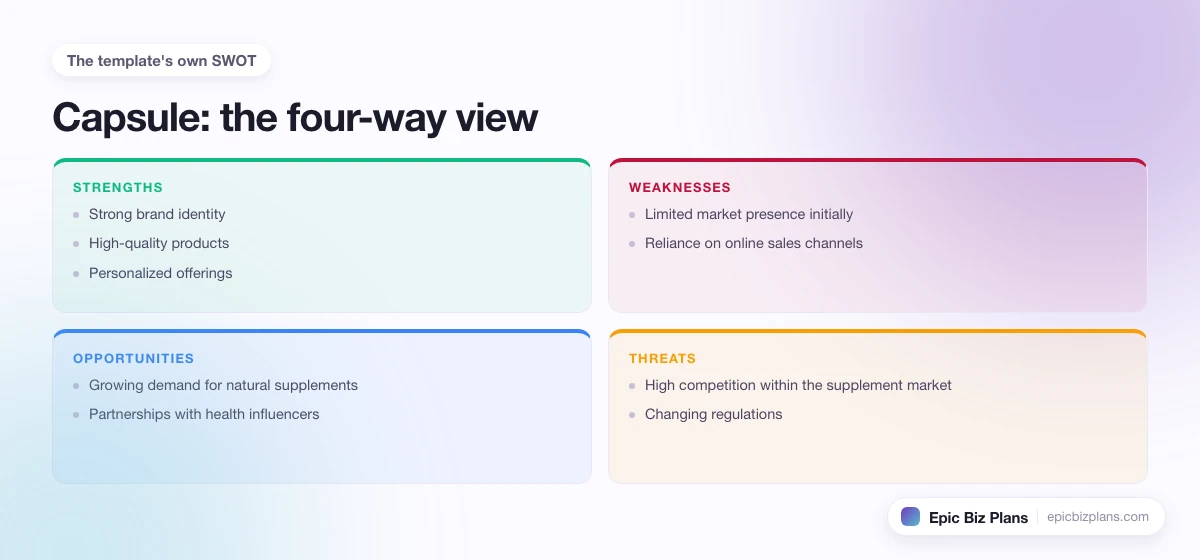
- Strengths: Strong brand identity, high-quality products, personalized offerings.
- Weaknesses: Limited market presence initially, reliance on online sales channels.
- Opportunities: Growing demand for natural supplements, partnerships with health influencers.
- Threats: High competition within the supplement market, changing regulations.
Capsule Business Name Ideas
Website
We will build on Shopify, which is the right choice for a product-based business with subscription components. Shopify's inventory management, payment processing, and subscription app integrations cover what we need without requiring custom development. The site design should emphasize ingredient transparency and the personalization angle, since those are the main reasons customers choose a brand like ours over a generic retailer.
Marketing Details
Our marketing plan combines SEO, email, and paid social. We will use SEMrush to identify high-intent search terms around supplement types and health goals, and build content that ranks for those queries. HubSpot will manage our email flows, including post-purchase sequences that encourage subscription upgrades. TikTok ads are particularly effective for this market because short-form video lets us show the product, explain the ingredients, and share customer results in under 60 seconds.
Industry Trends
The supplement industry is moving toward AI-driven personalization - some brands now offer quiz-based supplement regimens tailored to individual health data. This is the direction the market is heading, and getting a personalization framework in place early positions us ahead of competitors still selling static product lines. Transparency around sourcing and third-party testing is also increasingly expected by customers, not just appreciated.
Competitor Information
Established supplement brands have wide distribution and name recognition, but most offer generic formulations without meaningful customization. Local health stores compete on convenience but rarely match online pricing or selection. Our edge is the combination of personalized formulas and a direct relationship with the customer - something large brands struggle to replicate at scale.
Financial Information
Startup costs are estimated at $250,000, covering product development, branding, marketing, and initial inventory. We project $500,000 in revenue within the first two years. Ongoing expenses include production, marketing, and operations - all tracked against monthly P&L statements to stay on course. Cash flow management is critical in the supplement business because inventory purchase cycles often precede revenue by 60-90 days.
Legal and Compliance
Supplement businesses in the US operate under FDA oversight through the DSHEA framework - this means labeling requirements, manufacturing standards (GMP), and restrictions on health claims must all be addressed before products go to market. We will register as an LLC, work with a compliance attorney on labeling, and trademark our brand name and product line names early.
Operational Plan
Core operations include ingredient sourcing, contract manufacturing, order fulfillment, and customer support. We will build relationships with two or three contract manufacturers from the start to avoid single-source dependency. Our distribution will be direct-to-consumer initially, with third-party logistics handling warehousing and shipping as volume grows.
Contingency Planning
Supply chain disruptions and regulatory changes are the two most significant risks in this industry. We will maintain relationships with backup suppliers, keep 60 days of safety stock for our top-selling SKUs, and monitor FDA guidance for any changes that affect our product claims or formulations. Market competition is ongoing, so continuous product development and customer feedback loops are built into our quarterly planning cycle.
Additional Considerations for Supplement Brands
Customer acquisition cost in the supplement space is high, which means retention matters more than most founders expect. A customer who buys once and doesn't come back is often unprofitable. Building subscription models, loyalty programs, and re-engagement campaigns should be part of your plan from day one, not an afterthought added after you realize churn is eating your margins.
Third-party testing and certifications (NSF, Informed Sport, USP) add upfront cost but significantly improve conversion rates, especially for customers who have been burned by low-quality products before. Budget for at least one certification in your first year.
For related reading, see our natural supplements business plan template and nutrition business plan template for deeper guidance on product formulation strategy. The sport nutrition business plan template covers the athlete-focused market segment in more detail. If your capsule product line extends into broader wellness, the wellness centre business plan template has relevant frameworks for customer retention and programming. For the e-commerce execution side, the health business plan template provides a useful comparison model.
-
 SemrushSemrush is a platform with literally any online tool you will need to promote your business. Spy on your competitors, get search traffic, keyword research, social info, ad copies and much more. Used by most of the top online companies in the world. Besides all its tools, Semrush also has many available integrations possible with many other tools that will make your work even better.
 -
 Surfer SEOSurfer SEO is an incredibly smart AI tool that will give you exact explanations what to do in order to make your website rank better. They use hundreds of parameters, check your competitors and decide on the best course of action. Whether it be inner links, bold text, paragraphs, headers, images and much more. Surfer is a must-have in 2026.
Why Start a Capsule Supplement Business?
The supplement industry is large and growing, but it's also fragmented - most brands compete on price rather than differentiation. That creates real opportunity for a focused brand with a clear customer in mind. If you understand who you're serving and why your product is better for them specifically, you have a significant advantage over commodity players.
Adapting for Growth
As your business grows, revisit your plan regularly. New product lines, new target segments, and new distribution channels all require updates to your financial model and operational plan. A capsule supplement business that starts direct-to-consumer often finds wholesale and retail opportunities after 12-18 months - plan for that transition in advance rather than scrambling when the opportunity arrives.
Get Started
Your Capsule business plan is 100% free - with unlimited edits, unlimited downloads, and unlimited chances to refine it. Use it as a working document, not a one-time submission, and it will serve you well beyond your launch.
