
Cape Business Plan Template
-
 ShopifyPut your brand on Shopify. Launch your online store with tools designed for growth and success. Ready to turn your idea into profit? Start building your e-commerce business today.
 -
 SquarespaceShowcase your brand with Squarespace’s sleek designs. Build a professional online presence with ease. Start with a template that already looks finished.
 -
 WixBring your ideas to life with Wix. Customize every aspect of your site with unmatched flexibility. Start creating your unique online space and let your creativity shine.
 -
 ElementorCraft captivating websites effortlessly with Elementor. Enjoy complete creative control without coding. Make your site stand out to your audience. Start turning your vision into reality now.
- Executive Summary
- Business Info
- Business Model Overview
- SWOT Analysis
- Business Name Ideas
- Website
- Marketing Details
- Industry Trends
- Competitor Information
- Financial Information
- Legal and Compliance
- Operational Plan
- Contingency Planning
- Building a Cape Business That Serves Its Community
- Embrace Growth and Adaptability
- Take Action Today
Cape Town draws millions of visitors each year, and the tourism economy surrounding it generates consistent demand for quality travel accessories, local products, and visitor-focused services. A Cape business plan targeting this market needs to account for seasonal tourism patterns, the preferences of international versus domestic travelers, and the growing emphasis on locally sourced, sustainably produced goods. Getting those details right from the start puts you in a much stronger position than launching with a generic retail model.
This Cape business plan template focuses on a travel accessories venture serving tourists in Cape Town, but the framework applies broadly to any product or service business operating in a tourism-driven market. Adapt the financial projections, marketing channels, and operational details to fit your specific product category and customer base.
Executive Summary
We will establish a business providing premium travel accessories to tourists visiting Cape Town, with both an e-commerce platform and physical retail presence. Our mission is to improve every traveler's experience by offering practical, well-designed products that reflect the character of the Cape region. We aim to grow revenue by 20% annually over the first five years by combining direct-to-consumer online sales with strategic partnerships with local hotels and tour operators. Profitability is targeted within the second year of operation.
Business Info
We will offer a curated range of travel accessories including branded luggage tags, compact portable chargers, premium packing cubes, and locally designed travel pouches. Our target customers are domestic and international tourists, business travelers, and adventure seekers passing through Cape Town. Entrepreneurs considering broader African tourism markets should also review this South Africa business plan for regional market entry considerations and compliance requirements.
Business Model Overview
Our primary revenue channel is direct-to-consumer e-commerce, supplemented by a physical storefront in a high-foot-traffic tourist area. We will also develop wholesale relationships with local hotels and tour operators who gift accessories to their guests as part of premium packages.
SWOT Analysis
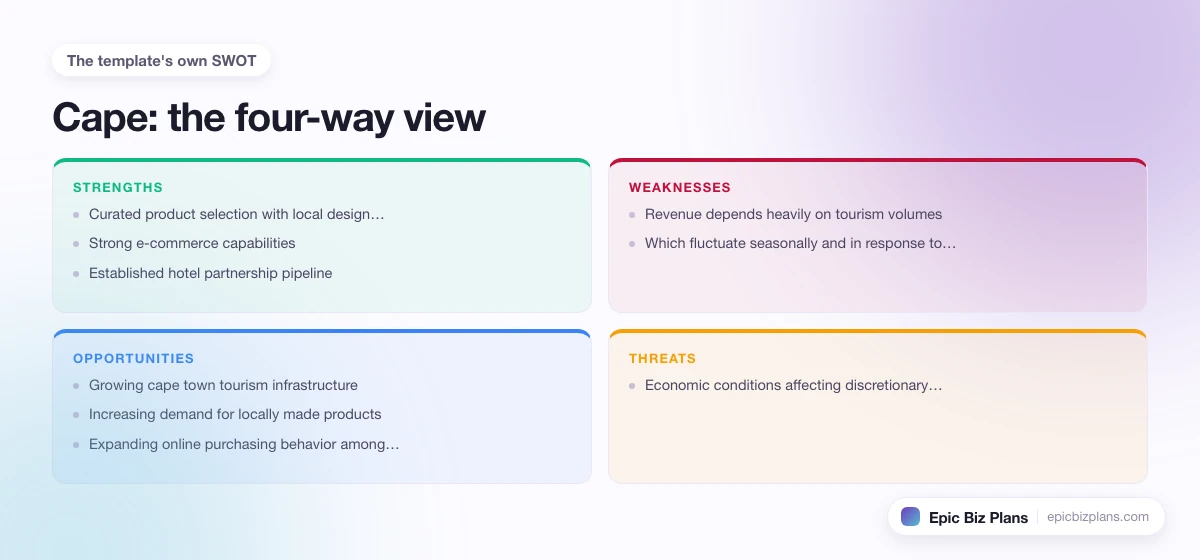
- Strengths: Curated product selection with local design character, strong e-commerce capabilities, and established hotel partnership pipeline.
- Weaknesses: Revenue depends heavily on tourism volumes, which fluctuate seasonally and in response to global events.
- Opportunities: Growing Cape Town tourism infrastructure, increasing demand for locally made products, and expanding online purchasing behavior among international travelers.
- Threats: Economic conditions affecting discretionary travel spending; competition from established international travel accessory brands available through airport retail.
Business Name Ideas
Website
We will build our primary sales channel on Shopify, which gives us robust inventory management, payment processing, and order tracking in a single platform. The site will feature destination-specific product guides, travel tips for Cape Town visitors, and a seamless mobile checkout experience designed for customers booking accessories before or during their trip. Product photography will emphasize local design influences and sustainable materials to resonate with environmentally conscious travelers.
Marketing Details
Our marketing strategy will lead with digital channels, starting with Semrush-driven SEO that targets searches from travelers planning Cape Town trips. Travel bloggers and Instagram accounts covering South African tourism will be engaged through a product seeding program. HubSpot will manage email sequences for customers who browse without purchasing, offering targeted follow-up content based on the product categories they viewed. TikTok campaigns will feature short-form videos showing product use in Cape Town locations to drive both brand awareness and purchase intent.
Industry Trends
The travel accessories market is shifting toward sustainable materials - recycled fabrics, biodegradable packaging, and products built to last rather than be discarded after a single trip. Smart accessories with embedded technology, like luggage trackers and solar charging pouches, are growing in demand among frequent travelers. Companies selling to tourism-dependent markets should also consider how a travel and tourism business plan can help structure partnerships with accommodation providers and tour operators. Local and artisanal products command premium pricing when presented with clear provenance stories.
Competitor Information
Our main competitors include international travel brands available through airport retail and online marketplaces, as well as local souvenir shops carrying lower-quality impulse purchases. We differentiate by occupying the middle ground - locally designed, quality-built products at prices that reflect craftsmanship without being prohibitive for budget-conscious travelers. Building relationships with hotel concierges and tour operators will give us a distribution channel that competitors cannot easily replicate.
Financial Information
We estimate startup costs at approximately ,000, covering initial inventory, website development, physical retail setup in a tourist area, and six months of marketing spend. First-year revenue is projected at ,000, growing steadily as our hotel partnerships develop and online search rankings improve. Ongoing monthly expenses include product procurement, rent, staff, and digital marketing. We will track cash flow weekly during the first year to manage seasonal revenue peaks and troughs effectively.
Legal and Compliance
We will register the business under South African company law and obtain all required retail trading licenses for our physical location. Any locally produced products will be sourced from verified manufacturers to ensure compliance with consumer safety standards. Brand trademarks and unique product designs will be protected through the appropriate intellectual property registrations.
Operational Plan
Operations center on three areas: product sourcing, retail management, and fulfillment for online orders. We will build relationships with multiple suppliers to avoid single-source dependency, particularly for our core high-velocity products. The physical store will be staffed with team members who are knowledgeable about Cape Town destinations and can make relevant product recommendations. Online orders will be fulfilled from a back-of-store warehouse, with a target of same-day dispatch for in-stock items.
Contingency Planning
Tourism disruptions - whether from global events, political instability, or natural factors - pose the primary revenue risk. We will maintain six months of operating reserves and develop a direct-to-consumer online channel that can generate revenue independent of physical foot traffic. Expanding our product range to serve local South African customers, not just tourists, will further diversify our revenue base.
Building a Cape Business That Serves Its Community
Tourism markets reward businesses that genuinely understand their customers. Travelers spend money when they trust that what they're buying has real value - functionally, aesthetically, or as a connection to the place they're visiting. Build that trust through product quality, honest pricing, and service that makes the purchase feel worthwhile, and your repeat customer rate and referrals will grow steadily.
Embrace Growth and Adaptability
As your Cape business develops, pay attention to which products sell best, which customer segments return most often, and which hotel and tour operator partners send the most referrals. Those data points should drive your inventory decisions, partnership investment, and marketing spend. Businesses that also serve the travel luggage market often find natural upsell opportunities with accessory-focused retailers like ours, making cross-referral partnerships worth exploring early.
-
 SemrushSemrush is a platform with literally any online tool you will need to promote your business. Spy on your competitors, get search traffic, keyword research, social info, ad copies and much more. Used by most of the top online companies in the world. Besides all its tools, Semrush also has many available integrations possible with many other tools that will make your work even better.
 -
 Surfer SEOSurfer SEO is an incredibly smart AI tool that will give you exact explanations what to do in order to make your website rank better. They use hundreds of parameters, check your competitors and decide on the best course of action. Whether it be inner links, bold text, paragraphs, headers, images and much more. Surfer is a must-have in 2026.
Take Action Today
Your Cape business plan is a working document, not a finished product. Revisit it quarterly during the first year to update your financial projections, refine your marketing approach, and capture lessons from customer feedback. Each iteration makes the plan more useful and your business more focused.
Your Cape business plan is 100% free - with unlimited edits, unlimited downloads, and unlimited chances to get it right. The future is bright; seize it.
