
Canopy Business Plan Template
-
 ShopifyPut your brand on Shopify. Launch your online store with tools designed for growth and success. Ready to turn your idea into profit? Start building your e-commerce business today.
 -
 SquarespaceShowcase your brand with Squarespace’s sleek designs. Build a professional online presence with ease. Start with a template that already looks finished.
 -
 WixBring your ideas to life with Wix. Customize every aspect of your site with unmatched flexibility. Start creating your unique online space and let your creativity shine.
 -
 ElementorCraft captivating websites effortlessly with Elementor. Enjoy complete creative control without coding. Make your site stand out to your audience. Start turning your vision into reality now.
- Executive Summary
- Business Info
- SWOT Analysis
- Canopy Business Name Ideas
- Website
- Marketing Details
- Industry Trends
- Competitor Information
- Financial Information
- Legal and Compliance
- Operational Plan
- Contingency Planning
- Installation Partnerships and Service Add-ons
- Seasonality and Demand Planning
- Your Vision, Your Canopy Business Plan
- Embrace Growth and Flexibility
- Real-World Applications
- Start Your process Today
A clear Canopy business plan helps you turn outdoor shelter and shade products into a working brand customers can find and trust. The market for canopies, awnings, and outdoor structures keeps growing as more homeowners invest in patios, backyards, and event spaces. Your plan should describe the product range, target buyer, sourcing approach, and the channels you will use to reach them. It should also account for installation, warranty support, and seasonal demand patterns.
This template walks through every section so you can finish a working draft in one sitting. Whether you sell pop-up event canopies, fixed patio shades, or full custom installations, the framework below applies. Adjust the details to match your category, but keep the structure intact.
Executive Summary
Our mission is to create a platform that connects people with outdoor living, offering eco-friendly canopy products and related services that promote sustainable use of outdoor space. Our vision is to lead in environmentally responsible outdoor structures, providing resources that educate buyers and help them make better long-term choices. Our value proposition rests on quality materials, fair pricing, and a buying experience that earns repeat customers. Our financial goals include profitability within the first two years and a revenue milestone of $500,000 by the end of year three.
Business Info
We will offer a range of canopy and outdoor shelter products, including pop-up canopies, fixed patio shades, and custom event structures. Operators focused mainly on shading can also review our shade business plan template. Businesses adding full tents to that lineup can review our tent house business plan. Our target market includes homeowners with patios, event planners, small commercial properties, and outdoor recreation customers. Our model is direct-to-consumer ecommerce with optional installation partners, which keeps overhead low and margins healthy. Adjacent categories such as tent products share similar suppliers and audiences.
SWOT Analysis
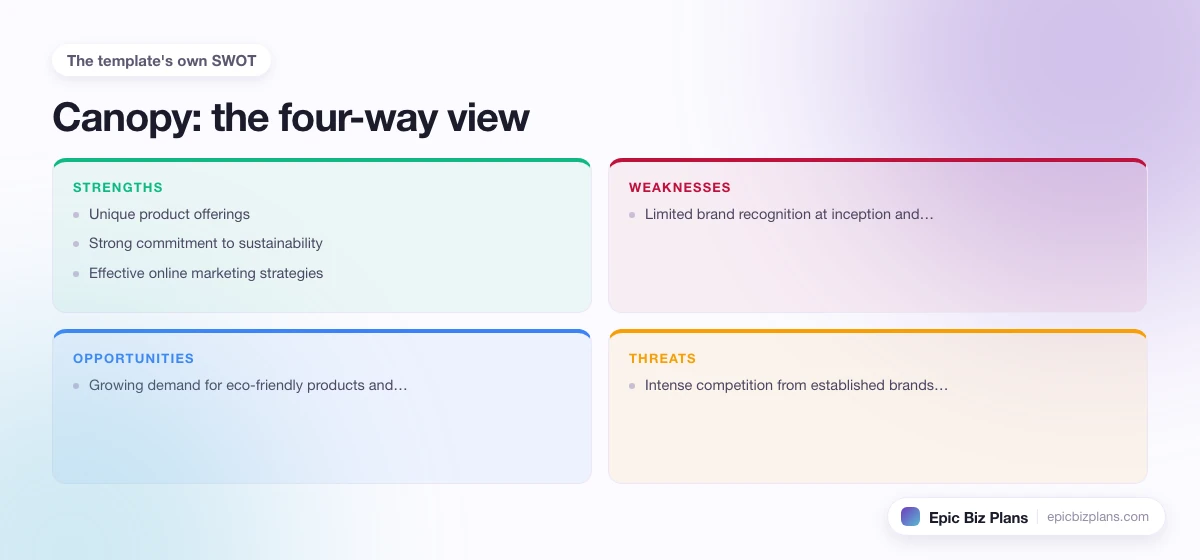
- Strengths: Unique product offerings, strong commitment to sustainability, and effective online marketing strategies.
- Weaknesses: Limited brand recognition at inception and reliance on online sales.
- Opportunities: Growing demand for eco-friendly products and increased consumer awareness about sustainability.
- Threats: Intense competition from established brands and changing regulations in sustainability practices.
Canopy Business Name Ideas
Website
We will build the website on Shopify because it pairs strong ecommerce features with simple product configuration tools. Shopify supports the variant logic needed for canopy sizes, fabrics, and frame materials. We may also pair Shopify with a Squarespace landing page for design-led campaigns and lookbooks. Inspiration from a related garden center plan can guide our seasonal merchandising calendar.
Marketing Details
Our marketing plan combines digital marketing, social engagement, and partnerships with installers and event planners. Semrush will guide SEO so we rank for terms like "10x10 canopy" and "patio shade installation." HubSpot will manage email campaigns aimed at past inquiries and customer renewals. Short-form video on TikTok and Instagram Reels will showcase setup time, durability tests, and real backyard installs.
Industry Trends
The outdoor product industry continues to grow as homeowners invest in patios, backyards, and outdoor entertainment areas. Buyers increasingly prefer products with sustainable materials, longer warranties, and clear care instructions. Customization, including printed canopies for events and branded structures for businesses, is also growing as a service line. Our roadmap reflects these shifts with a clear materials policy and an optional custom-print service.
Competitor Information
Our main competitors include other canopy and outdoor shelter brands selling online and through big-box retailers. We will stand out through better materials, clear sizing guides, strong product photography, and post-purchase support that includes setup videos and replacement part availability. Indirect competitors include traditional retailers selling lower-cost units; we will compete on durability and warranty rather than price alone.
Financial Information
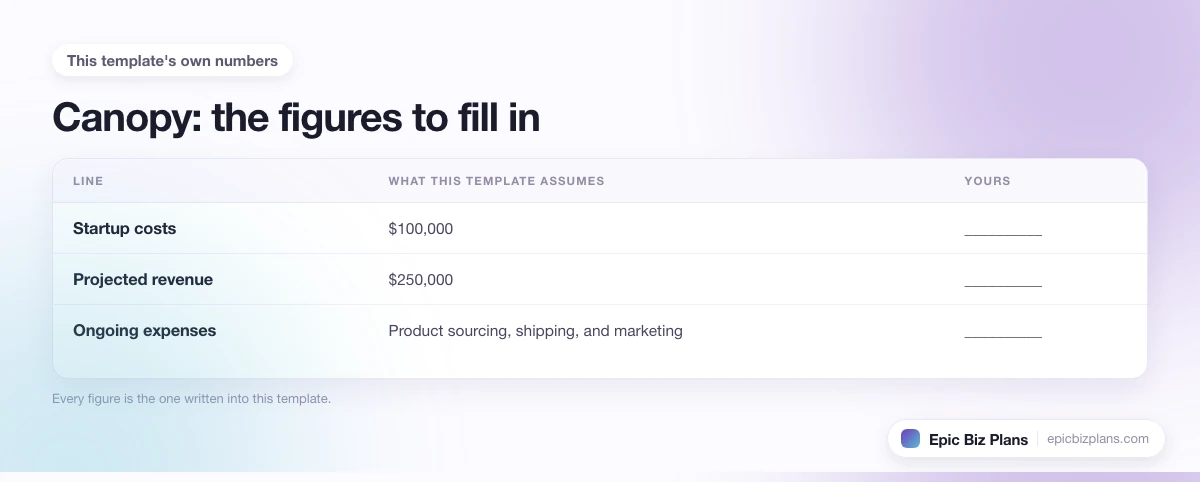
Initial startup costs are projected at about $100,000, covering inventory, website development, and marketing. We expect first-year revenue around $250,000, growing to $500,000 by the end of year three. Ongoing expenses cover product sourcing, shipping, and marketing, with cash flow tracked against inventory turnover and seasonal sales patterns. A detailed P&L statement will be developed as the business grows.
Legal and Compliance
We will meet all legal requirements, including business registration, sales tax setup, and product safety standards for outdoor structures. Trademarking the brand name and logo will protect our identity in the marketplace. We will also stay on top of any regulations regarding outdoor structures, fire-retardant fabrics, and event canopy permits.
Operational Plan
Day-to-day operations cover sourcing canopy products from vetted suppliers, maintaining a reliable supply chain, and running efficient logistics. Partnerships with shipping carriers experienced in oversized parcel delivery will keep delivery times consistent. Returns and replacement parts will be handled through a dedicated support email and a self-serve parts portal.
Contingency Planning
Risks include shifts in consumer preferences, supply chain disruptions, and seasonal demand swings. To address these, we will work with multiple suppliers, hold a cash reserve covering three months of operating costs, and run quarterly market research to spot category shifts early. Pre-season order programs with key suppliers will lock in pricing and capacity before peak demand.
Installation Partnerships and Service Add-ons
Adding a service layer on top of canopy products lifts both revenue per customer and overall satisfaction. We will recruit a network of vetted installers in our top metros, paid on a fixed per-job rate with quality bonuses. Service add-ons such as anchoring kits, weighted bases, and printed graphics will be offered at checkout with simple visual options. Each install will end with a five-minute care walkthrough so customers know how to extend product life.
Seasonality and Demand Planning
Canopy sales follow strong seasonal patterns, with most demand falling between March and August in the northern hemisphere. We will build a 12-month inventory plan that brings stock levels up by mid-February and winds them down by late September. Off-season months will focus on commercial accounts, event rental companies, and southern-state retail. Cash reserves will be sized to cover 90 days of operating costs through the slow winter months.
Your Vision, Your Canopy Business Plan
Building a business that aligns with your interests and skills is a process that rewards careful planning. The canopy niche has many entry points, whether you start with a small selection of pop-up units, an event-rental sideline, or a full custom-installation service. Each path holds real potential when paired with the right product mix and marketing.
-
 SemrushSemrush is a platform with literally any online tool you will need to promote your business. Spy on your competitors, get search traffic, keyword research, social info, ad copies and much more. Used by most of the top online companies in the world. Besides all its tools, Semrush also has many available integrations possible with many other tools that will make your work even better.
 -
 Surfer SEOSurfer SEO is an incredibly smart AI tool that will give you exact explanations what to do in order to make your website rank better. They use hundreds of parameters, check your competitors and decide on the best course of action. Whether it be inner links, bold text, paragraphs, headers, images and much more. Surfer is a must-have in 2026.
Embrace Growth and Flexibility
Your canopy business plan is a living document that should change as your business grows. As you expand your audience, test new pricing, or add product lines, revisit and update the plan. Tailoring strategy to fit different regions and sales channels will strengthen your competitive position.
Real-World Applications
Treat your canopy business plan as a working tool rather than a paper exercise. Use it when presenting to partners, planning a launch, securing funding, or clarifying strategy with new hires. A clear plan keeps everyone on the same page through busy seasons. Many founders pair this template with a focused home and garden plan when adding adjacent categories.
Start Your process Today
Your Canopy business plan is 100% free - with unlimited edits, unlimited downloads, and unlimited chances to get it right. Use this resource to turn your idea into a working brand and revisit it as the business grows.
