
Canada Immigration Business Plan Template
-
 ShopifyPut your brand on Shopify. Launch your online store with tools designed for growth and success. Ready to turn your idea into profit? Start building your e-commerce business today.
-
 SquarespaceShowcase your brand with Squarespace’s sleek designs. Build a professional online presence with ease. Start with a template that already looks finished.
-
 WixBring your ideas to life with Wix. Customize every aspect of your site with unmatched flexibility. Start creating your unique online space and let your creativity shine.
-
 ElementorCraft captivating websites effortlessly with Elementor. Enjoy complete creative control without coding. Make your site stand out to your audience. Start turning your vision into reality now.
- Executive Summary
- Business Info
- Business Model Overview
- SWOT Analysis
- Business Name Ideas
- What the Levels Plan Means for Your Client Pipeline
- Website
- Licensing: What It Costs and What Changed in July 2026
- Marketing Details
- Industry Trends
- Competitor Information
- Financial Information
- Legal and Compliance
- Operational Plan
- Contingency Planning
- Building a Consultancy on Expertise, Not Promises
- The Range of Service Models in This Space
- Keeping Your Plan Current
- Use Your Plan Strategically
Canada remains one of the most sought-after immigration destinations in the world, with structured programs for skilled workers, international students, family reunification, and business investment. Your Canada Immigration business plan needs to show that you understand both the regulatory environment you will be operating in and the specific clients you are positioned to serve. This is a compliance-heavy industry where credibility and accuracy matter more than marketing language.
Whether you are building a boutique consultancy focused on a single visa stream or a full-service firm handling multiple pathways, your plan needs to define your service scope clearly, document your compliance approach, and outline a realistic path to sustainable revenue. Two things have changed recently enough that most templates in this category are now out of date: the number of people Canada intends to admit, and the rules governing the people who advise them.
Executive Summary
We will provide immigration consulting services to individuals and families seeking to migrate to Canada. Our mission is to simplify the immigration process through accurate guidance, personalized service, and efficient application management. We aim to become a trusted consultancy that clients recommend because we actually help them succeed, not because we make the process sound simpler than it is. Our value proposition is built on deep knowledge of Canadian immigration law, transparent communication, and a track record of successful submissions. We are targeting breakeven within year one with a 25% annual increase in our client base in subsequent years. Businesses providing adjacent legal support services should also review an immigration consulting business plan for comparable service model and compliance frameworks.
Business Info
Our services include immigration eligibility assessments, application preparation and review, legal documentation assistance, and settlement support for clients after arrival. Our target market includes skilled professionals, international students transitioning to permanent residency, and families pursuing reunification pathways, primarily from regions with high historical immigration rates to Canada. Founders setting up alongside clients moving here can also reference our Canadian business plan template.
Business Model Overview
We operate on a fee-for-service model, with clients paying for specific services rendered based on the complexity of their case. We will also explore retainer arrangements for clients requiring ongoing support through multi-stage processes. Primary revenue comes from consultation engagements and application submissions.
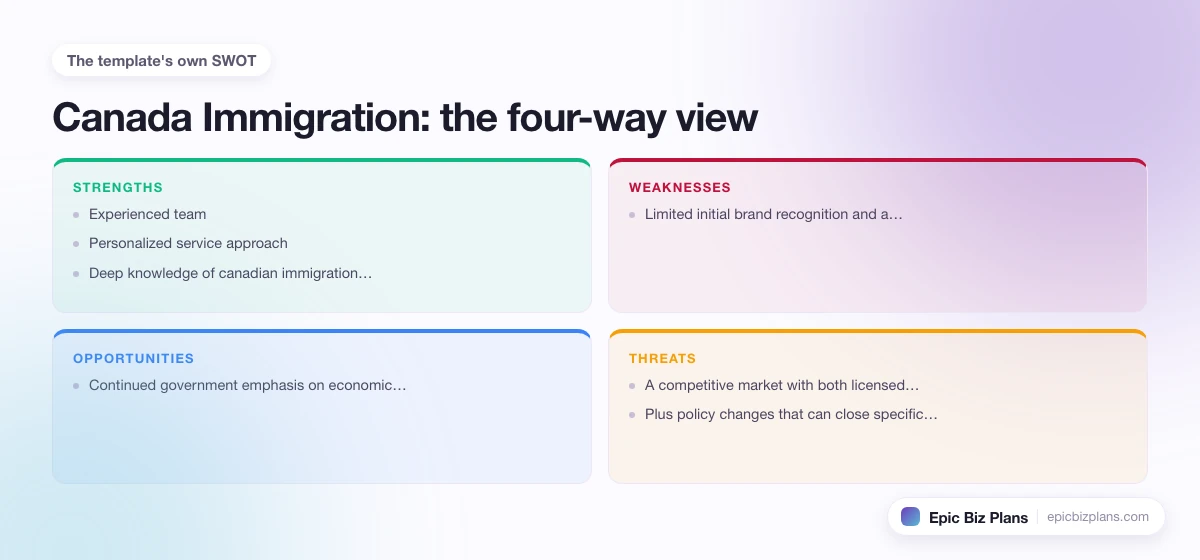
SWOT Analysis
- Strengths: Experienced team, personalized service approach, and deep knowledge of Canadian immigration regulations.
- Weaknesses: Limited initial brand recognition and a business model that is sensitive to regulatory and policy change.
- Opportunities: Continued government emphasis on economic immigration and a large in-Canada population of temporary residents seeking permanent status.
- Threats: A competitive market with both licensed consultants and law firms pursuing the same clients, plus policy changes that can close specific streams with little notice.
Business Name Ideas
- Maple Leaf Immigration Solutions
- True North Immigration Consultancy
- Canada Dream Migration Services
- Great White North Immigration Advisors
- New Horizons Immigration Assistance
- Canuck Immigration Consulting
- Pathway to Canada Immigration Services
- Immigrate Smart Canada
- Home to Canada Immigration Solutions
- Canada Gateway Immigration Services
What the Levels Plan Means for Your Client Pipeline
A consultancy's addressable market is set by federal admission targets, so build the plan around the published numbers rather than around the assumption that demand only grows. Under the 2026 to 2028 Immigration Levels Plan, permanent resident admissions stabilise at 380,000 a year through 2028. The economic category accounts for 64% of admissions in 2027 and 2028, refugee programmes about 13%, and family reunification between 21.3% and 22.1%.
The sharper change is on the temporary side. New temporary resident arrivals fall to 385,000 in 2026 and 370,000 in both 2027 and 2028, with a stated goal of reducing the temporary resident population below 5% of the total by the end of 2027. Set against that, two one-time measures create concentrated near-term demand: a simplified permanent residence route for 115,000 protected persons already in Canada, and a targeted transition of up to 33,000 temporary workers to permanent status across 2026 and 2027.
Three planning conclusions follow. First, economic streams are where the volume is and where a specialist should build depth. Second, the in-Canada transition market, people already here moving from temporary to permanent status, is growing while new temporary arrivals shrink, which argues for positioning toward that client rather than toward overseas study permit applicants. Third, a study-permit-heavy practice is building on a declining base, and the plan should say so rather than project growth into it.
Website
We will build our website on Wix for ease of maintenance and clean, professional templates suited to a service business that needs to project credibility. The site will include clear service descriptions, eligibility guides for each major stream, client testimonials, and a straightforward consultation booking system. Content will be optimized for search terms prospective clients actually use: program names, eligibility requirements, and country-specific pathways. Search demand here is narrow and high-intent rather than broad, with "immigration consultant canada" running about 1,300 US searches a month and "rcic canada" around 260, at advertiser bids of $2 to $9. That means content depth on specific programmes beats volume, and every page should carry our registration number visibly.
Licensing: What It Costs and What Changed in July 2026
Anyone who represents or advises a client for a fee in connection with a Canadian immigration application must be authorised, which in practice means a lawyer, a Quebec notary, or a consultant licensed by the College of Immigration and Citizenship Consultants. Operating outside that is the offence commonly called ghost consulting, and it is the single largest reputational problem in this industry.
Budget the licence as a permanent operating cost rather than a startup fee. Annual licence renewal runs approximately $1,809.25 plus tax, payable annually or quarterly. Licensees must pass the Entry-to-Practice Exam, hold professional liability insurance continuously, complete mandatory practice management education, and log 16 hours of continuing professional development every year. A licensee who causes an error or omission that prejudices a client and cannot be readily corrected must promptly inform the client, their insurer, and the Registrar, which is a disclosure obligation with no discretion in it.
New College regulations registered in April 2026 took effect on 15 July 2026, and they change the risk profile of the business. They establish a compensation fund for clients defrauded by their consultants, funded from monetary penalties ordered by the Discipline Committee, from licensee contributions collected within annual fees, and from amounts recovered from licensees and insurers. They expand the College's authority to investigate and discipline misconduct, and they raise the maximum monetary penalty for professional misconduct or incompetence to $50,000. One register provision phases in a year later.
Two consequences belong in the financial plan. Your annual licence cost now includes a contribution to that fund, so treat the published figure as a floor that the College can adjust through its by-laws. And file discipline exposure as a genuine business risk with a $50,000 ceiling attached, which is an argument for a documented file review process rather than for hoping.
Marketing Details
Organic search is our primary acquisition channel, because people searching for immigration guidance are actively looking for help and that traffic converts. We will identify keyword opportunities across specific visa programs and eligibility questions, and publish genuinely useful eligibility content rather than thin service pages. Email campaigns provide clients and prospects with updates on policy changes and new program announcements, which in this market is a retention tool as much as an acquisition one, since a client whose stream closes needs to hear it from us first.
Advertising carries constraints other professions do not face. Client communications must accurately represent the scope of our services and must not overstate success rates or guarantee outcomes that depend on a government decision, and the College's conduct rules apply to marketing as much as to advice. Every campaign is reviewed against that standard before it runs.
-
 SemrushSemrush is a platform with literally any online tool you will need to promote your business. Spy on your competitors, get search traffic, keyword research, social info, ad copies and much more. Used by most of the top online companies in the world. Besides all its tools, Semrush also has many available integrations possible with many other tools that will make your work even better.
-
 Surfer SEOSurfer SEO is an incredibly smart AI tool that will give you exact explanations what to do in order to make your website rank better. They use hundreds of parameters, check your competitors and decide on the best course of action. Whether it be inner links, bold text, paragraphs, headers, images and much more. Surfer is a must-have in 2026.
Industry Trends
Technology is changing how immigration services are delivered. Virtual consultations are standard, and assisted eligibility assessment tools reduce the time required for initial client screening. Automated application tracking gives clients real-time visibility into case status, which improves satisfaction and reduces support volume. Firms that invest in these tools now build operational advantages that compound. Consultancies expanding into broader settlement services should also reference a strategy consulting business plan for service packaging and client retention frameworks.
Competitor Information
The Canadian immigration consulting market includes licensed consultants, immigration lawyers, and large multi-service firms operating nationally. Competition for specific visa streams is intense, since most consultancies position around the same Express Entry and Provincial Nominee pathways. Our differentiation comes from personalized service and genuine expertise in a chosen specialization. Rather than handling every program at a generalist level, we will build deep credibility in specific pathways where we can demonstrate consistent results. If you are planning a venture on Canada's west coast, our Vancouver business plan template offers a city-specific starting point.
Financial Information
Startup costs cover business registration, professional licensing, professional liability insurance, practice management software, website development, and initial marketing. Licensing and insurance are recurring rather than one-time, and at roughly $1,809 a year in licence fees plus insurance premiums and 16 hours of continuing education, the compliance floor is a fixed cost that exists before a single client pays.
Revenue builds through referrals and organic search, both of which have long but valuable payback periods for a service business. We project breakeven in year one and 25% annual client growth thereafter. Cash flow needs particular attention because case timelines are long: a client who signs in March may not complete until the following year, and staged fee schedules tied to defined milestones are what keep revenue recognition aligned with work performed. Cash flow will be monitored monthly, with profit and loss statements reviewed quarterly.
Legal and Compliance
Operating as an immigration consultant in Canada requires a licence from the College of Immigration and Citizenship Consultants for anyone representing clients before Immigration, Refugees and Citizenship Canada. We will ensure all staff providing regulated immigration advice hold current credentials, and that unlicensed staff are restricted to administrative work with a written scope that makes the boundary explicit.
Beyond licensing, three obligations shape day-to-day operations. Client funds held in advance belong in a separate account and cannot be treated as revenue until the work is done. File records must be retained and be capable of reconstructing the advice given, because that file is the defence in any complaint. And retainer agreements must set out fees, scope, and what happens on withdrawal in terms a client with limited English can understand, which in practice means offering the agreement in the client's language wherever possible.
Operational Plan
Core operations center on client intake, eligibility assessment, application preparation, and ongoing case management. We will use secure document management to handle sensitive client information, with clear protocols for data protection. Quality review is built into the application preparation workflow to reduce errors and improve first-pass approval rates, with a second licensee reviewing every submission before filing. Given the disclosure obligation and the penalty ceiling described above, that second review is a compliance control, not an efficiency measure.
Contingency Planning
Policy change is our primary operational risk, since new programs can create sudden demand surges while restrictions can close pathways clients are relying on. We will monitor announcements closely and communicate proactively with clients when changes affect their cases. Diversifying across multiple streams reduces dependency on any single program's continued availability, and the levels plan above makes the specific direction of that diversification clear: weight the practice toward economic and in-Canada transition work rather than toward new temporary resident arrivals.
Building a Consultancy on Expertise, Not Promises
The immigration consulting industry has a real problem with firms that overpromise and underdeliver. Clients are making life-changing decisions and trusting consultants to guide them accurately. A business that builds its reputation on honest assessment, clear communication, and genuine expertise will consistently outperform competitors relying on claims they cannot substantiate. The 2026 regulations, with their compensation fund and higher penalties, make that the commercially safer position as well as the right one.
The Range of Service Models in This Space
Immigration consultancies operate across a wide range of formats, from solo consultants handling a focused client load to multi-advisor firms serving specific diaspora communities, educational institutions, or corporate immigration needs. Each model has different staffing requirements, compliance obligations, and revenue potential. Your plan should reflect a clear decision about which model fits your expertise and capital situation. Consultancies whose clients also need document translation can compare that adjacent service in the translation business plan template.
-
ShopifyPut your brand on Shopify. Launch your online store with tools designed for growth and success. Ready to turn your idea into profit? Start building your e-commerce business today.
-
SquarespaceShowcase your brand with Squarespace’s sleek designs. Build a professional online presence with ease. Start with a template that already looks finished.
-
WixBring your ideas to life with Wix. Customize every aspect of your site with unmatched flexibility. Start creating your unique online space and let your creativity shine.
-
ElementorCraft captivating websites effortlessly with Elementor. Enjoy complete creative control without coding. Make your site stand out to your audience. Start turning your vision into reality now.
Keeping Your Plan Current
Canadian immigration policy changes regularly, and program caps, processing times, and eligibility criteria all affect your business model. Your business plan should be reviewed at least annually, and immediately whenever a levels plan or a College by-law changes something you have budgeted against.
Use Your Plan Strategically
Present this plan to professional licensing bodies, potential business partners, or investors interested in the immigration services market. A well-documented plan that demonstrates regulatory awareness and a realistic client acquisition strategy builds confidence with everyone evaluating your operation.
Your Canada Immigration business plan is 100% free, with unlimited edits, unlimited downloads, and unlimited chances to get it right. Start with the programs you know best and build your reputation from there.
