
Calibration Business Plan Template
-
 ShopifyPut your brand on Shopify. Launch your online store with tools designed for growth and success. Ready to turn your idea into profit? Start building your e-commerce business today.
 -
 SquarespaceShowcase your brand with Squarespace’s sleek designs. Build a professional online presence with ease. Start with a template that already looks finished.
 -
 WixBring your ideas to life with Wix. Customize every aspect of your site with unmatched flexibility. Start creating your unique online space and let your creativity shine.
 -
 ElementorCraft captivating websites effortlessly with Elementor. Enjoy complete creative control without coding. Make your site stand out to your audience. Start turning your vision into reality now.
- Executive Summary
- Business Info
- Products and Services
- Target Market
- Business Model Overview
- SWOT Analysis
- Calibration Business Name Ideas
- Website
- Marketing Details
- Industry Trends
- Competitor Information
- Financial Information
- Legal and Compliance
- Operational Plan
- Quality Control and Traceability
- Contingency Planning
- Your process Begins Here
- Types of Businesses in Calibration
- Update Your Calibration Business Plan
- Practical Uses for Your Plan
- Your Future Awaits
Creating your calibration business plan is the first real step toward building a precision-focused service company. The calibration industry runs on accuracy, traceability, and tight tolerances, and clients depend on it to keep their instruments compliant. This plan is more than a set of guidelines; it sets out how your business will earn trust in a market where small measurement errors carry real cost.
A detailed calibration business plan helps you position your company against established labs and in-house calibration departments. It should spell out what makes your service distinct while addressing the specific accuracy and turnaround needs of your clients. As you build it, keep three things front of mind: technical credibility, scheduling discipline, and the ability to adapt as standards change.
Executive Summary
Our mission is to provide precise calibration services to a range of industries, keeping their equipment accurate and compliant with recognized standards. Our vision is to become a trusted regional provider known for measurement accuracy, dependable turnaround, and strong customer service. We will calibrate instruments and equipment across sectors, tailoring each service package to the client's tolerance and documentation requirements.
Our value proposition rests on quality, fast turnaround, and traceable results clients can audit. We aim to win a meaningful share of our regional market within the first three years, with a clear focus on repeat service contracts and steady, profitable growth.
Business Info
Products and Services
We will calibrate a wide range of equipment, including measurement devices, laboratory instruments, and manufacturing machinery. Our services will cover sectors such as healthcare, manufacturing, and construction, which makes us a flexible provider across very different accuracy requirements. Each job ships with a calibration certificate that records the standards used and the results obtained.
Target Market
Our primary target market includes businesses in manufacturing, laboratories, healthcare, and construction. We will focus on small to medium-sized enterprises that need reliable calibration to keep operations efficient and stay compliant with regulations. These clients rarely have the volume to justify an in-house metrology lab, which is exactly where an outside service fits. Companies running their own equipment fleets often pair calibration with an equipment repair service to keep tools both accurate and operational.
Business Model Overview
We will operate on a service-based model, earning revenue through service contracts, one-time calibration requests, and subscription plans for scheduled maintenance. Our pricing will stay competitive while reflecting the value of accurate, certified results. Recurring contracts give us predictable revenue and keep clients on a regular recalibration cycle.
SWOT Analysis
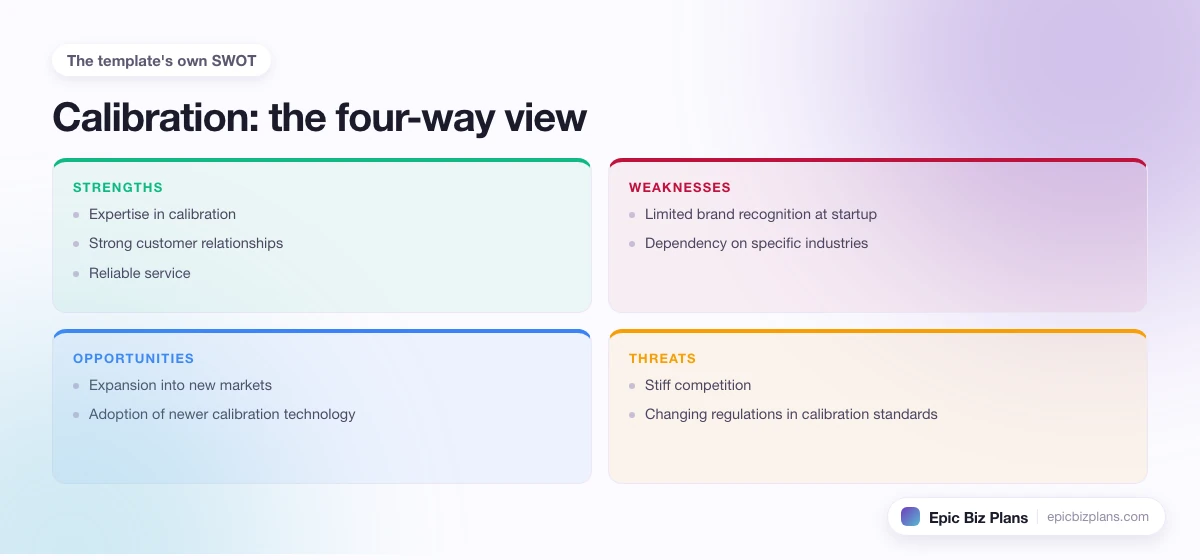
- Strengths: Expertise in calibration, strong customer relationships, and reliable service.
- Weaknesses: Limited brand recognition at startup, dependency on specific industries.
- Opportunities: Expansion into new markets, adoption of newer calibration technology.
- Threats: Stiff competition, changing regulations in calibration standards.
Calibration Business Name Ideas
Website
We will build our website using Shopify, since it handles service bookings and online inquiries well. The site will let clients request quotes, schedule pickups, and track calibration status. We will also consider Squarespace for its clean design and ease of use. Either way, the goal is a clear, professional site that showcases our certifications and makes it simple for prospects to get in touch.
Marketing Details
Our marketing will focus on digital efforts aimed at building awareness among technical buyers and generating qualified leads. We will use SEO with Semrush to improve our search visibility for calibration and metrology terms. We will also run targeted email campaigns through HubSpot to stay in front of prospects and keep existing clients on their recalibration schedule.
For social media, we will run focused ads aimed at procurement and quality managers in industries where calibration is critical. These ads will explain our turnaround times and the compliance risk of skipping scheduled calibration. Trade-specific content and case studies will carry more weight here than broad consumer messaging.
Industry Trends
Automation and smart instruments are reshaping how calibration work gets done, with more devices reporting their own drift between service intervals. The push for tighter accuracy keeps driving investment in better reference standards and software. Environmental and safety regulations are also influencing calibration practices, with growing attention to documentation and sustainability. Shops that move toward industrial automation often need calibration partners who can keep pace with sensor-heavy equipment.
Competitor Information
Our main competitors include established calibration firms, while indirect competition comes from the in-house calibration departments of larger companies. We will stand out through responsive service, fast turnaround, and certificates that hold up to audit. For clients in regulated fields, our documentation and traceability will be a clear point of difference.
Financial Information
We will outline startup costs, including reference standards, calibration equipment, initial marketing, and overhead. Projected revenue will be based on estimated service demand and our pricing structure.
We will track ongoing expenses such as labor, consumables, and the recalibration of our own reference equipment. Keeping a positive cash flow will be critical for stability and growth, and we will produce regular profit-and-loss statements to monitor financial health.
Legal and Compliance
Legal requirements will include business registration, the permits needed to operate, and compliance with the calibration standards relevant to each client's industry. Accreditation to a recognized standard such as ISO/IEC 17025 will be a priority, since many clients require it. We will also protect our proprietary calibration procedures and methodologies.
-
 SemrushSemrush is a platform with literally any online tool you will need to promote your business. Spy on your competitors, get search traffic, keyword research, social info, ad copies and much more. Used by most of the top online companies in the world. Besides all its tools, Semrush also has many available integrations possible with many other tools that will make your work even better.
 -
 Surfer SEOSurfer SEO is an incredibly smart AI tool that will give you exact explanations what to do in order to make your website rank better. They use hundreds of parameters, check your competitors and decide on the best course of action. Whether it be inner links, bold text, paragraphs, headers, images and much more. Surfer is a must-have in 2026.
Operational Plan
Key operations will cover service scheduling, equipment setup, calibration procedures, and quality checks. Our supply chain will be organized to ensure timely access to reference standards and tools, and we will keep our own equipment on a strict recalibration cycle. On-site logistics and clear communication will be central to client satisfaction.
Quality Control and Traceability
Every calibration we perform will trace back to national or international measurement standards, with records kept for each instrument we service. We will maintain calibration intervals, uncertainty budgets, and an audit trail that clients can request at any time. This level of documentation protects clients during inspections and supports the kind of inspection and testing work that quality programs depend on. Clear traceability is what separates a credible calibration provider from a general repair shop.
Contingency Planning
We will develop contingency plans for risks such as equipment failures, regulatory changes, or economic slowdowns. Having backup reference standards and a rapid-response plan will help us limit disruption and keep service running. A clear escalation process means clients are never left waiting when something goes wrong.
Your process Begins Here
Launching a calibration business is about more than numbers and specifications. It is about building a reputation for accuracy and earning a place as the partner clients call when measurements have to be right. Whether you are drawn to industrial calibration for heavy machinery or precision work on lab and electronic instruments, this path rewards discipline and technical depth. You can build a local service for nearby businesses or scale toward serving clients across a wider region.
Types of Businesses in Calibration
A calibration business can take many forms, from larger operations that keep industrial machinery within tolerance to small shops focused on consumer and electronic devices. You could specialize in custom calibration kits, or offer training that teaches technicians how to calibrate their own tools. Some providers grow alongside machine manufacturing firms that need ongoing instrument verification. Each route carries its own mix of challenges and rewards.
Update Your Calibration Business Plan
As you grow, treat your calibration business plan as a living document. Revisiting it regularly lets you target new industries, adjust pricing, or add services suited to specific regions or client types. Keeping the plan current makes it easier to act on opportunities as they appear.
Practical Uses for Your Plan
Your calibration business plan serves several purposes. Use it to present your idea to potential partners, prepare for launch, secure funding, or simply clarify your strategy. It is the reference point that keeps your decisions consistent as the business grows.
Your Future Awaits
With every edit, you are sharpening both a document and a plan of action. Your calibration business plan is 100% free, with unlimited edits, unlimited downloads, and unlimited chances to get it right. Take the next step and start building.
