
Cal Business Plan Template
-
 ShopifyPut your brand on Shopify. Launch your online store with tools designed for growth and success. Ready to turn your idea into profit? Start building your e-commerce business today.
 -
 SquarespaceShowcase your brand with Squarespace’s sleek designs. Build a professional online presence with ease. Start with a template that already looks finished.
 -
 WixBring your ideas to life with Wix. Customize every aspect of your site with unmatched flexibility. Start creating your unique online space and let your creativity shine.
 -
 ElementorCraft captivating websites effortlessly with Elementor. Enjoy complete creative control without coding. Make your site stand out to your audience. Start turning your vision into reality now.
- Executive Summary
- Business Info
- Products and Services
- Target Market
- Business Model Overview
- SWOT Analysis
- Cal Business Name Ideas
- Website
- Marketing Details
- Industry Trends
- Competitor Information
- Financial Information
- Legal and Compliance
- Operational Plan
- Contingency Planning
- Build a Business With Real Credibility
- Keep Evolving Your Plan
- Practical Uses for Your Plan
The Cal business plan is a structured guide for building a direct-to-consumer product business with sustainability at its core. In a market where eco-conscious consumers actively seek out brands that align with their values, having a clear strategy - from sourcing to marketing - is what separates credible brands from generic ones. This document gives you the foundation to launch, fund, and grow a business you believe in.
Your Cal business plan should be specific about what you sell, who you sell it to, and how your operations reflect your brand values. Vague commitments to quality and sustainability are not enough - buyers want to know your materials, your supply chain, and your real-world impact. The stronger your operational clarity, the more trust you build with your target customer.
Executive Summary
Our mission is to provide high-quality products and exceptional customer service, ensuring a memorable experience for every customer. We envision becoming a leading player in our industry by prioritizing innovation and sustainability across our supply chain. Our value proposition centers on delivering unique, durable, and genuinely eco-friendly products that meet the evolving needs of our target market. Financially, we aim to achieve breakeven within the first year and generate a profit margin of 20% by the end of the third year.
Business Info
Products and Services
We will offer a focused range of sustainable consumer products designed to reduce single-use waste and replace conventional alternatives. Each product will be vetted for environmental impact, from raw material sourcing through end-of-life disposal. Our initial lineup will include three to five core items, with new additions introduced based on customer demand and category performance.
Target Market
Our target market consists primarily of eco-conscious consumers aged 18 to 45 who prioritize sustainability and quality over price. This segment is concentrated in urban and suburban markets and skews toward online purchasing habits. Secondary audiences include corporate wellness buyers and gift market purchasers seeking purpose-driven brands.
Business Model Overview
Our business model will focus on direct-to-consumer sales through our e-commerce platform, which keeps brand control intact and allows us to capture full margin on each sale. We will also explore wholesale opportunities with retail partners whose customer demographics overlap with ours. Revenue from subscriptions or replenishment programs will be evaluated in year two.
SWOT Analysis
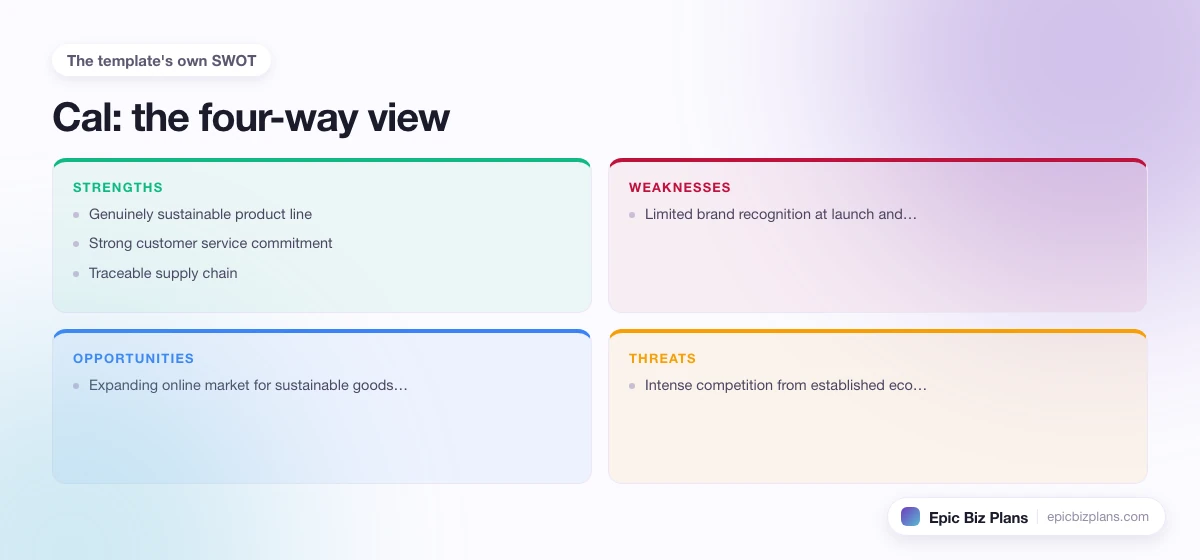
- Strengths: Genuinely sustainable product line, strong customer service commitment, and traceable supply chain.
- Weaknesses: Limited brand recognition at launch and dependence on online sales channels in the early phase.
- Opportunities: Expanding online market for sustainable goods and growing consumer skepticism toward greenwashing by larger brands.
- Threats: Intense competition from established eco brands and shifts in consumer priorities driven by economic pressures.
Cal Business Name Ideas
Website
We will build our website using Shopify, which provides a reliable e-commerce infrastructure with strong app integrations for sustainability certifications, carbon offset badges, and customer reviews. If we prioritize editorial content and brand storytelling over immediate transactional functionality, Squarespace offers a cleaner design environment that works well for purpose-driven brands.
Marketing Details
Our marketing strategy will rely heavily on organic search and email. We will use Semrush to identify high-intent keywords around sustainable products in our category and build content that earns rankings over time. HubSpot will manage our email sequences, from welcome flows for new subscribers to re-engagement campaigns for lapsed buyers. TikTok ads will support paid acquisition targeting younger demographics, using UGC-style creative that highlights real product use rather than polished brand messaging.
Industry Trends
Demand for sustainable consumer products continues to outpace the broader retail market, with independent research consistently showing that a significant portion of consumers will pay a premium for products with verified environmental credentials. Regulatory pressure in the EU and increasing FTC scrutiny of greenwashing claims in the US are raising the bar for what counts as a credible sustainability claim. Brands that can back their messaging with certifications, third-party audits, or material transparency are gaining consumer trust at the expense of those that rely on vague language. This environment favors well-documented businesses like those described in green and eco business plans and sustainable fashion businesses.
Competitor Information
We will analyze both direct competitors in our product category and indirect competitors who serve the same eco-conscious buyer. Understanding their pricing, product positioning, and marketing language will help us identify gaps we can fill. Our differentiation will come from a combination of product specificity, ingredient or material transparency, and stronger customer support than the larger players can offer. We will track competitor reviews on Trustpilot and Amazon to identify recurring complaints we can solve.
Financial Information
Startup costs will cover product development and initial inventory, branding, website setup, and six months of operating runway. We project revenue to grow steadily as we establish brand recognition, with ongoing expenses including inventory restocking, digital marketing, and platform fees. A detailed cash flow forecast will be maintained monthly to track actual versus projected performance. P&L statements will be prepared quarterly and reviewed against our original assumptions.
Legal and Compliance
We will register our business in the appropriate jurisdiction and obtain any permits required for our product category, including food-safety compliance if applicable. Trademarks will be filed for our brand name and key product names to protect intellectual property. We will also review FTC guidelines on environmental marketing claims to ensure all sustainability messaging is substantiated.
Operational Plan
Key operations will include supplier vetting, purchase order management, inventory control, and order fulfillment. We will prioritize suppliers who can provide third-party certifications for their materials. Logistics will be managed through a third-party fulfillment center for domestic orders, with international shipping evaluated in year two based on demand. Customer service will be handled in-house during the launch phase to maintain quality control and gather direct feedback. For additional operational context, see how similar businesses approach supply chains in green business plans and natural supplements businesses.
Contingency Planning
We will manage supply chain risk by qualifying at least two suppliers for each core product. If a primary supplier fails or delays, we have an alternative ready to activate. Consumer preference shifts - such as a move away from premium price points during economic downturns - will be addressed through a tiered product strategy that keeps an accessible entry-level option available. Marketing spend will be scaled based on monthly revenue performance rather than fixed as a percentage of projected sales.
Build a Business With Real Credibility
Building a sustainable product business is not just about choosing eco-friendly materials - it's about having a plan that holds up under scrutiny. Your Cal business plan gives you the structure to make real decisions: what to stock, how to price, who to market to, and how to stay solvent while you grow. The brands that win in this space are the ones with clear answers to those questions from day one.
-
 SemrushSemrush is a platform with literally any online tool you will need to promote your business. Spy on your competitors, get search traffic, keyword research, social info, ad copies and much more. Used by most of the top online companies in the world. Besides all its tools, Semrush also has many available integrations possible with many other tools that will make your work even better.
 -
 Surfer SEOSurfer SEO is an incredibly smart AI tool that will give you exact explanations what to do in order to make your website rank better. They use hundreds of parameters, check your competitors and decide on the best course of action. Whether it be inner links, bold text, paragraphs, headers, images and much more. Surfer is a must-have in 2026.
Keep Evolving Your Plan
Your Cal business plan should be updated as you learn. When you find out your true cost of goods, revise your margin projections. When you identify your top-performing customer segment, double down on messaging for that audience. When a supplier relationship breaks down, your contingency planning section should already have a path forward written into it.
Practical Uses for Your Plan
Your plan is the primary tool for communicating your business to any external stakeholder - whether that's a bank, a retail buyer, a co-founder, or a grant committee. A well-maintained business plan shows you are operating deliberately, not reactively. That credibility opens doors.
Your Cal business plan is 100% free - with unlimited edits, unlimited downloads, and unlimited chances to get it right. Build something you can stand behind.
