
Cacao Business Plan Template
-
 ShopifyPut your brand on Shopify. Launch your online store with tools designed for growth and success. Ready to turn your idea into profit? Start building your e-commerce business today.
 -
 SquarespaceShowcase your brand with Squarespace’s sleek designs. Build a professional online presence with ease. Start with a template that already looks finished.
 -
 WixBring your ideas to life with Wix. Customize every aspect of your site with unmatched flexibility. Start creating your unique online space and let your creativity shine.
 -
 ElementorCraft captivating websites effortlessly with Elementor. Enjoy complete creative control without coding. Make your site stand out to your audience. Start turning your vision into reality now.
- Executive Summary
- Business Info
- Business Model Overview
- SWOT Analysis
- Cacao Business Name Ideas
- Website
- Marketing Details
- Industry Trends
- Startup Cost Breakdown
- Competitor Information
- Financial Information
- Legal and Compliance
- Operational Plan
- Key Metrics to Track
- Contingency Planning
- Build a Cacao Business on Quality and Provenance
- Keep Your Plan Current
- Use Your Business Plan Strategically
Cacao is the raw ingredient behind a multi-billion dollar global industry, and the consumer shift toward premium, ethically sourced, and minimally processed cacao products has created real opportunities for independent producers and brands. A cacao business operating in this space - whether selling raw cacao powder, cacao nibs, gourmet chocolate bars, or processed cacao products - can build a differentiated brand around sourcing transparency, health credentials, and flavor quality that mass-market chocolate brands cannot easily replicate.
This cacao business plan template walks through the operational and financial realities of launching a cacao product brand, from supplier sourcing and food safety compliance to e-commerce operations, subscription revenue models, and marketing to health-conscious and gourmet food audiences.
Executive Summary
Our mission is to bring high-quality, sustainably sourced cacao products to health-conscious consumers and chocolate enthusiasts who want more from their cacao than commodity grocery store options deliver. We are building a brand grounded in sourcing transparency, product quality, and a clear narrative about where our cacao comes from and how it is processed. Founders turning single-origin beans into finished bars can pair this with the chocolate business plan template for the retail and product side.
Our financial targets include $500,000 in revenue by the end of year three, growing at 15% annually as our subscription base expands and retail distribution develops. Startup investment of $100,000 covers product development, inventory, packaging, website development, and initial marketing.
Business Info
Our product line covers raw cacao powder, cacao nibs, and gourmet chocolate bars made from single-origin cacao beans. We will offer both one-time purchase options and a subscription program that delivers product on a monthly or bi-monthly cycle. Our target market is urban consumers aged 25–45 who actively seek natural, minimally processed superfoods and premium chocolate products - buyers who read ingredient labels and are willing to pay a meaningful premium for provenance and quality. For context on how premium food brands approach product positioning and retail distribution, the luxury chocolate business plan template provides relevant market positioning strategies.
Business Model Overview
Our primary channel is direct-to-consumer through our own Shopify store, which allows us to control the brand experience, collect customer data, and maintain higher margins than retail channels. The subscription program is our priority revenue model - recurring monthly orders provide predictable cash flow and reduce customer acquisition cost per unit sold over time. We will also pursue wholesale relationships with premium health food stores, specialty grocers, and zero-waste shops that align with our brand values. The chocolate bar business plan template covers the retail distribution model for chocolate products in more detail.
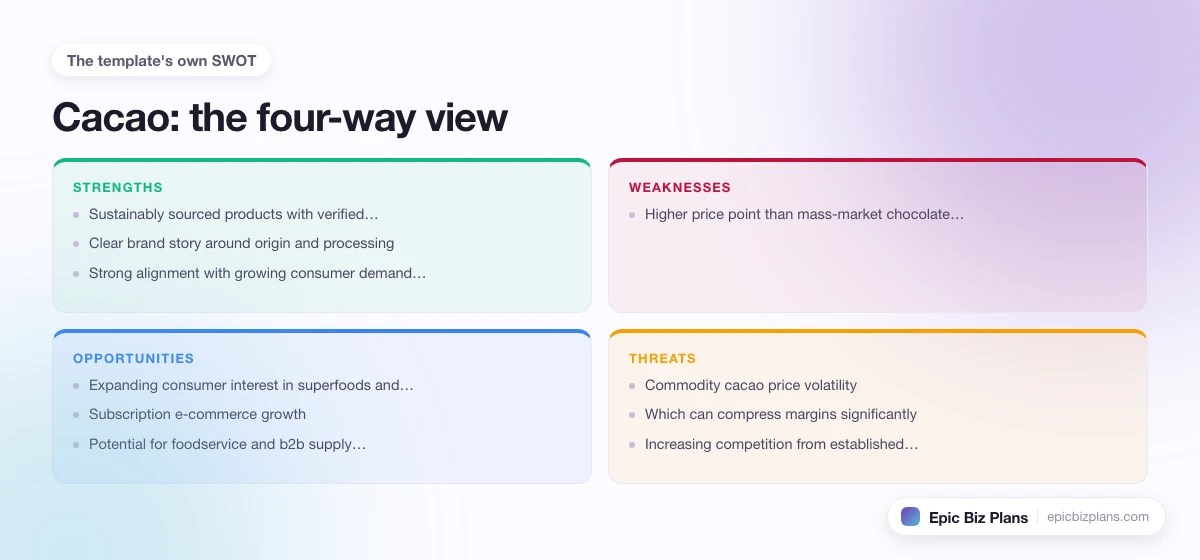
SWOT Analysis
- Strengths: Sustainably sourced products with verified health credentials, clear brand story around origin and processing, and strong alignment with growing consumer demand for transparency.
- Weaknesses: Higher price point than mass-market chocolate alternatives and dependence on a supply chain that includes overseas cacao farms with real disruption risk.
- Opportunities: Expanding consumer interest in superfoods and plant-based nutrition, subscription e-commerce growth, and potential for foodservice and B2B supply channels.
- Threats: Commodity cacao price volatility, which can compress margins significantly, and increasing competition from established health food brands entering the premium cacao category.
Cacao Business Name Ideas
Website
Shopify is the right platform for a direct-to-consumer cacao brand - it handles subscription billing natively through apps like Recharge or Bold Subscriptions, integrates with your inventory management system, and supports the product photography and storytelling content that converts premium food buyers. Your homepage should lead with the origin story of your cacao - where it comes from, how it is farmed, and why it is different from commodity alternatives. Ingredient transparency and certifications (organic, fair trade, single-origin) should be prominently displayed, as these are primary purchase decision factors for your target audience.
Marketing Details
Content marketing is the strongest channel for a premium cacao brand - educational content about the health benefits of raw cacao, the difference between cacao and cocoa, and the sourcing practices that distinguish quality producers generates organic search traffic and builds brand authority simultaneously. Use Semrush to identify high-volume cacao and health food keywords and develop articles that address the questions your target audience is actively searching for. Email marketing through HubSpot or Klaviyo supports new product launches, subscription renewal communications, and seasonal promotions. TikTok and Instagram content showing cacao recipes, production processes, and sourcing visits to cacao farms perform well for this category and build the authentic brand identity that premium food buyers respond to.
Industry Trends
Consumer interest in cacao as a functional food - not just a flavoring ingredient - has grown substantially, driven by widely published research on the flavonoid content of dark chocolate and raw cacao. Buyers who previously consumed commodity chocolate are actively trading up to single-origin, minimally processed cacao products as they become more aware of how processing affects nutritional content. The subscription food model has also matured significantly - consumers in the premium health food category are comfortable with recurring delivery subscriptions, which gives cacao brands a pathway to predictable recurring revenue that few other food categories can access as effectively.
Startup Cost Breakdown
Initial inventory procurement - your first production run of cacao powder, nibs, and chocolate bars - is your largest startup cost, typically $20,000–$40,000 depending on volume and supplier minimum order requirements. Packaging design and initial packaging order will run $5,000–$10,000. Website development, photography, and brand identity design should be budgeted at $5,000–$10,000. Food safety certification, business registration, and product labeling compliance will cost $2,000–$4,000. Initial marketing - content production, paid social advertising, and influencer outreach - should be budgeted at $15,000–$25,000 for the first six months. Total startup investment is estimated at $100,000, with the remainder allocated to working capital and a three-month operating reserve.
Competitor Information
Established chocolate brands like Lindt, Ghirardelli, and Green & Black's compete on mainstream distribution and brand recognition. Specialist raw cacao brands like Navitas Organics and Terrasoul Superfoods compete directly in the health food channel. Your competitive positioning should emphasize single-origin provenance and sourcing transparency in a way that commodity brands cannot credibly claim. Building a direct relationship with your cacao farmers - and documenting it through content - creates a story that resonates with your target audience and cannot be replicated by larger brands. The confectionery business plan template addresses how specialty food brands compete against established players through niche positioning and channel strategy.
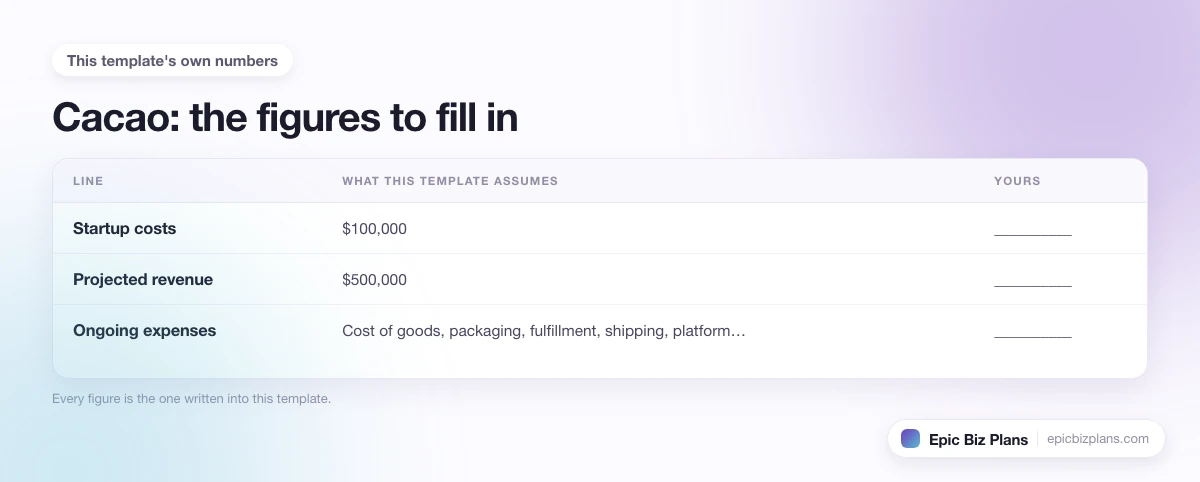
Financial Information
Startup costs are estimated at $100,000, covering inventory, packaging, branding, website, compliance, and initial marketing. Revenue of $500,000 is targeted by end of year three, growing at 15% annually from a year-one base of approximately $180,000–$220,000. Subscription revenue should be prioritized - even 200 subscribers at $50/month generates $120,000 annually in recurring revenue with relatively low marketing cost once acquired. Ongoing expenses include cost of goods, packaging, fulfillment, shipping, platform fees, and marketing. Track gross margin per product SKU monthly to understand where your profitability is concentrated and which products contribute most effectively to covering fixed costs.
Legal and Compliance
Food products sold online require compliance with ingredient labeling, allergen disclosure, and nutritional information requirements specific to your operating jurisdiction. If you are importing cacao beans directly from overseas farms, you will need to comply with import regulations and potentially obtain food import certifications. Organic or fair-trade certification - if you intend to use these claims on packaging - requires third-party auditing and annual renewal costs, which should be factored into your operating budget. Trademark your brand name and logo before you invest significant marketing spend in building brand awareness.
Operational Plan
Your supply chain has two critical links: cacao sourcing from farms or distributors and processing or manufacturing of your finished products. If you are not processing cacao yourself, identify a contract manufacturer with food safety certifications appropriate to your market. Maintain relationships with at least two cacao suppliers to reduce dependency on a single source - cacao yields are affected by weather events and disease, which can create sudden supply shortages. Inventory management is critical for a food business with shelf-life constraints - track stock levels and production lead times carefully to avoid both stockouts and excess inventory that expires before it can be sold.
Key Metrics to Track
Monthly recurring revenue (MRR) from subscriptions is your most important financial metric for long-term business health. Track subscriber churn rate monthly - high churn indicates product quality or expectation management issues that need addressing before they compound. For one-time purchase customers, track repeat purchase rate and average time between first and second order. Cost of goods as a percentage of revenue tells you whether your pricing is sustainable as input costs fluctuate. Monitor cacao commodity prices monthly and model the impact of a 20% price increase on your margin structure so you have a response plan ready.
-
 SemrushSemrush is a platform with literally any online tool you will need to promote your business. Spy on your competitors, get search traffic, keyword research, social info, ad copies and much more. Used by most of the top online companies in the world. Besides all its tools, Semrush also has many available integrations possible with many other tools that will make your work even better.
 -
 Surfer SEOSurfer SEO is an incredibly smart AI tool that will give you exact explanations what to do in order to make your website rank better. They use hundreds of parameters, check your competitors and decide on the best course of action. Whether it be inner links, bold text, paragraphs, headers, images and much more. Surfer is a must-have in 2026.
Contingency Planning
Cacao price volatility is your most significant financial risk - commodity cacao prices have historically moved by 30–50% within a single year due to weather events and geopolitical factors affecting major producing regions. Maintain forward purchasing agreements with your suppliers where possible to lock in pricing for 3–6 months ahead. If a significant price increase is unavoidable, plan your customer communication and pricing adjustment strategy before the increase takes effect rather than reacting under pressure. Maintain a reserve fund of at least three months of operating costs to manage cash flow during supply disruptions or slow-growth periods.
Build a Cacao Business on Quality and Provenance
The cacao market rewards producers and brands that commit to quality from the source. Consumers who discover a genuinely exceptional cacao product - one that tastes different, sources transparently, and delivers on its health claims - become loyal customers and advocates. Build your brand around those commitments from day one, not as a marketing exercise, but as the operational standard that governs your sourcing decisions and quality control process.
Keep Your Plan Current
Your cacao business plan should evolve as your subscription base grows, your retail distribution develops, and your understanding of your most profitable customer segments deepens. Review your financial projections quarterly and update your marketing and channel strategy based on what the data shows about where your best customers are coming from and how much they spend over their lifetime with your brand.
Use Your Business Plan Strategically
This plan supports conversations with specialty retailers about wholesale terms, pitches to impact investors who prioritize ethical food sourcing, and your own internal planning. Use it as a working reference document rather than a static launch document.
This cacao business plan template is free - edit it, download it, and revise it as your brand grows. Start with a clear plan, build your sourcing relationships carefully, and let product quality drive your reputation.
