
Cab Business Plan Template
-
 ShopifyPut your brand on Shopify. Launch your online store with tools designed for growth and success. Ready to turn your idea into profit? Start building your e-commerce business today.
 -
 SquarespaceShowcase your brand with Squarespace’s sleek designs. Build a professional online presence with ease. Start with a template that already looks finished.
 -
 WixBring your ideas to life with Wix. Customize every aspect of your site with unmatched flexibility. Start creating your unique online space and let your creativity shine.
 -
 ElementorCraft captivating websites effortlessly with Elementor. Enjoy complete creative control without coding. Make your site stand out to your audience. Start turning your vision into reality now.
- Executive Summary
- Business Info
- Business Model Overview
- SWOT Analysis
- Cab Business Name Ideas
- Website
- Marketing Details
- Industry Trends
- Competitor Information
- Financial Information
- Legal and Compliance
- Operational Plan
- Contingency Planning
- Build Your Freedom with a Cab Business Plan
- Explore Your Options in the Cab Industry
- Grow and Adapt Your Business Plan
- Practical Uses for Your Business Plan
A cab business plan sets out how you will run a taxi service that people can count on. It covers your vehicles, your drivers, your booking system, and how each ride earns money. This template walks through every section you need before you put a car on the road. Use it to plan a service that fits your city, your budget, and the customers you want to reach.
Your cab business plan is more than numbers on a page. It explains how your service competes with rideshare apps and other local operators, and what makes customers choose you again. A clear plan also makes it easier to apply for licenses, line up insurance, and talk to lenders. The sections below break the work into manageable parts.
Executive Summary
Our mission is to provide reliable, affordable cab service to our local community, with safe and on-time rides for every passenger. We plan to combine simple booking technology with strong customer service so riders get a smooth experience from request to drop-off.
Our advantage rests on quick response times and steady comfort during each trip. Financially, we aim to reach profitability within our first year, with projected revenue growth of 20% annually over the next five years.
Business Info
We will run a cab service for people who need transport for commuting, airport transfers, and local errands. Our target market includes residents, tourists, and businesses across both urban and suburban areas. Operators planning a higher-end service can compare this model with a limo service business plan template built around premium rides.
Business Model Overview
Our business will follow a traditional cab service model supported by digital booking and payment. We will use an app that makes it easy for riders to request a car and pay, and we will keep pricing competitive by running an efficient operation.
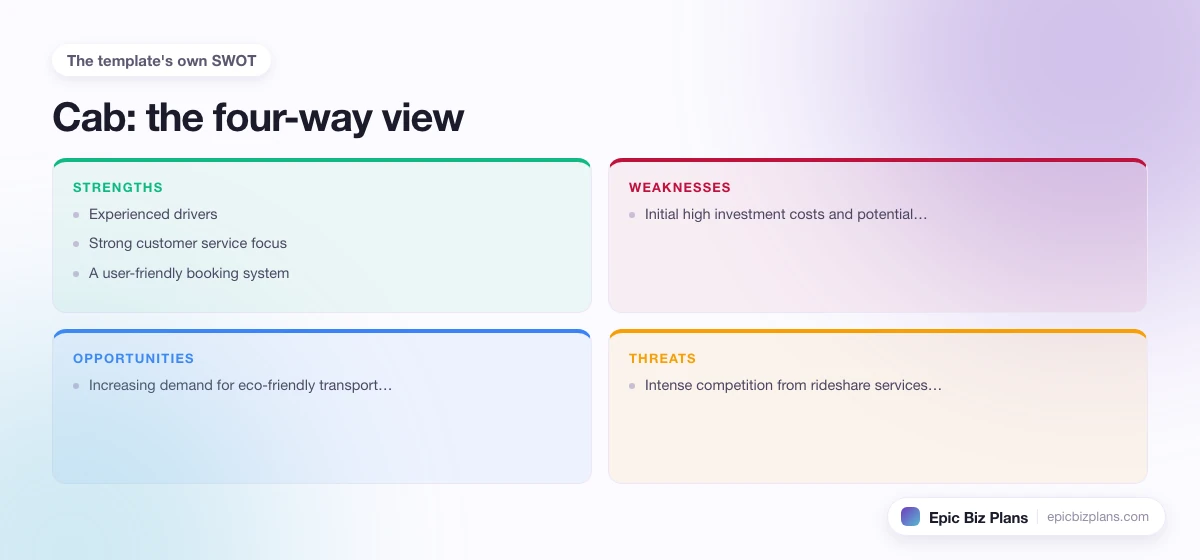
SWOT Analysis
- Strengths: Experienced drivers, strong customer service focus, and a user-friendly booking system.
- Weaknesses: Initial high investment costs and potential market saturation.
- Opportunities: Increasing demand for eco-friendly transport options and partnerships with local businesses.
- Threats: Intense competition from rideshare services and fluctuating fuel prices.
Cab Business Name Ideas
Website
We will build our website using Wix because it is easy to set up and maintain for owners without much technical background. The site will include online booking, service details, fare estimates, and customer reviews so riders can plan a trip in a few clicks. A clear, mobile-friendly site also helps us rank in local search and win customers who look up cab services on their phones.
Marketing Details
Our marketing will combine digital channels aimed at our target riders. We will use Semrush to improve our SEO and grow online visibility, and run email campaigns through HubSpot to share promotions and updates with past customers.
We will also use TikTok ads to reach younger riders with short, creative videos that build brand awareness. Local partnerships with hotels and event venues will round out the plan and bring in steady bookings.
Industry Trends
The cab industry has shifted toward mobile booking and cashless payment, and riders now expect both. Concern for the environment has also raised demand for eco-friendly cabs, which gives us a chance to add hybrid or electric vehicles over time. Owners who want to add courier or package runs alongside passenger trips can study a driver business plan template that covers mixed delivery and ride work.
Competitor Information
Our main competitors include established cab companies and rideshare apps. To stand apart, we will focus on personal customer service, strong knowledge of local routes, and fast pickups.
Indirect competition includes public transport. We will stress convenience and comfort as our key advantages in our marketing. Adjacent local-service operators, such as those running a valet parking business plan, often compete for the same event and hospitality customers.
Financial Information
Our startup costs cover vehicle purchases, licensing, insurance, and marketing, totaling roughly $100,000. We expect revenue of about $200,000 in the first year, with running costs such as fuel, maintenance, and staffing near $150,000. We will keep a detailed cash flow statement and projected profit-and-loss statements to track financial health.
Legal and Compliance
We will meet all legal requirements, including the licenses and permits needed to operate a cab service. To protect our brand, we will register a trademark and set clear policies that keep us in line with local regulations. Driver background checks and vehicle inspections will be part of our standard process.
Operational Plan
Our key operations center on an efficient dispatch system that matches cars to demand. We will work with local mechanics for vehicle maintenance and require every driver to complete training and a background check.
-
 SemrushSemrush is a platform with literally any online tool you will need to promote your business. Spy on your competitors, get search traffic, keyword research, social info, ad copies and much more. Used by most of the top online companies in the world. Besides all its tools, Semrush also has many available integrations possible with many other tools that will make your work even better.
 -
 Surfer SEOSurfer SEO is an incredibly smart AI tool that will give you exact explanations what to do in order to make your website rank better. They use hundreds of parameters, check your competitors and decide on the best course of action. Whether it be inner links, bold text, paragraphs, headers, images and much more. Surfer is a must-have in 2026.
The supply side covers vehicle purchases and partnerships for insurance and fuel. We will plan routes and shifts to cut wait times and keep cars available when riders need them. Owners scaling toward a larger fleet may also find a shipping and logistics business plan template useful for routing and dispatch ideas.
Contingency Planning
We will review risks such as demand swings and operational setbacks, then build plans to handle them. We will set aside contingency funds for unexpected costs and use flexible scheduling to match driver hours to busy and slow periods. Keeping a cash buffer protects the business through fuel price spikes and quiet seasons.
Build Your Freedom with a Cab Business Plan
Starting your own cab business is about more than profit. It is about building a service on your own terms, with the schedule and structure you want. Whether you picture a local taxi service, a small ride-share operation, or a tech-driven transport venture, your cab business plan lays the groundwork for that vision.
Explore Your Options in the Cab Industry
The cab industry offers many paths, from a traditional city taxi service to an app-based ridesharing platform. You can build a full fleet or keep things small and personal. There is also room to focus on a niche, such as airport transfers, school runs, or special-event transport.
Grow and Adapt Your Business Plan
Like any business, your cab business plan will need updates over time. Be ready to revise it as your customer base grows, your pricing changes, or you expand into new areas. Staying flexible keeps you competitive and on track toward your goals.
Practical Uses for Your Business Plan
Your cab business plan is a working tool. It can help you pitch partners, plan a launch, secure funding, or clarify your strategy. This roadmap guides you through the challenges and wins of running a transport business.
Your cab business plan is 100% free, with unlimited edits, unlimited downloads, and unlimited chances to get it right. Turn your plan into a working business, and use it to keep moving toward success.
