
Buying And Selling Business Plan Template
-
 ShopifyPut your brand on Shopify. Launch your online store with tools designed for growth and success. Ready to turn your idea into profit? Start building your e-commerce business today.
 -
 SquarespaceShowcase your brand with Squarespace’s sleek designs. Build a professional online presence with ease. Start with a template that already looks finished.
 -
 WixBring your ideas to life with Wix. Customize every aspect of your site with unmatched flexibility. Start creating your unique online space and let your creativity shine.
 -
 ElementorCraft captivating websites effortlessly with Elementor. Enjoy complete creative control without coding. Make your site stand out to your audience. Start turning your vision into reality now.
- Executive Summary
- Business Info
- SWOT Analysis
- Buying And Selling Business Name Ideas
- Website
- Marketing Details
- Industry Trends
- Competitor Information
- Financial Information
- Legal and Compliance
- Operational Plan
- Sourcing and Resale Channels
- Contingency Planning
- Building Your Legacy Through Buying And Selling
- The Spectrum of Opportunities
- Adapting Your Plan as You Grow
- Practical Applications
A Buying And Selling business plan is the blueprint that turns sourcing and reselling into a profitable operation. This market moves quickly, with new product categories and sales channels opening up constantly. A strong plan outlines your strategy while reflecting your brand identity and the buyers you want to reach. It keeps your decisions grounded when margins, suppliers, or demand shift.
Buying and selling is not only about transactions. It is about building supplier relationships and reading market trends before competitors do. Your plan should capture how you price, source, and market across your chosen categories. Whatever your niche, the goal is a clear, specific plan that helps your business stand out rather than blend in.
Executive Summary
Our mission is to create a smooth and efficient platform for buying and selling various products. We aim to connect consumers with high-quality goods while providing exceptional customer service. Our vision is to be a trusted marketplace known for reliability and value. Our financial goals include achieving a profit margin of 20% within the first three years of operation.
Business Info
We specialize in the buying and selling of various consumer goods, focusing on electronics, home goods, and fashion items. Our target market includes tech-savvy individuals aged 18-45, seeking convenience and competitive pricing. Our business model operates on a commission basis for sales made through our platform, which will provide a steady stream of revenue.
SWOT Analysis
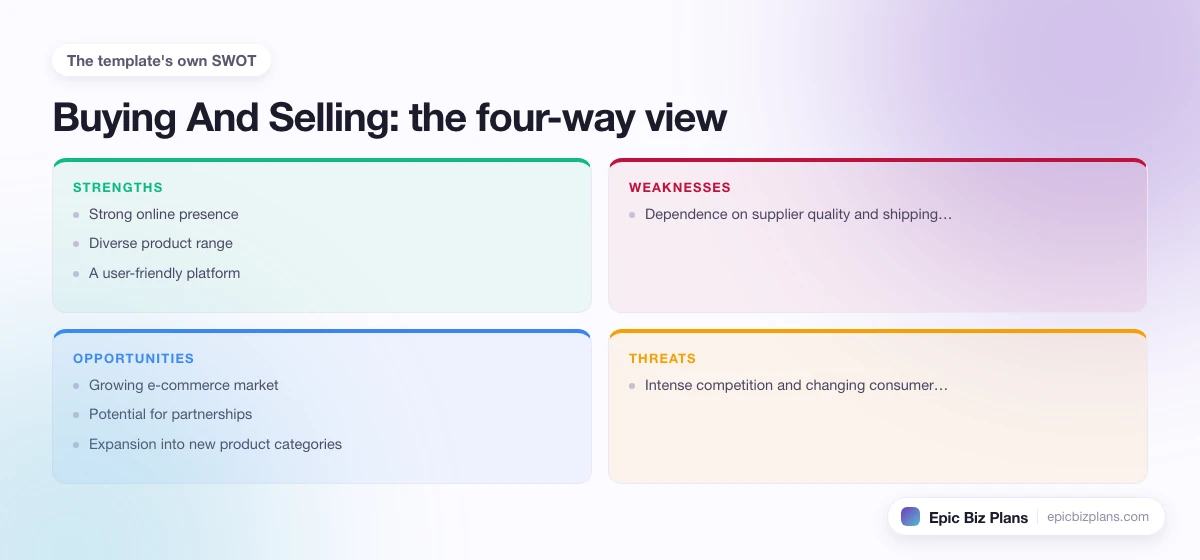
- Strengths: Strong online presence, diverse product range, and a user-friendly platform.
- Weaknesses: Dependence on supplier quality and shipping logistics.
- Opportunities: Growing e-commerce market, potential for partnerships, and expansion into new product categories.
- Threats: Intense competition and changing consumer preferences.
Buying And Selling Business Name Ideas
Website
We will build our website on Shopify or Squarespace, as these platforms are highly regarded for e-commerce capabilities. Shopify will allow us to create an attractive storefront with various payment options, while Squarespace offers beautiful design layouts. We will evaluate the specific needs to determine which platform best serves our business model and target audience.
Marketing Details
Our marketing strategy will include a mix of digital marketing initiatives. We will use Semrush for optimizing our website's SEO and driving organic traffic. Additionally, HubSpot will support our email marketing campaigns, helping us engage with customers effectively. Social media marketing with TikTok ads will target younger demographics, allowing us to create engaging content that reaches potential buyers.
Industry Trends
The e-commerce industry is witnessing rapid growth, driven by technological advancements. Increasing mobile usage and the rise of social commerce are shaping consumer behavior. Sustainability and ethical consumerism are also becoming significant trends, prompting us to consider eco-friendly products and practices. If you plan to source inventory secondhand, a thrift store business plan covers the sorting, pricing, and condition-grading systems that protect margins on used goods.
Businesses combining buying and resale activity should also review a general sell business plan for the foundational e-commerce model, customer acquisition cost frameworks, and multi-channel sales structure that apply across all product-selling operations regardless of whether inventory is sourced new or through resale channels. A focused buy and sell business plan is useful when you want a tighter framework built around margin per transaction rather than recurring subscriptions.
Competitor Information
Our main competitors include established e-commerce platforms like eBay and Amazon. Indirect competitors also consist of local stores that offer similar products. To differentiate ourselves, we will focus on customer experience, efficient logistics, and unique product offerings, making sure we stand out in a crowded market. Sellers stocking a broad mix of everyday products can compare their range with a general merchandise business plan.
Financial Information
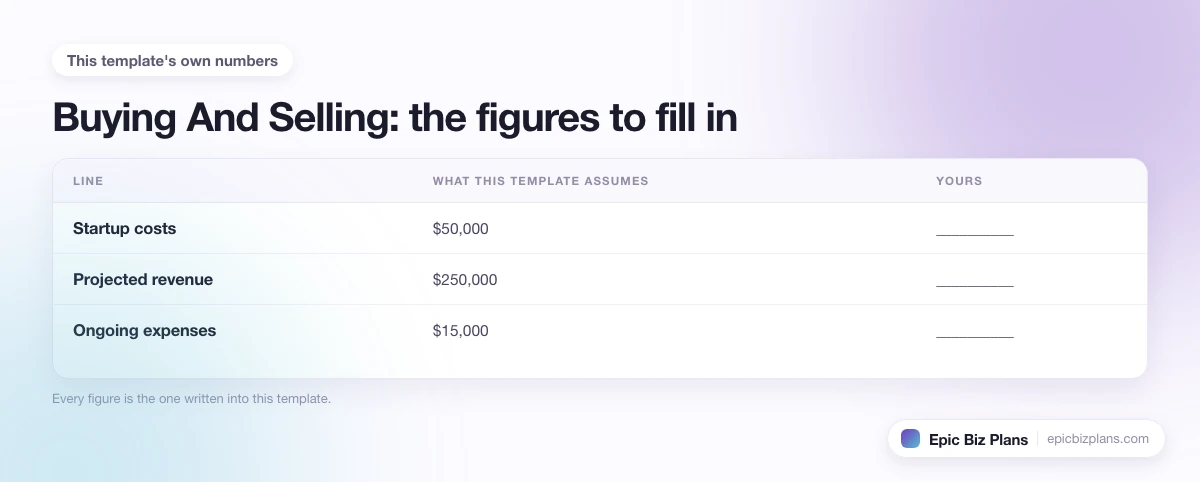
Startup costs are estimated at $50,000, covering website development, initial inventory, and marketing expenses. We project revenue to reach $250,000 in the first year, with ongoing expenses averaging $15,000 monthly. Cash flow management will be critical, and we will maintain a detailed Profit and Loss statement to monitor financial health.
Legal and Compliance
Legal requirements include registering our business, obtaining necessary licenses, and ensuring compliance with local regulations. We will also focus on intellectual property protection to safeguard our brand and any unique product designs.
Operational Plan
Key operations will include procurement, inventory management, and order fulfillment. We will establish relationships with suppliers to ensure quality products and efficient logistics. Our supply chain will prioritize timely delivery to enhance customer satisfaction.
Sourcing and Resale Channels
The products you buy are only profitable if you sell them through the right channels at the right margin. We will test several sourcing paths, including wholesale lots, liquidation pallets, and direct supplier accounts, then track sell-through rate for each. Resale will run across our own storefront plus established marketplaces to spread risk. A model built around reselling clothes shows how condition, seasonality, and listing speed affect turnover, and many of those lessons carry over to electronics and home goods. We will also keep a small general dropshipping line so we can test new categories without holding inventory.
Contingency Planning
Potential risks involve supply chain disruptions, changes in market demand, and legal challenges. To mitigate these risks, we will diversify our supplier base, continuously analyze market trends, and stay informed about legal obligations. Clear crisis management protocols will also be developed to address unforeseen challenges.
Building Your Legacy Through Buying And Selling
Why start the process of writing a Buying And Selling business plan? Because it is not just about transactions; it is about building an identity, choosing a way of working that gives you flexibility, and connecting with the buyers and sellers around you. This business model suits people who follow specific interests and want to turn that knowledge into income.
-
 SemrushSemrush is a platform with literally any online tool you will need to promote your business. Spy on your competitors, get search traffic, keyword research, social info, ad copies and much more. Used by most of the top online companies in the world. Besides all its tools, Semrush also has many available integrations possible with many other tools that will make your work even better.
 -
 Surfer SEOSurfer SEO is an incredibly smart AI tool that will give you exact explanations what to do in order to make your website rank better. They use hundreds of parameters, check your competitors and decide on the best course of action. Whether it be inner links, bold text, paragraphs, headers, images and much more. Surfer is a must-have in 2026.
The Spectrum of Opportunities
In buying and selling, the options are wide. From small local shops that curate unique artisan products to large e-commerce stores that reach international markets, the types of businesses you can build are varied. You could specialize in thrift flipping, vintage collections, drop shipping, or even real estate. Each path comes with its own challenges and rewards.
Adapting Your Plan as You Grow
Your Buying And Selling business plan is not static; it should change as you do. As your business expands, update it for different audiences, pricing strategies, product lines, and distribution channels. This keeps you relevant in a competitive market and gives you room to respond when demand shifts.
Practical Applications
Use your Buying And Selling business plan as a working tool in several situations, from pitching potential partners to planning a launch, securing funding, or refining your overall strategy. A clear, well-organized plan gives you guidance and confidence as you network and grow.
Your Buying And Selling business plan is 100% free, with unlimited edits and downloads, so you have plenty of room to refine your vision and path. Get started and begin building something that lasts.
