
Bush Business Plan Template
-
 ShopifyPut your brand on Shopify. Launch your online store with tools designed for growth and success. Ready to turn your idea into profit? Start building your e-commerce business today.
 -
 SquarespaceShowcase your brand with Squarespace’s sleek designs. Build a professional online presence with ease. Start with a template that already looks finished.
 -
 WixBring your ideas to life with Wix. Customize every aspect of your site with unmatched flexibility. Start creating your unique online space and let your creativity shine.
 -
 ElementorCraft captivating websites effortlessly with Elementor. Enjoy complete creative control without coding. Make your site stand out to your audience. Start turning your vision into reality now.
- Executive Summary
- Business Info
- Business Model Overview
- SWOT Analysis
- Business Name Ideas
- Website
- Marketing Details
- Industry Trends
- Competitor Information
- Financial Information
- Legal and Compliance
- Operational Plan
- Contingency Planning
- Summing It All Up
- Multiple Business Formats to Consider
- Keep Your Plan Updated
- Use Your Plan Practically
A bush business plan is a framework for launching a company built around natural, bush-sourced products - herbal teas, natural remedies, artisan crafts, and similar offerings rooted in locally harvested or ethically sourced materials from wild and rural environments. This market is real and growing: consumers are actively seeking natural alternatives to mass-produced health and wellness products, and authentically sourced products from a credible brand story command premium pricing.
The challenge in this category is building enough brand credibility to justify the premium prices that make the business financially viable. A thorough business plan helps you define your product sourcing, your customer, your pricing rationale, and your path to a sustainable operation - before you invest significant capital in inventory and marketing.
Executive Summary
We will build a business focused on naturally sourced, bush-based products - specifically herbal teas, natural remedies, and handcrafted goods made with locally harvested materials. Our mission is to connect consumers with authentic, sustainably sourced products from environments that most of our target customers cannot access directly themselves, and to do so with full transparency about sourcing practices and ingredient origins.
Year one revenue target is $100,000 with a startup investment of $50,000 covering initial inventory, website development, and first-quarter marketing. We will grow 20% annually through expanding our product range and building a loyal subscriber base. Our competitive position is built on authentic sourcing, genuine brand story, and a product quality that the large wellness brands operating at scale cannot replicate. For related planning reference, see the herbal medicine business plan and candle and soap business plan for complementary product strategies.
Business Info
Our product range at launch covers three categories: herbal tea blends using wild-harvested and organically sourced botanicals, natural topical remedies (balms, salves, and tinctures) using plant-based ingredients, and a small selection of handcrafted goods that use natural materials - carved items, woven goods, pressed botanical art. The product range is deliberately tight at launch to keep quality control manageable and sourcing relationships focused.
Target customers are environmentally conscious adults aged 25 to 50 who are willing to pay meaningfully more for products that come with a verifiable sourcing story and authentic handcrafted quality. This customer has grown skeptical of mass-produced "natural" products that use the word but do not deliver the substance - our positioning as a genuinely small-batch, honestly sourced brand is the differentiator they are looking for.
Business Model Overview
Primary sales channel is direct-to-consumer e-commerce, which gives us control over the customer experience, direct customer relationships, and better margins than wholesale. Local markets and craft fairs serve as a secondary channel in year one - they provide immediate revenue, genuine customer feedback on product reception, and brand-building that feeds back into online sales through word of mouth and social media content.
A subscription option for herbal tea (a natural repeat-purchase product) will be offered from launch at a modest discount. Subscriptions smooth out revenue volatility and reduce the churn risk that comes with a market where many customers try once and never return.
SWOT Analysis
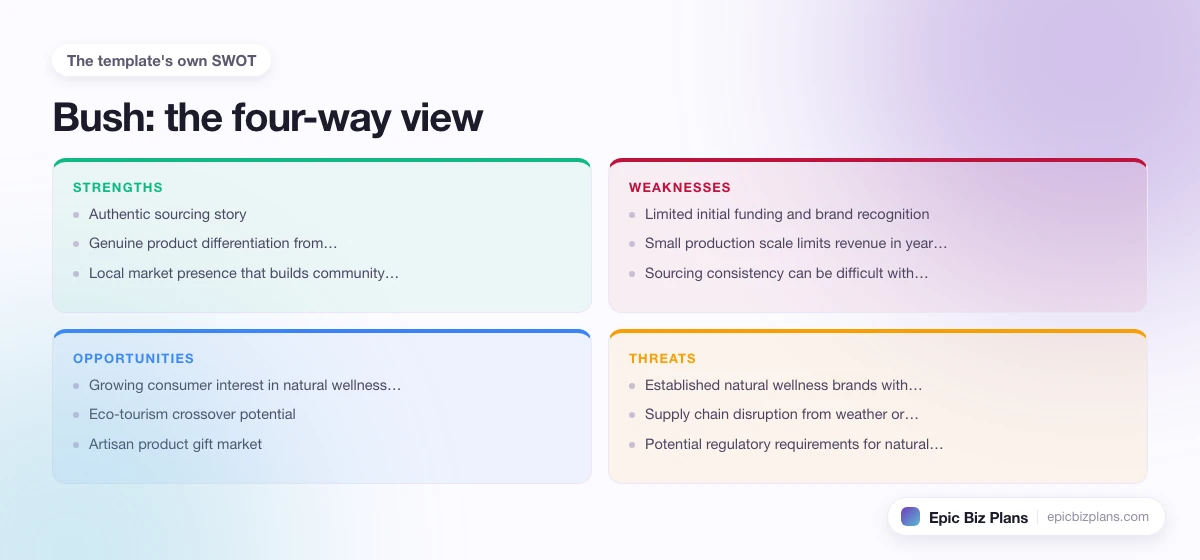
- Strengths: Authentic sourcing story, genuine product differentiation from mass-market alternatives, local market presence that builds community relationships.
- Weaknesses: Limited initial funding and brand recognition, small production scale limits revenue in year one, sourcing consistency can be difficult with wild-harvested materials.
- Opportunities: Growing consumer interest in natural wellness products and sustainable sourcing, eco-tourism crossover potential, artisan product gift market.
- Threats: Established natural wellness brands with larger marketing budgets, supply chain disruption from weather or seasonal variability in wild-harvested materials, potential regulatory requirements for natural remedy labeling.
Business Name Ideas
Website
We will build on Shopify, which handles e-commerce, inventory, and payment processing without requiring custom development. For a brand that depends heavily on visual storytelling - showing the sourcing environment, the harvesting process, and the craftsmanship behind each product - our product pages and brand content pages need to be photographically rich. High-quality photography of the source environment and the production process is one of the most important investments we make in year one. Squarespace is an alternative for brands that prioritize design aesthetics over e-commerce functionality, but Shopify's inventory and subscription management tools serve a product brand better long-term.
Marketing Details
Our marketing strategy leans heavily on content and visual storytelling. Instagram and Pinterest are the strongest channels for brands in the natural goods and artisan products space - the visual nature of these platforms suits our product category well, and the community of buyers in this space is active and engaged on both platforms.
We will use Semrush to identify organic search opportunities for herbal tea, natural remedy, and wild-harvested product keywords, and publish content that explains our sourcing process, the properties of specific botanicals, and how to use our products. This educational content brings in organic traffic from buyers who are already interested in the product category. HubSpot will manage our email list with post-purchase sequences, product education newsletters, and seasonal product launch announcements. TikTok content showing the sourcing and crafting process has demonstrated strong organic reach for this type of brand - we will test it as an awareness channel in quarter two.
Industry Trends
The natural products market is seeing consistent consumer movement away from synthetic ingredients and toward products with traceable, verifiable sourcing. Buyers who care about this actively research brands before purchasing and are more loyal once they find one they trust. This is the customer profile our brand is built for, and the trend underlying it shows no sign of reversing.
Eco-tourism and nature connection experiences are growing alongside the natural products market - consumers increasingly want to both purchase natural goods and engage with the environments those goods come from. For a bush product brand, this creates longer-term opportunities around experiences (farm visits, sourcing workshops, guided nature walks) that extend the brand well beyond product sales.
Competitor Information
Our competitors fall into two groups: large natural wellness brands that use "natural" positioning but operate at mass-production scale, and small independent producers operating locally without significant online presence. The large brands have marketing reach we cannot match, but they cannot credibly claim the authentic sourcing story we can. The small independents have the authenticity but often lack the marketing skill or online infrastructure to reach customers beyond their immediate geography.
Our position is a small, authentically sourced brand with enough digital marketing competency to reach customers nationally through e-commerce. This combination - genuine provenance plus digital reach - is what most small producers in this space lack. The key risk is that we maintain the authentic quality story as we grow, which requires disciplined sourcing practices and honest communication about production realities.
-
 SemrushSemrush is a platform with literally any online tool you will need to promote your business. Spy on your competitors, get search traffic, keyword research, social info, ad copies and much more. Used by most of the top online companies in the world. Besides all its tools, Semrush also has many available integrations possible with many other tools that will make your work even better.
 -
 Surfer SEOSurfer SEO is an incredibly smart AI tool that will give you exact explanations what to do in order to make your website rank better. They use hundreds of parameters, check your competitors and decide on the best course of action. Whether it be inner links, bold text, paragraphs, headers, images and much more. Surfer is a must-have in 2026.
Financial Information
Startup investment of $50,000 covers: initial inventory and production materials ($20,000), website development and photography ($12,000), packaging design ($5,000), first-quarter marketing ($8,000), and working capital ($5,000). Year one revenue of $100,000 with a target gross margin of 55-60% generates $55,000-$60,000 gross profit to cover operating expenses for marketing, shipping, platform fees, and administrative costs.
Cash flow management requires careful attention because inventory investment happens before sales revenue arrives. We will maintain detailed weekly cash flow tracking and avoid large inventory commitments before we have validated which specific products sell through reliably at which price points.
Legal and Compliance
Natural remedy products - particularly tinctures and topical treatments - face specific labeling and claims requirements that vary by product type and jurisdiction. We will confirm all labeling with a regulatory consultant before producing or selling any remedy product. Herbal teas used purely as beverages have simpler requirements, but any health-related claims on packaging must be supported and compliant. Business registration, product liability insurance, and a clear returns policy for consumable products are all required before launch.
Operational Plan
Sourcing is the most critical and most variable operation in this business. Wild-harvested materials are seasonal and weather-dependent. We will build relationships with multiple sourcing partners - both wild harvesters and small organic farms - to reduce our dependence on any single supply source. Quality review of all incoming materials will happen before they enter production to catch consistency issues before they become customer problems.
Production will be done in-house at small batch scale in year one, with quality documentation for each production run. As volume grows, we will evaluate contract production for the highest-volume products while keeping premium and handcrafted items in-house. This hybrid approach protects quality on differentiated products while allowing scaling on commodity items.
Contingency Planning
Sourcing disruption - a drought, a harvest failure, or a supplier relationship breakdown - is our primary operational risk. Our mitigation is supplier diversification and maintaining 60-90 days of finished goods inventory on our highest-volume products so a sourcing disruption does not immediately affect our ability to fulfill customer orders. If a specific material becomes unavailable, we will communicate proactively with customers and offer comparable alternatives rather than fulfilling with inferior substitutions.
If online sales growth proves slower than projected, we will increase our focus on local markets and wholesale to independent retailers in our geography - channels that require less marketing investment to generate revenue than DTC e-commerce, even if they deliver lower margins.
Summing It All Up
The bush business plan gives you a structured framework for building a natural products brand that can compete on authentic sourcing, genuine quality, and a brand story that mass-produced alternatives cannot replicate. The market for honest, natural products continues to grow, and well-run small brands with compelling sourcing stories are winning customers from larger but less authentic competitors.
Multiple Business Formats to Consider
A bush product business can take many forms: a pure e-commerce brand, a farmers market and craft fair vendor with online presence, a wholesale supplier to independent health stores, or an experience-based business that combines product sales with nature immersion workshops or sourcing tours. Each format has different capital requirements and margin profiles. Start with the model that matches your resources and build toward more formats as revenue allows.
Keep Your Plan Updated
Update this plan at least quarterly once you are operating, with real data on which products sell, which channels drive the most customers, and what your actual margin per product looks like. The numbers you discover in the first six months will likely differ significantly from your projections - and that is exactly the information you need to make better decisions about where to focus and where to pull back.
-
ShopifyPut your brand on Shopify. Launch your online store with tools designed for growth and success. Ready to turn your idea into profit? Start building your e-commerce business today.
-
SquarespaceShowcase your brand with Squarespace’s sleek designs. Build a professional online presence with ease. Start with a template that already looks finished.
-
WixBring your ideas to life with Wix. Customize every aspect of your site with unmatched flexibility. Start creating your unique online space and let your creativity shine.
-
ElementorCraft captivating websites effortlessly with Elementor. Enjoy complete creative control without coding. Make your site stand out to your audience. Start turning your vision into reality now.
Use Your Plan Practically
Your bush business plan is a tool for more than internal planning. Use it to present to craft fair organizers who want to evaluate vendor applications, to wholesale buyers who want to see a serious brand before stocking your products, or to grant programs for small sustainable businesses - a growing category with relevant funding opportunities. A clear, specific plan signals that you have thought through the business seriously.
Your bush business plan is 100% free - with unlimited edits, unlimited downloads, and unlimited chances to refine it as your brand grows.
