
Burning Business Plan Template
-
 ShopifyPut your brand on Shopify. Launch your online store with tools designed for growth and success. Ready to turn your idea into profit? Start building your e-commerce business today.
 -
 SquarespaceShowcase your brand with Squarespace’s sleek designs. Build a professional online presence with ease. Start with a template that already looks finished.
 -
 WixBring your ideas to life with Wix. Customize every aspect of your site with unmatched flexibility. Start creating your unique online space and let your creativity shine.
 -
 ElementorCraft captivating websites effortlessly with Elementor. Enjoy complete creative control without coding. Make your site stand out to your audience. Start turning your vision into reality now.
- Executive Summary
- Business Info
- SWOT Analysis
- Burning Business Name Ideas
- Website
- Marketing Details
- Industry Trends
- Competitor Information
- Financial Information
- Legal and Compliance
- Operational Plan
- Contingency Planning
- Why This Business Model Works
- The Spectrum of Business Models in This Niche
- Keeping the Plan Current
- Practical Uses
- Get Started
The burning community - encompassing fire performance, burn events, fire art installations, and related equipment - has grown into a genuine market with real commercial infrastructure. This business plan is for entrepreneurs who want to serve that community with products, workshops, or event services. It takes the same business planning approach you'd apply to any niche ecommerce or service operation, adapted for the specific regulatory and supply considerations that come with fire-related products and performances.
This niche rewards businesses that understand the culture. The burning community values authentic participation, safety, and sustainability - vendors who demonstrate genuine knowledge of fire arts and responsible practices earn trust quickly. Those who treat it as just another ecommerce category tend to struggle to build the community relationships that drive repeat purchases and event referrals.
Executive Summary
Our mission is to provide an engaging platform and resource hub for burning-related activities, services, and products - connecting enthusiasts, performers, and event organizers with what they need to create safely and creatively. We aim to become a trusted source for the burning community across equipment, workshops, and event coordination. Our financial target is break-even within the first 18 months, with 20% annual revenue growth thereafter. Our value proposition centers on community knowledge, quality products, and a genuine commitment to safety and sustainable practice.
Business Info
We offer products and services covering burning-themed activities: specialized equipment, safety gear, workshops, and community events. Our target market is artists, performers, event organizers, and enthusiasts aged 18-45 who are active in burning culture. Our business model combines ecommerce sales with community engagement - the online store handles product sales while workshops and events build the relationships that drive loyalty and referrals. Sellers building a fire-adjacent product line might also find useful operational context in a fireplace service business plan, particularly for understanding how safety compliance and supplier relationships work in fire-related product categories.
SWOT Analysis
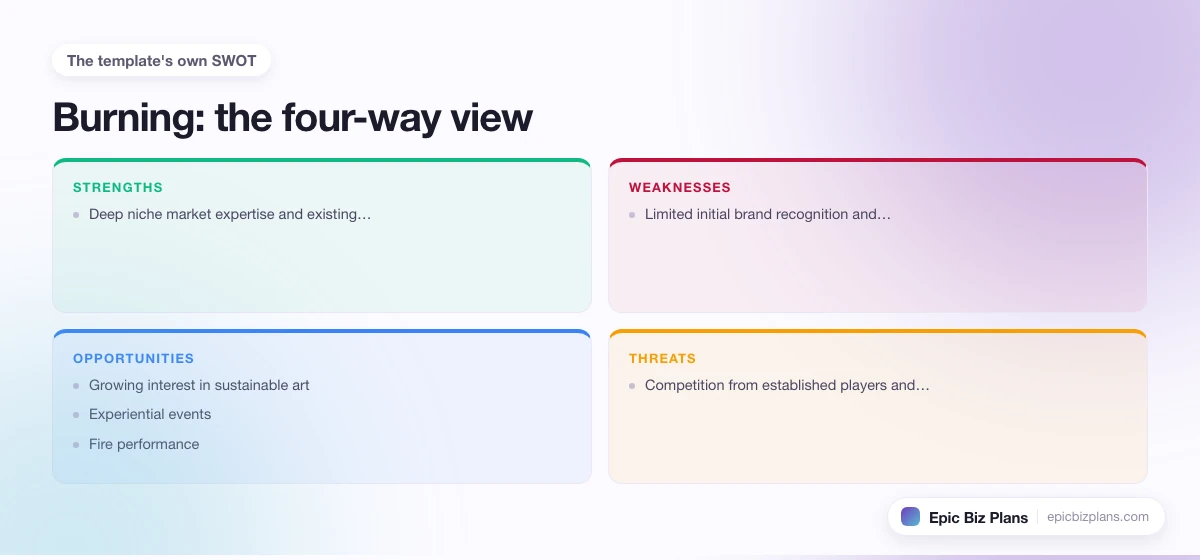
- Strengths: Deep niche market expertise and existing community relationships.
- Weaknesses: Limited initial brand recognition and reliance on seasonal events.
- Opportunities: Growing interest in sustainable art, experiential events, and fire performance.
- Threats: Competition from established players and regulatory restrictions on fire-related activities.
Burning Business Name Ideas
Website
We will build on Shopify, which handles the ecommerce side - product listings, inventory management, and checkout - reliably for a product-heavy operation. Shopify's app ecosystem also makes it straightforward to add event booking, email capture, and subscription features as the community side of the business grows. Product photography and safety documentation will be prominent on product pages - customers buying fire equipment want to see clear specifications and safety certifications before purchasing.
Marketing Details
Our marketing strategy centers on search visibility via Semrush, email marketing through HubSpot, and social media targeting. TikTok works well for this category - fire performance content has strong organic reach, and paid ads can amplify that reach to younger demographics who are discovering burn culture for the first time. The goal is to build both a product-buying audience and a community of practitioners who view us as a trusted resource, not just a store. Event-focused businesses in this space should also review a creative art business plan for how to structure workshop pricing and community event revenue alongside product sales.
Industry Trends
Experiential art events are growing as audiences look for participatory experiences rather than passive entertainment. Burn culture is part of this broader shift. Sustainable practices have become a significant consideration - eco-friendly fuels, responsible fire management, and reduced waste at events are increasingly expected by the community. Augmented reality is beginning to appear at large-scale burn events, creating immersive overlays on physical fire installations that expand the creative possibilities for both artists and audiences.
Competitor Information
Our main competitors are established retailers selling fire equipment and event services, along with community organizations that host related activities. We'll differentiate through the depth of our community engagement - workshops, educational content, safety training, and genuine participation in the culture rather than just selling to it. Long-term relationships with performers, event organizers, and artists are the competitive moat that large retailers can't replicate. Businesses that also serve the broader custom event and art market should look at a custom art business plan for how to price commissioned work and structure client relationships in creative niches.
Financial Information
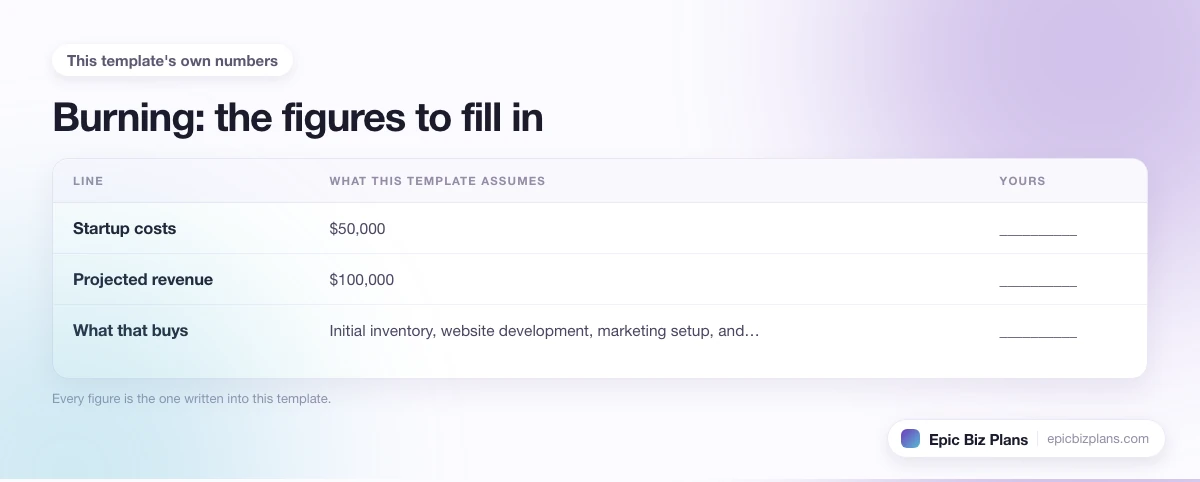
Startup costs are estimated at approximately $50,000, covering initial inventory, website development, marketing setup, and operational expenses. First-year revenue target is $100,000, growing through community expansion and event participation. Ongoing monthly expenses - inventory restocking, marketing, and administration - are projected at around $5,000. Cash flow will be monitored monthly, with close attention to seasonal revenue swings tied to event season. The contingency fund should cover at least three months of fixed operating costs before launch.
Legal and Compliance
We will register the business and secure all required permits, including any specific to fire-related product sales or event operations. Local fire codes and safety regulations vary significantly by jurisdiction and must be reviewed for any physical events or workshops we produce. IP protection for the brand and any proprietary product designs will be established through trademark registration from the outset.
Operational Plan
Core operations include sourcing quality products from reliable suppliers, managing inventory through the online platform, and coordinating workshops and events. Supply chain reliability is especially important for safety equipment - we will not compromise on product quality to reduce cost. Event logistics require coordination with venues, safety officers, and performers well in advance of each event date. For businesses combining product sales with community-building events, reviewing how similar community-centered businesses structure their operations is valuable - a community center business plan covers membership models, programming, and space management that translate to community-driven event businesses.
Contingency Planning
Regulatory changes are a real risk in the fire-related product and event space - local ordinances can shift with limited notice. We'll stay connected to industry associations and local fire authorities to anticipate changes. Supply chain disruptions for specialized equipment will be managed through relationships with backup suppliers and maintaining higher buffer stock for our core product lines. Revenue diversification across product sales, workshops, and events reduces dependence on any single revenue stream during slow periods.
Why This Business Model Works
The burning niche works as a business category precisely because it's specific enough to have a dedicated audience that's hard to reach through generic channels. Community trust is the currency in this market - once you've established credibility through genuine participation, product quality, and reliable service, that trust compounds through word of mouth at events and within online communities. That's a different growth pattern than most ecommerce businesses, and it requires patience in the first year as the community relationships are built.
The Spectrum of Business Models in This Niche
This category includes small specialist equipment retailers, full-service event production companies, workshop-based performance schools, and hybrid models that combine all three. Your plan should specify which model you're building because the capital requirements, revenue timing, and customer acquisition strategies are quite different across those formats.
Keeping the Plan Current
Update your plan after each event season with actual revenue, cost, and attendance data. The burn calendar is defined enough that you can plan inventory and marketing cycles around it - use that predictability to tighten your financial projections each year.
-
 SemrushSemrush is a platform with literally any online tool you will need to promote your business. Spy on your competitors, get search traffic, keyword research, social info, ad copies and much more. Used by most of the top online companies in the world. Besides all its tools, Semrush also has many available integrations possible with many other tools that will make your work even better.
 -
 Surfer SEOSurfer SEO is an incredibly smart AI tool that will give you exact explanations what to do in order to make your website rank better. They use hundreds of parameters, check your competitors and decide on the best course of action. Whether it be inner links, bold text, paragraphs, headers, images and much more. Surfer is a must-have in 2026.
Practical Uses
Use this plan when pitching suppliers for better terms, applying for a business loan, or bringing on a co-founder who needs to understand the full business before committing. A clear plan that shows you understand both the community and the commercial mechanics is the best signal you can send to anyone whose support you're asking for.
Get Started
Your Burning business plan is 100% free - with unlimited edits, unlimited downloads, and unlimited chances to get it right. Build it around your specific vision for this community, and use it as an active planning tool rather than a one-time document.
