
Burlesque Business Plan Template
-
 ShopifyPut your brand on Shopify. Launch your online store with tools designed for growth and success. Ready to turn your idea into profit? Start building your e-commerce business today.
 -
 SquarespaceShowcase your brand with Squarespace’s sleek designs. Build a professional online presence with ease. Start with a template that already looks finished.
 -
 WixBring your ideas to life with Wix. Customize every aspect of your site with unmatched flexibility. Start creating your unique online space and let your creativity shine.
 -
 ElementorCraft captivating websites effortlessly with Elementor. Enjoy complete creative control without coding. Make your site stand out to your audience. Start turning your vision into reality now.
- Executive Summary
- Business Info
- SWOT Analysis
- Burlesque Business Name Ideas
- Website
- Marketing Details
- Industry Trends
- Competitor Information
- Financial Information
- Startup Cost Breakdown
- Common Mistakes to Avoid
- Legal and Compliance
- Operational Plan
- Contingency Planning
- Your Burlesque Business Starts Here
- Types of Burlesque Businesses
- Keep It Fresh
- Practical Applications
- Take the Next Step
A burlesque business plan is the working document a producer, venue operator, or performer-turned-entrepreneur uses to map out a sustainable burlesque operation. Burlesque has had a steady commercial revival since the mid-2010s, with dedicated rooms in cities like Vegas, Nashville, New Orleans, and Portland filling weekly for ticketed shows alongside corporate buyouts and private bookings. Your plan should make clear exactly what you're building: a recurring revue series at a partner venue, a permanent room of your own, a touring troupe, an instructional studio offering classes, or some combination. Founders running broader nightlife venues can also reference the nightlife business plan template for the adjacent format.
Skip the romantic language and use real numbers. A ticketed burlesque revue in a 100-seat room typically sells tickets at $25-$45 each with a 60-75% sell-through on weekend dates. Performer fees range from $75-$200 per act, and a typical revue programs 6-10 acts plus a host. Cover your venue agreement (flat-fee, door-split, or hybrid), production costs per show, ticketing platform fees, and the marketing spend that fills the room consistently. Producers and venue operators reading the plan want to see that you understand the economics of putting on a live show, not just the artistic vision.
Executive Summary
We will build a burlesque entertainment company with a mission to produce inclusive, well-produced performance art for adult audiences. Our vision is a recurring revue series and a touring extension that gives performers a real stage and audiences a polished, high-quality experience. Our value proposition centers on consistent show quality, a casting process that prioritizes diversity in body, gender, and background, and a marketing approach that respects both the audience and the art form. We aim for profitability within the first two years through ticket sales, merchandise, private bookings, and selective classes.
Business Info
We will offer live burlesque revues featuring a rotating cast of performers, with a mix of classic and contemporary acts. Our target market is adult audiences aged 21-45 looking for live entertainment, plus a bachelor/bachelorette segment that books group tickets, and tourists exploring local nightlife. Our business model focuses on weekly or bi-weekly ticketed shows, merchandise sold at the venue, private corporate and birthday bookings, and limited workshops or classes for the burlesque community. Operators planning a dedicated lounge format can also reference the night club business plan template for the broader venue operations.
SWOT Analysis
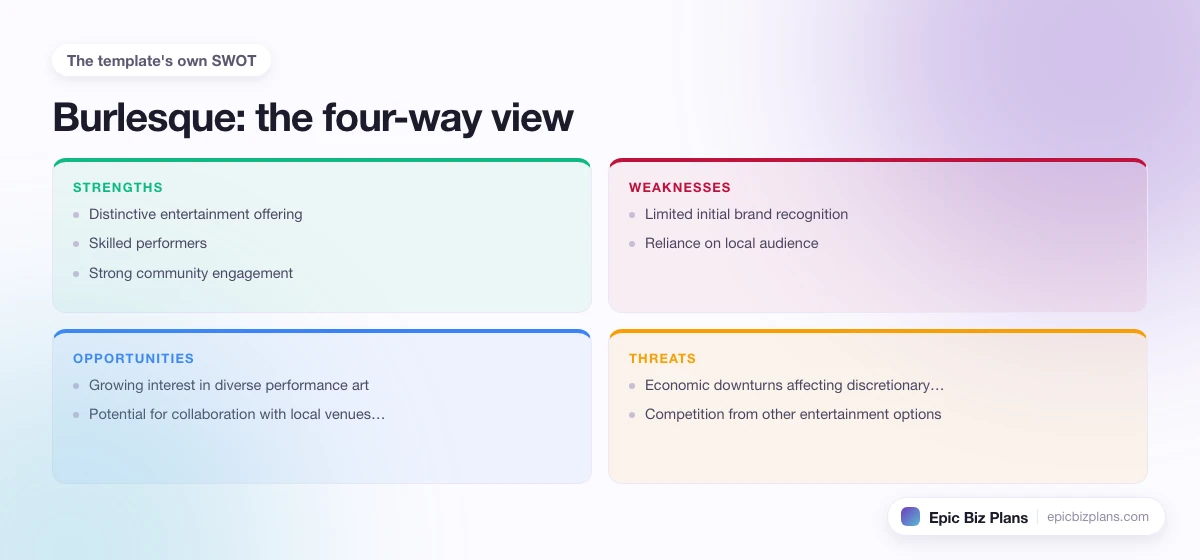
- Strengths: Distinctive entertainment offering, skilled performers, strong community engagement.
- Weaknesses: Limited initial brand recognition, reliance on local audience.
- Opportunities: Growing interest in diverse performance art, potential for collaboration with local venues and brands.
- Threats: Economic downturns affecting discretionary spending, competition from other entertainment options.
Burlesque Business Name Ideas
Website
We will build our website on Wix or Squarespace, both of which work well for show-driven sites that need a clean calendar and photo gallery. Ticket sales will route through Eventbrite or DICE so we keep clear financial records and customer data. The site will list upcoming shows, performer bios, behind-the-scenes photos, and a clear path for private group bookings. Performers also expect a press kit page so booking partners can preview the production quality.
Marketing Details
Our marketing strategy combines social, email, partnerships, and earned press. We will use Semrush to research keywords like "burlesque show [your city]" or "best cabaret night out" and write location-specific landing pages. Email flows through HubSpot or Klaviyo will handle weekly show announcements, presale access for subscribers, and post-show review prompts.
For social, Instagram Reels and TikTok work for short, on-stage clips (subject to platform content rules), backstage glimpses, and performer takeovers. Partnerships with bachelorette-party planners, hotel concierges, and local lifestyle blogs are also reliable sources of booking referrals. Operators running comedy and burlesque on alternating nights can reference the comedy club business plan template for that programming pattern.
Industry Trends
Burlesque continues to grow as part of a broader return to live entertainment. Audiences are spending again on in-person experiences, and live revues offer a price point ($25-$45 ticket) that hits a sweet spot between a low-cost bar night and a $100+ concert ticket. Streaming and hybrid formats (paid livestream of a featured headliner) are also expanding the addressable audience, though in-room ticket revenue remains the core of the model. Producers programming larger productions can reference the theater business plan template for the production side.
Competitor Information
We will analyze direct and indirect competitors. Direct competitors include other local burlesque and cabaret producers, while indirect competitors are live music venues, comedy clubs, and theatrical productions competing for the same date-night dollar. To differentiate, we will focus on consistent production quality, a casting process that brings in fresh faces alongside established performers, and a clear sense of curatorial voice that audiences come to recognize.
Financial Information
Our initial startup costs will include venue rental or build-out, costume and prop budget, performer guarantees for opening shows, branding, marketing, and a website with integrated ticketing. We project year-one revenue from ticket sales (the core), private bookings (typically 15-25% of total revenue at scale), and merchandise. Ongoing expenses include performer fees, venue costs, marketing, and operational overhead.
Startup Cost Breakdown
For a producer running a weekly revue in a partner venue, the typical startup budget is $20,000-$40,000: branding and website $5,000, ticketing platform setup $1,000, initial costume and prop budget $4,000, performer guarantees for the first eight shows $8,000-$15,000, marketing for launch and first three months $5,000-$10,000, insurance for the year $1,500-$3,000, and a working capital cushion $2,000-$5,000. Operators opening a permanent room of their own should budget 3-5x this amount once build-out, sound, lighting, and lease deposits are included.
Common Mistakes to Avoid
The most common mistake in burlesque production is paying performers under market, which damages reputation in the community fast and limits who will work with you. The second is over-investing in the venue before audience demand is proven. Start in a partner venue with a door-split and build the brand before signing a permanent lease. The third is ignoring reviews and word-of-mouth: a great show with no Google, TripAdvisor, or Eventbrite ratings will struggle to scale. Build a review-request flow into the night-of operations.
Legal and Compliance
Establishing our business will require registration as a performing arts entity. We will keep compliant with local entertainment laws, including any required cabaret or live-performance licensing in our city. Performer agreements will be in writing, classifying acts properly (W-2 or 1099), and we will maintain general liability insurance plus event-specific coverage where the venue requires it. Trademarks on the brand name and primary marks will be filed before public launch.
Operational Plan
Key operations include casting and booking, weekly show production, ticketing, merchandise inventory, and post-show review management. Costumes and props will be tracked in a simple inventory system, and a production lead will own pre-show technical rehearsal so each show runs on time without surprises.
Contingency Planning
To address risks like venue changes, performer cancellations, or economic dips, we will keep flexible operational plans, a roster of standby performers, and a 60-day cash reserve. Regular reviews of attendance, marketing performance, and audience feedback will let us adjust the calendar and the casting as conditions change.
-
 SemrushSemrush is a platform with literally any online tool you will need to promote your business. Spy on your competitors, get search traffic, keyword research, social info, ad copies and much more. Used by most of the top online companies in the world. Besides all its tools, Semrush also has many available integrations possible with many other tools that will make your work even better.
 -
 Surfer SEOSurfer SEO is an incredibly smart AI tool that will give you exact explanations what to do in order to make your website rank better. They use hundreds of parameters, check your competitors and decide on the best course of action. Whether it be inner links, bold text, paragraphs, headers, images and much more. Surfer is a must-have in 2026.
Your Burlesque Business Starts Here
Starting a burlesque business is a real opportunity to build a brand around live performance art that audiences continue to pay for. Whether you're producing a recurring local revue, building an online merchandise storefront for costumes and props, or developing instructional content that teaches the craft to new performers, your burlesque business plan is the document that connects vision to execution.
Types of Burlesque Businesses
The burlesque category is wider than most outsiders realize: intimate local revues, mid-sized touring productions, costume and prop ecommerce, online and in-person classes, and event services (private parties, corporate buyouts, festival bookings). Founders typically pick one or two of these and treat the rest as expansion paths once the core revenue is steady.
Keep It Fresh
As you grow, revisit and revise your burlesque business plan. Your audience may shift, ticket pricing might need to change, and new revenue lines (workshops, livestreams, partnerships) will open up. A flexible plan keeps the business aligned with what's actually working in the market.
Practical Applications
Your burlesque business plan serves many practical purposes. Use it to present to venue partners, plan a launch, secure funding, or clarify the team's strategy. The plan is most valuable when it's a working document you reach for during real decisions, not a glossy PDF sitting in a drawer.
Take the Next Step
Your burlesque business plan is 100% free, with unlimited edits, unlimited downloads, and unlimited chances to get it right. Build the first draft, then refine it as the business reveals what works.
