
Building Business Plan Template
-
 ShopifyPut your brand on Shopify. Launch your online store with tools designed for growth and success. Ready to turn your idea into profit? Start building your e-commerce business today.
 -
 SquarespaceShowcase your brand with Squarespace’s sleek designs. Build a professional online presence with ease. Start with a template that already looks finished.
 -
 WixBring your ideas to life with Wix. Customize every aspect of your site with unmatched flexibility. Start creating your unique online space and let your creativity shine.
 -
 ElementorCraft captivating websites effortlessly with Elementor. Enjoy complete creative control without coding. Make your site stand out to your audience. Start turning your vision into reality now.
- Executive Summary
- Business Info
- Business Model Overview
- SWOT Analysis
- Building Business Name Ideas
- Website
- Marketing Details
- Industry Trends
- Competitor Information
- Financial Information
- Legal and Compliance
- Operational Plan
- Contingency Planning
- Embrace Your Passion
- Stay Adaptable
- Put Your Plan to Work
- Courage to Create
A Building business plan sets the strategy for a construction company before the first project starts. It defines the services you offer, the clients you target, and how you price and deliver work in a competitive local market. This document is less a checklist and more a working map for sourcing, staffing, and growth. Treat it as the foundation you build everything else on.
Every construction business starts with a clear plan, and yours should reflect what sets your work apart. It is not about copying another firm's model; it is about defining a build quality and service approach that fits the clients you want. Set out your vision clearly so partners and lenders understand it. The sections below give you a structure to follow.
Executive Summary
We will run a construction business delivering high-quality building services. Our mission is to deliver strong craftsmanship and practical design while keeping a focus on sustainability. Our vision is to become a trusted regional construction company known for reliability and customer satisfaction.
Our value proposition centers on quality, environmental responsibility, and strong client relationships. We aim to reach $500,000 in revenue within the first two years, with roughly 20% annual growth after that, supported by tight cost control of the kind set out in a quantity surveying business plan.
Business Info
We will offer residential construction, commercial builds, renovations, and project management. Our target market includes homeowners, real estate developers, and commercial property owners who need dependable construction services. Firms focused on full-service delivery can also study a design and construction business plan for how to combine design and build under one contract.
Business Model Overview
We will operate mainly on a project-based model, earning revenue through contracts for various construction services. We will keep pricing competitive while holding high standards for quality and service delivery.
SWOT Analysis
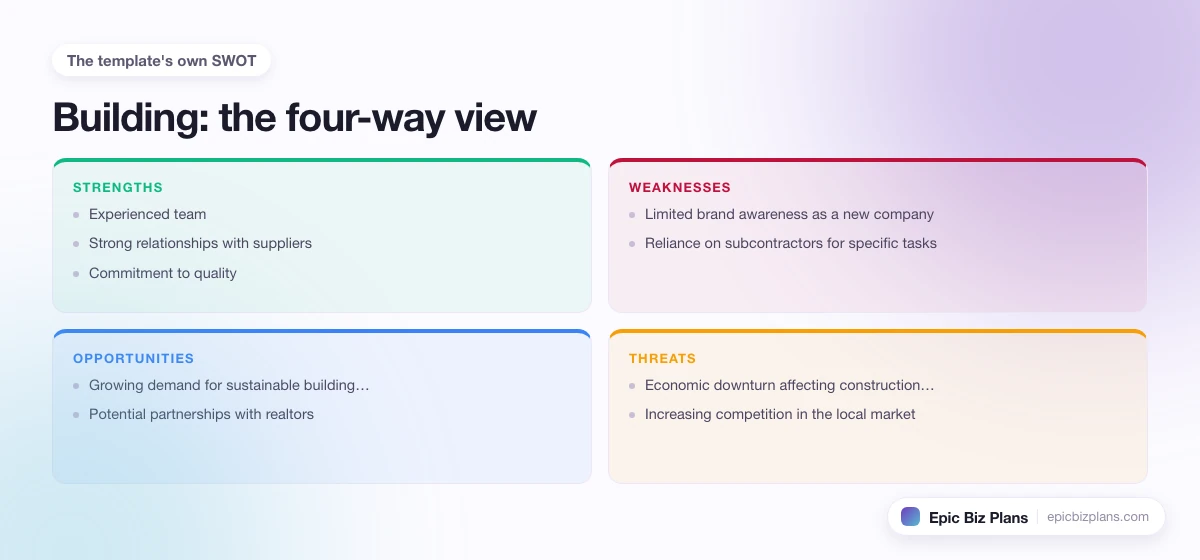
- Strengths: Experienced team, strong relationships with suppliers, commitment to quality.
- Weaknesses: Limited brand awareness as a new company, reliance on subcontractors for specific tasks.
- Opportunities: Growing demand for sustainable building practices, potential partnerships with realtors.
- Threats: Economic downturn affecting construction budgets, increasing competition in the local market.
Building Business Name Ideas
Website
We will build our website using Wix, since it is straightforward and good for showing a project portfolio. It lets us update content and maintain the site without advanced technical skills. Later, we may consider Shopify or Squarespace if we expand into e-commerce or want a larger online presence.
Marketing Details
Our marketing strategy combines digital marketing and social media. We will use Semrush for SEO so the site ranks well for relevant construction terms, and HubSpot for email campaigns to keep potential clients informed about services and offers.
On social media, we will run TikTok ads to reach younger buyers who are increasingly involved in home and property decisions. The goal is clear, visual content that shows our projects and connects with potential clients.
Industry Trends
We will track current trends, including sustainable building technology, smart home integration, and client-focused design. Using eco-friendly materials and methods helps meet regulatory changes and appeals to environmentally conscious clients. Specialist trades such as those in an electrical contractor business plan often coordinate closely with general builders on these upgrades.
Competitor Information
We will analyze both direct and indirect competitors. Direct competitors are other construction firms in our area. Indirect competitors include DIY services and home renovation kits.
To stand apart, we will focus on strong customer service, transparent pricing, and adaptable service offerings tailored to each client's needs. A remodeling business plan shows how renovation-focused firms position against the same buyers.
Financial Information
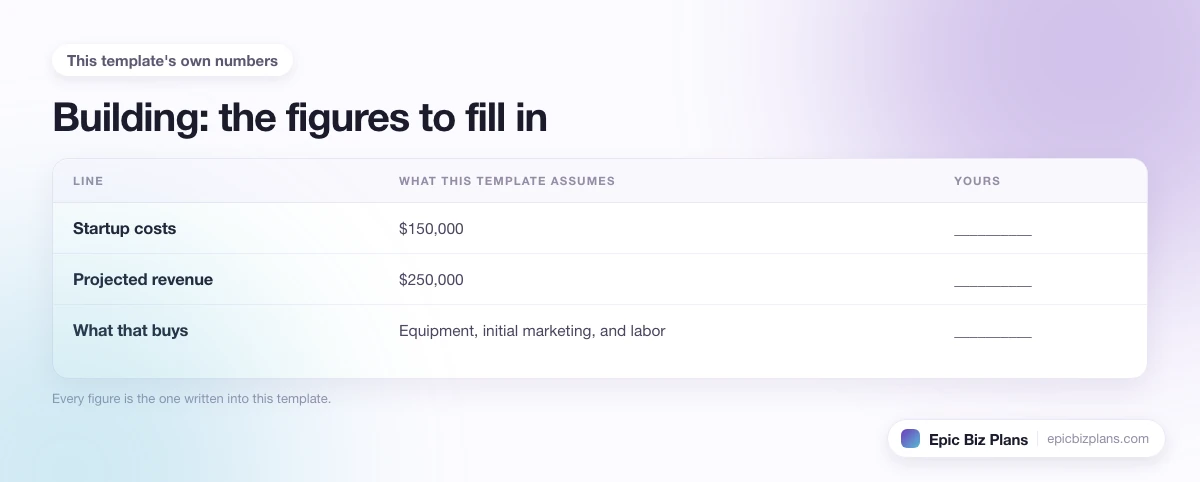
We expect startup costs of around $150,000, covering equipment, initial marketing, and labor. Projected first-year revenue is $250,000, rising to $500,000 by year three. Ongoing expenses, including overhead, materials, and labor, are estimated at about $100,000 a year.
We will manage cash flow carefully and keep detailed P&L statements to support financial health and steady operations.
Legal and Compliance
We will comply with local construction regulations and obtain all required licenses and permits before starting operations. We will also set up intellectual property protections for any unique designs and branding.
-
 SemrushSemrush is a platform with literally any online tool you will need to promote your business. Spy on your competitors, get search traffic, keyword research, social info, ad copies and much more. Used by most of the top online companies in the world. Besides all its tools, Semrush also has many available integrations possible with many other tools that will make your work even better.
 -
 Surfer SEOSurfer SEO is an incredibly smart AI tool that will give you exact explanations what to do in order to make your website rank better. They use hundreds of parameters, check your competitors and decide on the best course of action. Whether it be inner links, bold text, paragraphs, headers, images and much more. Surfer is a must-have in 2026.
Operational Plan
Our operational plan includes a strong supply chain strategy, working with reputable material suppliers and subcontractors for specialized tasks. We will keep logistics efficient so projects finish on time, with regular team communication to track progress and resolve issues quickly. Firms scaling residential output can reference a home builder business plan for repeatable build processes.
Contingency Planning
We recognize risks such as economic swings, project delays, and supply chain disruptions. To limit them, we will use flexible project timelines, keep a reserve fund for unexpected costs, and maintain relationships with multiple suppliers so materials stay available. A general contractor business plan covers similar risk planning across trades.
Embrace Your Passion
A building business plan is more than numbers on a page. It is a statement of how you want to run the company and the work you want to be known for. Whether you focus on residential builds, commercial projects, or renovation services, the options in this field are wide. Each project, large or small, can reflect the standards and community you want to serve.
Stay Adaptable
Your approach will change over time, and your building business plan should change with it. As you grow, update the strategy for different client types, test new pricing models, and adjust to new service lines. Staying flexible keeps the plan relevant to what your market needs now and later. Regular updates surface opportunities that match your growth.
Put Your Plan to Work
Your building business plan works as a roadmap. Use it to present to potential partners, outline a new service launch, secure funding, or refine your overall strategy. It is a practical guide that helps you move forward with confidence and keeps each step clearer.
Courage to Create
Your building business plan is 100% free, with unlimited edits, unlimited downloads, and unlimited chances to get it right. This is the point to start. There is real demand for solid construction work, so put the plan to use and build it.
