
Bucket Business Plan Template
-
 ShopifyPut your brand on Shopify. Launch your online store with tools designed for growth and success. Ready to turn your idea into profit? Start building your e-commerce business today.
 -
 SquarespaceShowcase your brand with Squarespace’s sleek designs. Build a professional online presence with ease. Start with a template that already looks finished.
 -
 WixBring your ideas to life with Wix. Customize every aspect of your site with unmatched flexibility. Start creating your unique online space and let your creativity shine.
 -
 ElementorCraft captivating websites effortlessly with Elementor. Enjoy complete creative control without coding. Make your site stand out to your audience. Start turning your vision into reality now.
- Executive Summary
- Business Info
- Business Model Overview
- SWOT Analysis
- Bucket Business Name Ideas
- Startup Cost Breakdown
- Website
- Marketing Details
- Revenue Streams
- Industry Trends
- Competitor Information
- Financial Information
- Legal and Compliance
- Operational Plan
- Contingency Planning
- Build What the Market Actually Needs
- Keep Evolving
- Practical Uses for Your Plan
Buckets are one of the most consistently purchased utility products across residential, commercial, and industrial markets. If you're looking to build a product business with reliable demand, low barriers to customization, and straightforward e-commerce fulfillment, a bucket business is a more practical opportunity than it might first appear. This plan gives you the framework to build it seriously.
Whether you're targeting cleaning companies, contractors, gardeners, or retail consumers, this template covers the business fundamentals - from startup investment and revenue projections to competitive positioning and contingency planning.
Executive Summary
Our mission is to provide high-quality, durable bucket products for both residential and commercial customers who need reliable solutions for cleaning, construction, gardening, and general-purpose use. Our value proposition is a combination of quality construction, practical design options, and consistent availability - things budget bucket suppliers often can't guarantee. We're targeting $500,000 in year one revenue and a 20% market share within five years through e-commerce sales and retail partnerships.
Business Info
We produce and sell a range of bucket products including standard utility buckets, collapsible versions for space-saving storage, and specialty buckets for specific applications like pool care, painting, and food-grade uses. Our customers include homeowners, cleaning professionals, contractors, and businesses that need reliable bulk bucket supply. We operate primarily as a direct-to-consumer e-commerce business, supplemented by partnerships with local hardware and retail stores.
Business Model Overview
Our core model is direct online sales through our own website, with economies of scale in manufacturing driving competitive pricing. As volume grows, we'll pursue wholesale distribution agreements with regional retailers and janitorial supply companies. The B2B channel offers lower per-unit margin but higher order volume and more predictable revenue.
SWOT Analysis
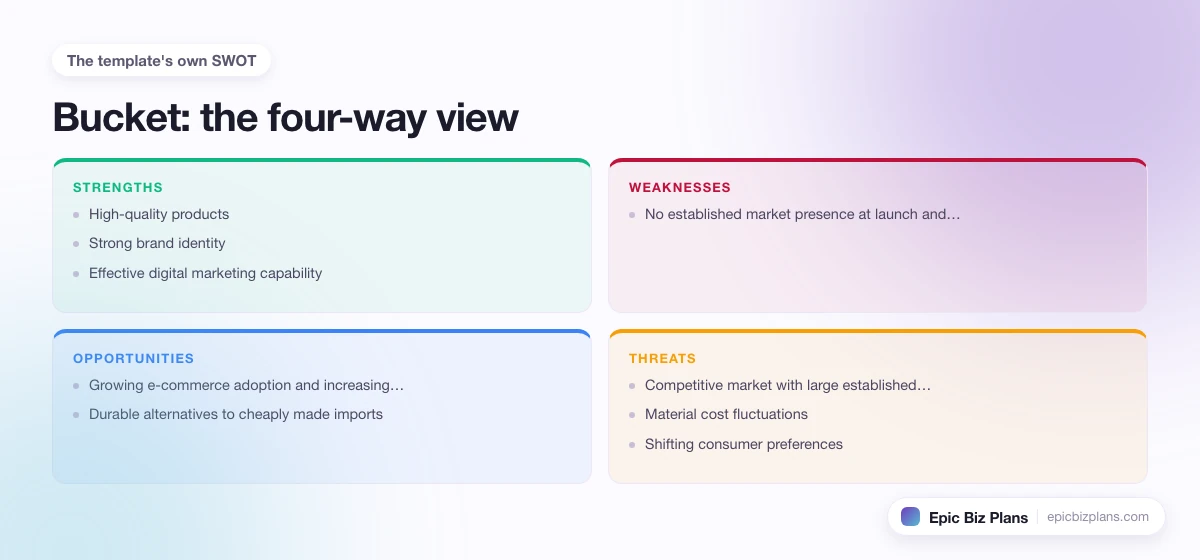
- Strengths: High-quality products, strong brand identity, and effective digital marketing capability.
- Weaknesses: No established market presence at launch and initial dependence on online sales volume.
- Opportunities: Growing e-commerce adoption and increasing demand for sustainable, durable alternatives to cheaply made imports.
- Threats: Competitive market with large established players, material cost fluctuations, and shifting consumer preferences.
Bucket Business Name Ideas
Startup Cost Breakdown
Starting a bucket manufacturing or import/distribution business requires investment in production setup, inventory, and marketing:
- Initial inventory or manufacturing setup: $30,000–$60,000
- Molds and tooling (if manufacturing custom designs): $10,000–$25,000
- Website and e-commerce platform: $3,000–$8,000
- Branding and packaging: $3,000–$6,000
- Marketing (first 6 months): $8,000–$20,000
- Legal, licensing, and business formation: $2,000–$5,000
- Working capital reserve: $20,000–$30,000
Total estimated startup costs: $76,000–$154,000. Businesses that source finished products from established manufacturers rather than investing in custom tooling can launch at the lower end of this range while testing market demand before committing to proprietary designs.
Website
Shopify handles the inventory management, bulk pricing, and payment processing needs of a bucket business well. For B2B buyers - contractors, cleaning companies, and facilities managers ordering in bulk - build out a dedicated wholesale section with volume pricing and easy reorder functionality. Include detailed product specifications (material, dimensions, load capacity, food-grade certifications) since commercial buyers make decisions based on specs, not just photos.
Marketing Details
SEO through tools like Semrush should target commercial and trade-specific searches - "bulk utility buckets for contractors," "food-grade buckets wholesale," and "collapsible buckets for cleaning crews" are the kinds of high-intent searches that convert to actual orders. Email marketing through HubSpot is particularly effective for B2B reorder campaigns. TikTok can work for the consumer side of the business through product demonstration content showing clever uses and durability tests. Professional cleaning businesses represent a significant bulk buyer opportunity - the janitorial business plan covers how that customer segment evaluates cleaning supply vendors.
Revenue Streams
A bucket business benefits from layered revenue channels:
- Direct consumer e-commerce: Individual and small-quantity sales at full retail margin.
- B2B wholesale: Bulk orders from cleaning companies, contractors, and facilities management firms at lower margins but higher volume.
- Custom-branded bucket orders: Businesses that want their logo on buckets for marketing or operational use - good margin and repeat potential.
- Specialty and niche product lines: Food-grade buckets for home brewers and food preservation, painting contractor sets, pool care kits, and gardening bundles all command premium pricing.
- Retail distribution partnerships: Hardware stores, gardening centers, and cleaning supply retailers.
Industry Trends
The market is moving toward sustainable materials - recycled plastic and BPA-free certifications matter more to buyers than they did five years ago. Collapsible and stackable designs are growing in popularity as consumers and businesses alike look to reduce storage space. Commercial buyers are consolidating suppliers, which creates opportunities for businesses that can offer a full product range reliably rather than a single SKU. For businesses targeting the window and exterior cleaning market, the window cleaning business plan covers bucket and equipment requirements from the service business perspective - useful for understanding your B2B customer's actual needs. Pool and outdoor care businesses are consistent bucket buyers; the pool cleaning business plan provides insight into that customer segment's purchasing behavior.
Competitor Information
Main competitors include large generalist suppliers like Uline and regional distributors, as well as big-box retailers like Home Depot and Costco for the consumer end of the market. The differentiator for a focused bucket brand is product quality, specification transparency, and service to niche use cases that generalists don't cater to well. Competing on price alone against large-volume importers is difficult - competing on quality, sustainability credentials, and B2B service is more defensible.
Financial Information
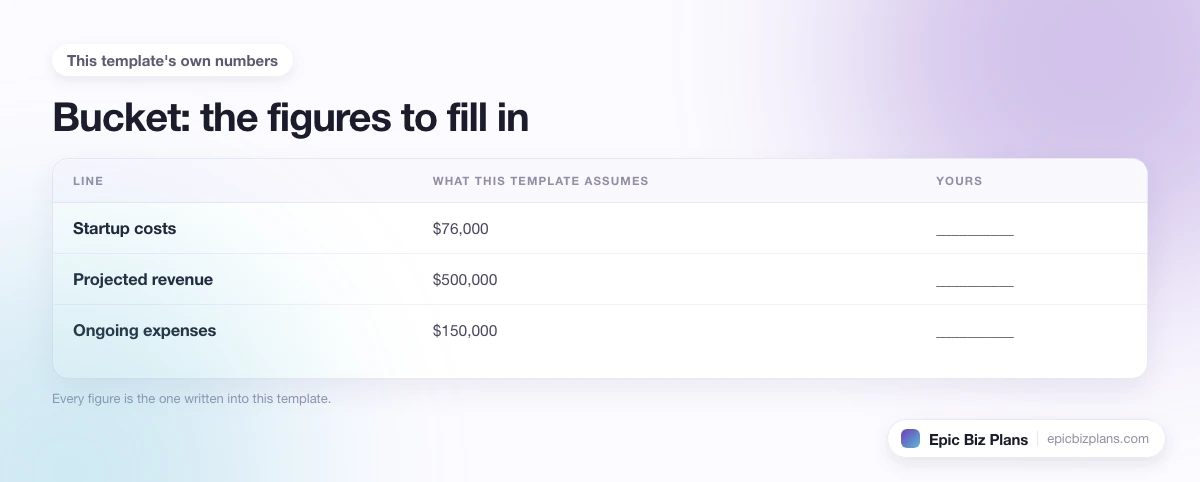
Startup costs are estimated at $76,000–$154,000. Year one revenue target is $500,000, with ongoing expenses of approximately $150,000 annually covering materials, fulfillment, marketing, and platform costs. Monthly P&L tracking will measure margin by product category and channel. B2B growth is the key lever for revenue scale - each new wholesale account provides recurring revenue with lower per-acquisition cost than consumer channels.
Legal and Compliance
Register the business, obtain necessary product safety certifications (especially for food-grade products), and trademark your brand name. If your products make contact with food or beverages, FDA compliance and BPA-free certification are requirements, not optional. Have product liability insurance in place before your first commercial sale.
Operational Plan
Core operations center on manufacturing or import procurement, quality control, warehousing, and order fulfillment. Establish relationships with at least two reliable suppliers so a disruption with one doesn't halt your business. Build a quality control process that checks incoming goods before they go into your inventory - catching defects before they reach customers is far less costly than managing returns and complaints. Review your inventory turnover and fulfillment accuracy monthly.
-
 SemrushSemrush is a platform with literally any online tool you will need to promote your business. Spy on your competitors, get search traffic, keyword research, social info, ad copies and much more. Used by most of the top online companies in the world. Besides all its tools, Semrush also has many available integrations possible with many other tools that will make your work even better.
 -
 Surfer SEOSurfer SEO is an incredibly smart AI tool that will give you exact explanations what to do in order to make your website rank better. They use hundreds of parameters, check your competitors and decide on the best course of action. Whether it be inner links, bold text, paragraphs, headers, images and much more. Surfer is a must-have in 2026.
Contingency Planning
Supply chain disruptions affecting plastic raw materials or overseas manufacturing are a real risk - maintain buffer inventory on your best-selling SKUs and keep at least one domestic manufacturing option identified as backup. Economic downturns reduce construction and renovation activity, which is one of your key B2B markets - diversifying across consumer, commercial cleaning, and gardening segments reduces this exposure. Maintain 3 months of operating expenses as a cash reserve.
Build What the Market Actually Needs
A bucket business succeeds by focusing on what buyers actually value: reliability, quality, and availability. Customers who've ordered from a supplier who delivers consistently and responds to issues professionally don't switch vendors for minor price differences. Build that reputation from day one and the business compounding it becomes your primary growth engine.
Keep Evolving
Review your business plan every six months and update it based on what you're learning. Which customer segments are buying most? Which product lines have the best margins? Which channels are acquiring customers most efficiently? Let the data guide your plan updates rather than sticking with assumptions you made before launch.
Practical Uses for Your Plan
This plan works as a pitch document for manufacturing financing, a reference for wholesale partnership discussions, and a working strategic guide for daily decisions. A clear, detailed plan is your best tool for getting the terms and relationships you need to grow faster.
This Bucket business plan template is completely free - edit and download it as many times as you need.
