
Bubble Bath Business Plan Template
-
 ShopifyPut your brand on Shopify. Launch your online store with tools designed for growth and success. Ready to turn your idea into profit? Start building your e-commerce business today.
 -
 SquarespaceShowcase your brand with Squarespace’s sleek designs. Build a professional online presence with ease. Start with a template that already looks finished.
 -
 WixBring your ideas to life with Wix. Customize every aspect of your site with unmatched flexibility. Start creating your unique online space and let your creativity shine.
 -
 ElementorCraft captivating websites effortlessly with Elementor. Enjoy complete creative control without coding. Make your site stand out to your audience. Start turning your vision into reality now.
- Executive Summary
- Business Info
- SWOT Analysis
- Bubble Bath Business Name Ideas
- Website
- Marketing Details
- Industry Trends
- Competitor Information
- Financial Information
- Startup Cost Breakdown
- Legal and Compliance
- Operational Plan
- Common Mistakes to Avoid
- Key Performance Metrics
- Contingency Planning
- Your Vision, Your Freedom
- Explore Every Angle
- Practical Applications
- Take Action Today
A Bubble Bath business plan covers the operational and financial side of a bath product brand serving the wellness and self-care market. The category continues to grow as buyers spend more on home routines, but it is also crowded, with mass retailers, indie brands, and creator-led labels all chasing the same shoppers. A working plan defines exactly which sliver of the wellness aisle you intend to own, what makes your formulation different, and how unit economics work after packaging, paid social, and DTC fulfillment costs.
The plan also has to confront the operational realities most templates skip: stability testing for natural formulas, packaging that protects the product without adding wasteful materials, regulatory labeling requirements, and the cost of holding inventory while DTC demand builds. Treat the document as a working playbook rather than a pitch deck. Keep it specific to your formulation strategy, target customer, and channel mix, and revise it after each batch as you learn what actually sells through.
Executive Summary
Our mission is to create a focused bubble bath product line that supports a real wellness routine. Our vision is to be a recognized brand in the wellness category, known for clean formulations, considered packaging, and honest brand voice rather than buzzword marketing.
Our value proposition is artisanal bubble bath products built on natural ingredients and clear sensory experiences (scent, foam, skin feel) that buyers can describe in their own words. We aim for $100,000 in sales within the first year and a 20% profit margin. Operators looking at adjacent product lines can reference a bath and body business plan for category benchmarks.
Business Info
We will specialize in bubble bath products formulated from natural ingredients. Our target market includes health-conscious consumers, primarily women aged 25-45, who buy self-care products on a regular cadence. The business model focuses on direct-to-consumer sales through our online platform and partnerships with boutique spas and wellness centers.
SWOT Analysis
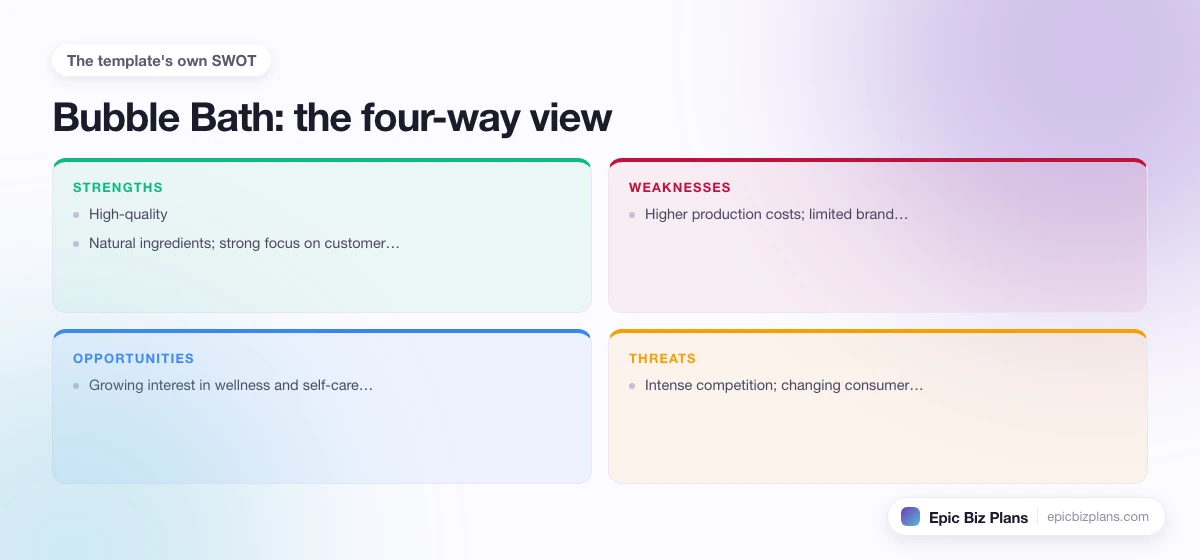
- Strengths: High-quality, natural ingredients; strong focus on customer experience.
- Weaknesses: Higher production costs; limited brand recognition initially.
- Opportunities: Growing interest in wellness and self-care products; potential collaborations with influencers.
- Threats: Intense competition; changing consumer preferences.
Bubble Bath Business Name Ideas
Website
We will build the website on Shopify because it handles inventory, payments, and subscription apps out of the box. The site will load fast on mobile, where most of our paid social traffic lands, and product pages will include real customer photos and ingredient transparency rather than only stock imagery.
The store will be optimized for mobile checkout and one-click upsells (a hand soap, a goat milk soap bar, or body butter at the cart) so we can lift average order value without complicating the customer experience.
Marketing Details
Our marketing combines SEO, paid social, and influencer partnerships. We will use Semrush for keyword research, with a focus on long-tail terms tied to specific ingredients (for example, "oat milk bubble bath" or "sulfate-free bubble bath"). HubSpot will run our email campaigns, including a welcome flow with a discount, weekly self-care content, and reorder reminders for subscribers.
Influencer partnerships will favor smaller, niche creators in the wellness and self-care space because their audiences convert better than generic lifestyle accounts. We will run TikTok and Instagram Reels ads tied to specific product pages and run a referral program for existing customers because word-of-mouth is the highest-converting channel in this category.
Industry Trends
The wellness category is shifting toward clean labels, refillable packaging, and ingredient transparency. Buyers expect to see what is in the bottle and what it does, with no industry jargon and no surprise allergens. We will track these shifts and update formulations and packaging as customer demand justifies it. Operators in adjacent categories such as a homemade soap business plan face similar formulation and packaging pressures.
Competitor Information
Competitor analysis covers established luxury bath brands, mass retailers expanding into clean-label lines, and indie creators selling on Etsy and through their own DTC sites, including small makers who follow the whipped soap business plan template. Established brands compete on shelf presence and brand recognition; indie creators and adjacent liquid soap makers compete on personality and unique formulations.
We differentiate through tight focus on bubble bath specifically (rather than sprawling across categories), unique formulations, recyclable or refillable packaging, and a brand voice that does not pretend to be more than it is. Operators in the broader health and wellness business plan category use similar tactics.
Financial Information
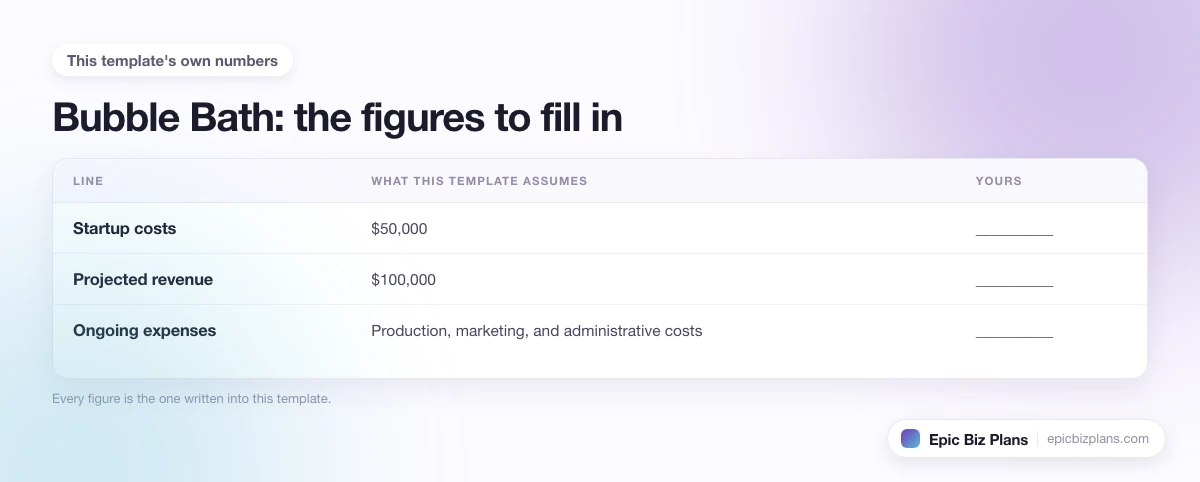
Startup costs are estimated at $50,000, covering product formulation, initial inventory, marketing, and website development. Year-one revenue is forecast at $100,000 with a 20% profit margin. Ongoing expenses include production, marketing, and administrative costs, with detailed cash flow and quarterly P&L statements.
Startup Cost Breakdown
- Product formulation and stability testing: $3,000-$10,000 across multiple iterations.
- Initial inventory production: $10,000-$25,000 depending on co-manufacturer minimum order quantities.
- Packaging design and print plates: $2,000-$8,000 for branded labels, boxes, and inserts.
- Shopify and apps: $50-$200 per month for the store, subscriptions, and reviews.
- Initial paid ads and influencer seeding: $5,000-$15,000 to find a winning creative angle.
- Compliance and legal: $1,000-$3,000 for cosmetic labeling compliance, INCI naming, and trademark filing.
Legal and Compliance
We will comply with local cosmetic regulations regarding product safety, INCI ingredient naming, and labeling. This includes registering the business and obtaining the necessary permits to produce and sell personal care products. We will also pursue trademark protection for our brand name and any unique product line names.
Operational Plan
Day-to-day operations cover ingredient sourcing, formulation, packaging, and order fulfillment. A reliable supply chain is essential, especially for natural ingredients with seasonality. We will work with a vetted co-manufacturer for production and a 3PL for fulfillment so we can focus on brand and demand generation.
-
 SemrushSemrush is a platform with literally any online tool you will need to promote your business. Spy on your competitors, get search traffic, keyword research, social info, ad copies and much more. Used by most of the top online companies in the world. Besides all its tools, Semrush also has many available integrations possible with many other tools that will make your work even better.
 -
 Surfer SEOSurfer SEO is an incredibly smart AI tool that will give you exact explanations what to do in order to make your website rank better. They use hundreds of parameters, check your competitors and decide on the best course of action. Whether it be inner links, bold text, paragraphs, headers, images and much more. Surfer is a must-have in 2026.
Common Mistakes to Avoid
- Launching with too many SKUs: three to five focused products convert better than a dozen mediocre ones.
- Skipping stability testing: a natural formula that separates or molds on shelf damages the brand fast.
- Overpaying for influencers: small niche creators usually outperform large lifestyle accounts.
- Pricing too low: low prices attract one-time customers and signal a budget brand.
- Ignoring reorder cadence: bubble bath is consumable; build automated reminders to drive subscriptions.
Key Performance Metrics
We track gross margin per SKU, customer acquisition cost, repeat purchase rate, subscription churn, and average order value. Targets are at least 60% gross margin on DTC, a CAC payback under six months, and a 30%+ 60-day repeat purchase rate. Operators in adjacent categories such as an ecommerce candle business plan watch similar metrics with different benchmarks.
Contingency Planning
Key risks include ingredient price volatility, formulation changes that affect product feel, and ad cost inflation. We mitigate ingredient risk with multiple supplier relationships and rolling stability testing. We mitigate ad risk by building owned channels (email, SMS, content) so we are not dependent on a single platform's costs. We will hold three months of operating expenses in reserve.
Your Vision, Your Freedom
Building a bubble bath business is about more than selling product. It combines formulation, brand identity, and a real point of view on what self-care should feel like. The work is creative and operational at the same time, and the model fits founders who care about both the science of formulation and the design of a brand experience.
Explore Every Angle
The bubble bath plan should adapt as you grow. Update the audience, pricing model, and channel mix based on what real customers do. Keep the document dynamic so the strategy keeps pace with the business. Adjacent operators in candle and soap often run a similar review cadence on their own plans.
Practical Applications
Your bubble bath business plan supports several practical tasks: pitching potential partners, planning a launch, supporting a funding application, or simply pressure-testing your own thinking. Each round of edits brings the document closer to something you actually run the business from.
Take Action Today
Your bubble bath business plan is 100% free, with unlimited edits and unlimited downloads. Use it as a starting point and shape it into something specific to your formulations, your customers, and your supplier setup.
