
Bubba Business Plan Template
-
 ShopifyPut your brand on Shopify. Launch your online store with tools designed for growth and success. Ready to turn your idea into profit? Start building your e-commerce business today.
 -
 SquarespaceShowcase your brand with Squarespace’s sleek designs. Build a professional online presence with ease. Start with a template that already looks finished.
 -
 WixBring your ideas to life with Wix. Customize every aspect of your site with unmatched flexibility. Start creating your unique online space and let your creativity shine.
 -
 ElementorCraft captivating websites effortlessly with Elementor. Enjoy complete creative control without coding. Make your site stand out to your audience. Start turning your vision into reality now.
- Executive Summary
- Business Info
- Business Model Overview
- SWOT Analysis
- Bubba Business Name Ideas
- Website
- Marketing Details
- Industry Trends
- Competitor Information
- Financial Information
- Legal and Compliance
- Operational Plan
- Contingency Planning
- Why a Food Business Built on Quality Actually Works
- The Range of Business Models in This Space
- Updating Your Plan as Your Business Learns
- Use Your Plan Strategically
Your Bubba business plan covers a specific niche: high-quality, home-style food products that compete on authenticity and flavor rather than price. The market for artisanal food brands is growing, but standing out in it requires more than good recipes - it requires a documented strategy for positioning, distribution, and financial sustainability.
This plan is a practical starting point. It covers the core sections every serious food business needs: a clear executive summary, a realistic financial model, a marketing approach grounded in where your customers actually spend their time, and contingency planning for the supply disruptions that every food business eventually faces.
Executive Summary
Bubba delivers high-quality, home-style food products grounded in traditional family recipes - sauces, seasonings, and packaged meals made to taste like something from an actual kitchen. Our mission is to give customers a convenient way to eat food that feels homemade, not manufactured. We see a direct line from our brand promise to customer loyalty in a market where most packaged food tastes processed and generic. Financially, we are targeting breakeven in year one and $500,000 in revenue by the end of year two. Founders building adjacent comfort food brands should also review a home-made food business plan for comparable positioning and production strategies.
Business Info
Our product line includes artisanal sauces, seasonings, and packaged meals. Target customers are food enthusiasts, families who want convenient but quality food, and individuals who care about what they're eating and where it came from. We will sell primarily online with farmers' markets and local food festivals as complementary channels for brand building and in-person trial.
Business Model Overview
Direct-to-consumer e-commerce is our primary channel, keeping margins healthy and giving us direct customer relationships. We will complement online sales with local market appearances to build brand recognition in our home region before expanding distribution. Catering for local events provides a third revenue stream that requires minimal additional overhead.
SWOT Analysis
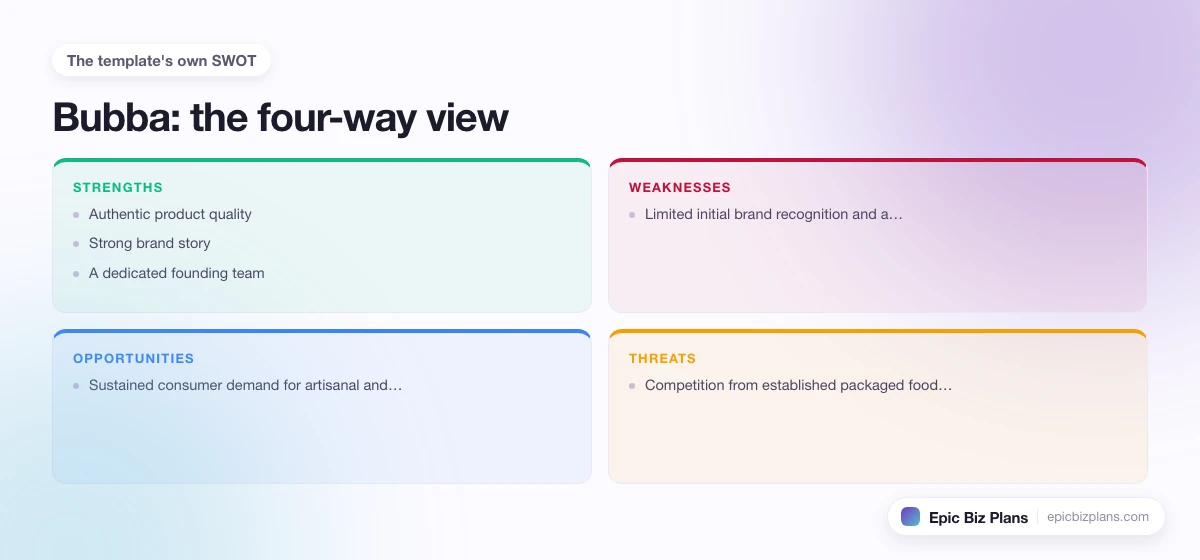
- Strengths: Authentic product quality, strong brand story, and a dedicated founding team.
- Weaknesses: Limited initial brand recognition and a revenue model that depends heavily on online traffic and repeat purchases.
- Opportunities: Sustained consumer demand for artisanal and locally-sourced food products.
- Threats: Competition from established packaged food brands with larger marketing budgets and changing consumer spending patterns.
Bubba Business Name Ideas
Website
We will build on Shopify for its product management, payment processing, and inventory tools - all well-suited for a packaged food brand managing a SKU-based catalog. Product pages will feature clear ingredient lists, sourcing notes, and serving suggestions that reinforce our quality story. We will also maintain a recipe blog to drive organic search traffic and give customers practical reasons to buy our products regularly. Brands pairing packaged sauces with a broader seasoning line should also look at a seasoning business plan for category expansion strategy.
Marketing Details
Semrush will guide our keyword and content strategy, focusing on search terms related to artisanal food, family recipes, and specific product categories we sell. HubSpot will manage email campaigns including product launch announcements, recipe content, and loyalty offers for repeat customers. TikTok advertising will target younger food enthusiasts who respond to behind-the-scenes production content and recipe videos - a format that showcases our authenticity naturally.
Industry Trends
Consumer preference for clean-label, locally-sourced, and small-batch food products has grown consistently over the past decade and shows no sign of reversing. Sustainability in packaging and ingredient sourcing is moving from a differentiator to a baseline expectation among our target customers. E-commerce has made it practical for small food brands to reach national audiences without retail distribution, which lowers the capital requirements for entering this market compared to five years ago. Food businesses expanding from packaged goods into related restaurant concepts should review a fast food business plan for operational benchmarks.
Competitor Information
Direct competitors include other artisanal food brands selling through their own sites and farmers' markets. Indirect competitors include mainstream grocery store brands that target convenience rather than quality. Our differentiation is authenticity - our recipes, our ingredients, and our production process are all things our customers can see and understand, which is not something large packaged food companies can replicate credibly.
Financial Information
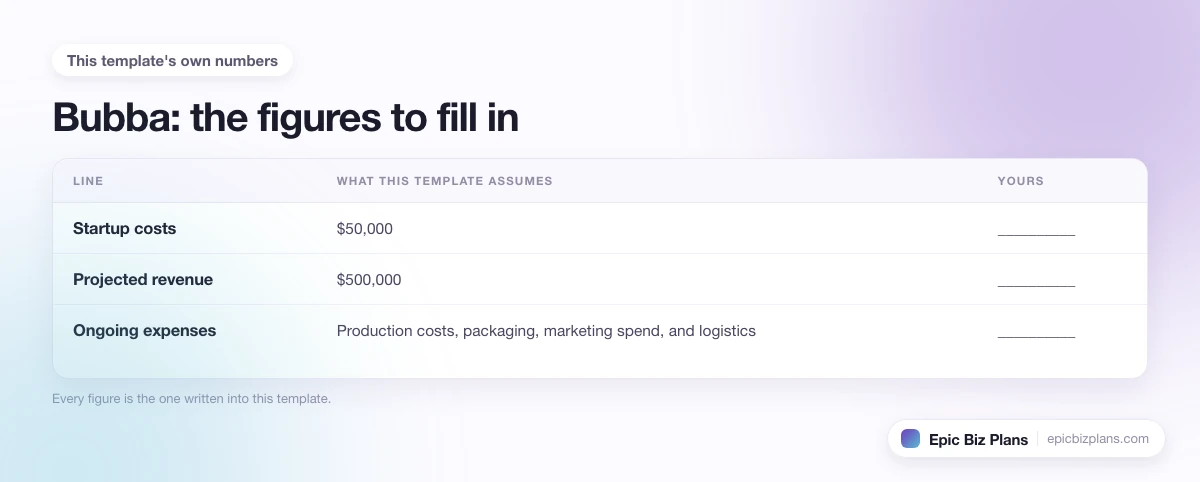
Startup costs are estimated at $50,000, covering production equipment, initial inventory, website development, and launch marketing. We project $250,000 in first-year revenue, growing to $500,000 by end of year two. Monthly operating expenses include production costs, packaging, marketing spend, and logistics. Cash flow will be reviewed monthly with P&L statements prepared each period to track progress against targets.
Legal and Compliance
We will obtain all required business licenses and food production permits before any product goes to market. Labeling will comply fully with applicable food safety regulations, including allergen disclosures and ingredient transparency. We will trademark the Bubba brand name and evaluate recipe protection options as our product line matures.
Operational Plan
Core operations center on sourcing quality ingredients from local vendors, maintaining production consistency, and fulfilling online orders within published shipping windows. We will establish formal agreements with two or three suppliers for each key ingredient category to reduce dependency on any single source. Delivery partnerships will be selected based on handling standards for food products and shipping time reliability.
Contingency Planning
Supply chain disruptions and ingredient cost increases are the most predictable risks for a food business at our stage. We will maintain relationships with backup suppliers for our primary ingredients and hold a cash reserve sufficient to cover three months of operating costs without revenue. If a key ingredient becomes unavailable, we have recipe flexibility built into our development process to substitute without sacrificing quality.
Why a Food Business Built on Quality Actually Works
Consumers are paying more attention to what they eat and where it comes from. A brand that can deliver on a genuine quality promise - not just a marketing claim - earns repeat purchases and word-of-mouth referrals in a way that advertising cannot buy. The Bubba concept is built on that premise: food that actually tastes like someone cared about making it.
The Range of Business Models in This Space
Artisanal food businesses operate across a wide range of formats - from solo makers selling at weekend markets to fully scaled e-commerce brands with national distribution. The model you choose affects your production requirements, pricing structure, and growth timeline. This plan is flexible enough to support any of those paths; what matters is that you pick one and build toward it with discipline.
-
 SemrushSemrush is a platform with literally any online tool you will need to promote your business. Spy on your competitors, get search traffic, keyword research, social info, ad copies and much more. Used by most of the top online companies in the world. Besides all its tools, Semrush also has many available integrations possible with many other tools that will make your work even better.
 -
 Surfer SEOSurfer SEO is an incredibly smart AI tool that will give you exact explanations what to do in order to make your website rank better. They use hundreds of parameters, check your competitors and decide on the best course of action. Whether it be inner links, bold text, paragraphs, headers, images and much more. Surfer is a must-have in 2026.
Updating Your Plan as Your Business Learns
Your Bubba business plan should evolve with your business. As you discover which products sell fastest, which marketing channels bring repeat buyers, and which price points your audience accepts, update the plan accordingly. A business plan grounded in real data is a far more useful tool than one that exists only as a projection.
Use Your Plan Strategically
Present this plan to potential retail buyers, investors, or co-packing partners to demonstrate that you've thought through the real challenges of building a food brand. A clear, specific plan builds credibility with everyone who needs to trust your operation before they commit to it.
Your Bubba business plan is 100% free - with unlimited edits, unlimited downloads, and unlimited chances to get it right. Start with what you know, test what you don't, and build from there.
