
Brownies Business Plan Template
-
 ShopifyPut your brand on Shopify. Launch your online store with tools designed for growth and success. Ready to turn your idea into profit? Start building your e-commerce business today.
 -
 SquarespaceShowcase your brand with Squarespace’s sleek designs. Build a professional online presence with ease. Start with a template that already looks finished.
 -
 WixBring your ideas to life with Wix. Customize every aspect of your site with unmatched flexibility. Start creating your unique online space and let your creativity shine.
 -
 ElementorCraft captivating websites effortlessly with Elementor. Enjoy complete creative control without coding. Make your site stand out to your audience. Start turning your vision into reality now.
- Executive Summary
- Business Info
- SWOT Analysis
- Brownies Business Name Ideas
- Website
- Marketing Details
- Industry Trends
- Competitor Information
- Commercial Kitchen and Licensing Requirements
- Financial Information
- Packaging and Shipping Strategy
- Legal and Compliance
- Operational Plan
- Contingency Planning
- Pricing and Profit Margins
- Start Your Brownies Business
- Adapt and Evolve Your Business Plan
- Practical Uses for Your Plan
- Get Started
A brownies business plan is your guide to turning a love of baking into a real, revenue-generating company. The dessert market has room for specialty bakers who can deliver consistently great products, and brownies are one of the most popular and giftable treats around. Whether you plan to sell online, at local markets, or wholesale to cafes, this plan helps you map out every step.
As you develop your brownies business plan, focus on what makes your recipes worth buying. Maybe it is your ingredient sourcing, your unique flavor combinations, or your options for dietary restrictions like vegan or gluten-free. Each decision should be grounded in what your target customers actually want, not just what sounds good on paper. If you plan to add cold items, a melt business plan template covers artisan ice cream and frozen treats that pair well with baked goods.
Executive Summary
Our mission is to provide high-quality, delicious brownies that cater to various tastes and dietary preferences. We aim to become a recognized brand among brownie lovers, known for creative flavors and premium ingredients. Our value proposition is delivering a fresh, indulgent experience that satisfies cravings while using sustainably sourced ingredients.
We plan to reach profitability within the first year of operations and achieve substantial revenue growth over the following five years.
Business Info
We will specialize in artisan brownies, offering classic chocolate, vegan, gluten-free, and seasonal flavors. Our target market includes dessert enthusiasts, health-conscious consumers, and people shopping for gourmet gift options. The business model combines direct online sales through our website, local event sales, and wholesale distribution to cafes and restaurants.
SWOT Analysis
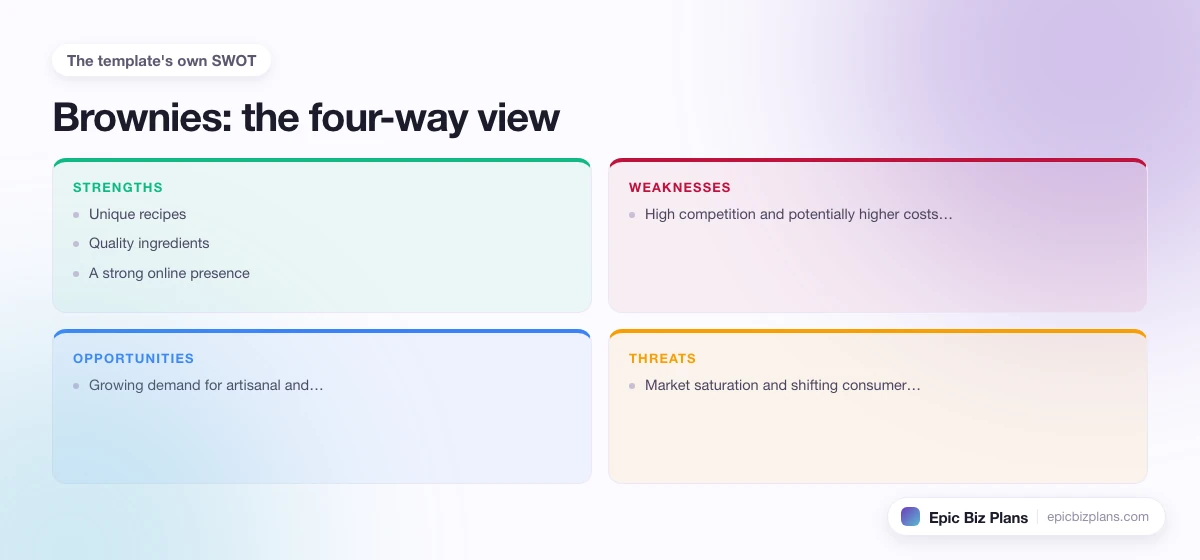
- Strengths: Unique recipes, quality ingredients, and a strong online presence.
- Weaknesses: High competition and potentially higher costs for quality ingredients.
- Opportunities: Growing demand for artisanal and dietary-friendly desserts.
- Threats: Market saturation and shifting consumer preferences.
Brownies Business Name Ideas
Website
We will build our website using Shopify, which handles e-commerce well and makes it simple to manage product listings, orders, and shipping. Shopify's built-in tools for inventory and customer management will save time as we scale. Squarespace is also worth considering if our brand leans toward a premium aesthetic with strong photography. Bakers starting from a domestic kitchen can review our home baking business plan template for cottage-food setup specifics.
Marketing Details
Our marketing strategy will combine SEO, email, and social media. Semrush will help us rank for searches related to brownie delivery, gourmet brownies, and specialty desserts. HubSpot will manage our email list, sending promotions, new flavor announcements, and seasonal offers to subscribers.
TikTok and Instagram will be our main social platforms. Short baking videos, packaging reveals, and taste-test content are proven formats for food businesses. User-generated content from happy customers is the most effective form of social proof. For inspiration on food business marketing, see our confectionery business plan template.
Industry Trends
The dessert industry is experiencing strong demand for artisanal, small-batch products. Consumers are increasingly willing to pay more for premium ingredients and unique flavors. E-commerce and food delivery services have expanded how people buy baked goods, making it possible to ship nationwide. Health-conscious alternatives like vegan, keto, and gluten-free options are no longer niche but mainstream expectations. The same buyer behavior shows up across baked goods, as outlined in our cake business plan template.
Competitor Information
Direct competitors include other specialty brownie brands selling online and at local markets. Indirect competitors include bakeries with brownie offerings and large retailers with packaged brownie products. We will differentiate through unique flavor profiles, premium packaging, and a brand personality that connects with customers on social media. Brownie businesses looking to expand their product line with complementary items like cookies and specialty bars should review the cookies and brownies business plan template, which covers combined product strategy, dietary-specific variants, and the corporate gifting sales channel in detail.
Commercial Kitchen and Licensing Requirements
Most states require food businesses to prepare products in a licensed commercial kitchen. Options include renting time in a shared commercial kitchen, which typically costs $15-$30 per hour, or building out your own licensed space. You will also need a food handler's permit and potentially a cottage food license if your state allows home-based food production under certain conditions.
Health department inspections are routine, so keep your workspace clean and your documentation organized. Labeling requirements for allergens and nutritional information vary by state and sales channel. For additional context, see our cookie business plan template.
Financial Information
Startup costs include ingredients, packaging materials, marketing expenses, and website development. We project initial revenue from online sales and local events, aiming to break even within the first year. Ongoing expenses cover production costs, marketing, and operational overhead. Monthly cash flow tracking and profit-and-loss reviews will keep our finances on course.
Packaging and Shipping Strategy
Packaging is a major part of the customer experience for a brownie business. Invest in sturdy, attractive boxes that protect the product during shipping and look great when opened. Custom branded packaging with your logo reinforces brand recognition and encourages customers to share unboxing photos on social media.
For shipping, test multiple carriers to find the best balance of cost and delivery speed. Brownies ship well when vacuum-sealed or individually wrapped, and including a small branded card or note adds a personal touch that drives repeat purchases. Brownies sell strongly as presents, so the channel strategy in our gifting business plan template pairs well with this plan. For related shipping and fulfillment ideas, check our gluten-free food box business plan template.
-
 SemrushSemrush is a platform with literally any online tool you will need to promote your business. Spy on your competitors, get search traffic, keyword research, social info, ad copies and much more. Used by most of the top online companies in the world. Besides all its tools, Semrush also has many available integrations possible with many other tools that will make your work even better.
 -
 Surfer SEOSurfer SEO is an incredibly smart AI tool that will give you exact explanations what to do in order to make your website rank better. They use hundreds of parameters, check your competitors and decide on the best course of action. Whether it be inner links, bold text, paragraphs, headers, images and much more. Surfer is a must-have in 2026.
Legal and Compliance
We will complete business registration and obtain all permits required for food sales in our area. Recipe and branding protection through intellectual property registrations will be pursued as appropriate. If selling across state lines, federal food safety regulations also apply. Explore more on food business compliance in our chocolate banana business plan template.
Operational Plan
Operations will center on sourcing quality ingredients from local suppliers, managing production in a licensed commercial kitchen, and fulfilling orders on time. Inventory management is critical for perishable goods, so we will use a just-in-time approach to minimize waste. As volume grows, batch scheduling and prep lists keep production efficient.
Contingency Planning
Key risks include supply chain disruptions for specialty ingredients and seasonal demand fluctuations. We will maintain backup suppliers for all critical ingredients and diversify our product line to include items with longer shelf life. A three-month financial reserve covers operating costs during slow periods. For more food business risk strategies, see our smoothie bowl business plan template.
Pricing and Profit Margins
Pricing brownies starts with knowing your cost per unit, which includes ingredients, packaging, kitchen rental, and a share of labor. Premium brownies typically sell for $3 to $6 each at retail, while gift boxes of six to twelve range from $24 to $48. A healthy specialty bakery aims for food costs at or below 30 percent of the selling price, leaving room for shipping and marketing.
Wholesale pricing to cafes usually runs 40 to 50 percent below retail, so reserve that channel for steady, high-volume accounts. Track margins by flavor, because vegan and gluten-free batches often carry higher ingredient costs that justify a price premium. Reviewing pricing every quarter against ingredient cost changes keeps the business profitable as you scale. For a deeper look at premium positioning, see our chocolate bar business plan template.
Start Your Brownies Business
A brownies business combines a practical skill with a product that people genuinely enjoy buying and giving as gifts. Whether you start with a small home kitchen operation or launch directly into a commercial space, the path from first batch to full-time business is well-worn and achievable. The key is consistency in your product, attention to your customers, and a willingness to adapt as you learn.
Adapt and Evolve Your Business Plan
Your brownies business plan will change as you grow. New recipes, different markets, seasonal offerings, and pricing adjustments should all be reflected in updated versions of your plan. Use customer feedback to guide your menu development and marketing direction. For related baking business ideas, browse our tiramisu business plan template.
Practical Uses for Your Plan
Think of your brownies business plan as a working document. It helps you present to potential wholesale partners, apply for a commercial kitchen lease, plan your launch, or organize your finances. Each update makes your business stronger.
Get Started
Your brownies business plan is 100% free with unlimited edits, unlimited downloads, and unlimited chances to get it right. Start baking your way to a successful business today.
