
Braid Business Plan Template
-
 ShopifyPut your brand on Shopify. Launch your online store with tools designed for growth and success. Ready to turn your idea into profit? Start building your e-commerce business today.
 -
 SquarespaceShowcase your brand with Squarespace’s sleek designs. Build a professional online presence with ease. Start with a template that already looks finished.
 -
 WixBring your ideas to life with Wix. Customize every aspect of your site with unmatched flexibility. Start creating your unique online space and let your creativity shine.
 -
 ElementorCraft captivating websites effortlessly with Elementor. Enjoy complete creative control without coding. Make your site stand out to your audience. Start turning your vision into reality now.
- Executive Summary
- Business Info
- Products and Services
- Target Market
- Business Model Overview
- SWOT Analysis
- Braid Business Name Ideas
- Website
- Marketing Details
- Industry Trends
- Competitor Information
- Financial Information
- Legal and Compliance
- Operational Plan
- Contingency Planning
- Startup Cost Breakdown
- Your Braid Business Awaits
- Types of Braid Businesses
- Future-Proof Your Plan
- Practical Uses of Your Plan
Hair braiding is one of the few beauty service businesses where deep cultural knowledge is a genuine competitive advantage. Clients don't just want technical skill - they want someone who understands their hair type, the styles they're asking for, and the care required to maintain their hair's health. If you have that expertise, this business plan will help you build it into a scalable, profitable operation.
The braiding market has expanded well beyond traditional hair braiding services into handcrafted braided jewelry, home decor, and educational workshops. This plan covers the core service model but also outlines how to add product revenue streams that extend your income beyond appointment bookings. For a closely related angle, see the Wig business plan template.
Executive Summary
We will establish a braiding-focused business offering hair braiding services, handcrafted braided products (jewelry and home decor), and braiding workshops. Our mission is to deliver a high-quality, culturally informed braiding experience that clients cannot find at a generic salon. We project Year 1 revenue of $300,000, growing at 20% annually, built from service revenue, product sales, and workshop enrollment fees. We aim for 20% net profit margins by Year 2 as our client base grows through referrals and our product line scales.
Business Info
Products and Services
Our primary service is professional hair braiding - box braids, cornrows, knotless braids, locs installation, and related styles. Supplementary products include handcrafted braided jewelry and decorative braided items sold through our Shopify store. Workshops and tutorials (both in-person and online) provide an additional revenue stream while establishing our expertise authority in the market. Businesses building out a full natural hair care service model may want to reference a natural hair care business plan for complementary service structures.
Target Market
Our primary customers are fashion-forward individuals aged 15-35 who value skilled, culturally knowledgeable braiding services. We also serve parents seeking quality protective styles for children, and eco-conscious buyers looking for handcrafted alternatives to mass-produced accessories. Our workshop audience includes aspiring braiders and beauty professionals looking to expand their skill set.
Business Model Overview
We operate through a physical studio for service delivery and an online store for product and workshop sales. Service appointments are the primary revenue driver; the online channel extends our revenue nationally without geographic limitations. This dual model allows us to build brand recognition locally while selling products and workshop access to a much larger audience. For those operating the product side more extensively, a hair and beauty business plan outlines the retail and wholesale dynamics relevant to beauty product lines.
SWOT Analysis
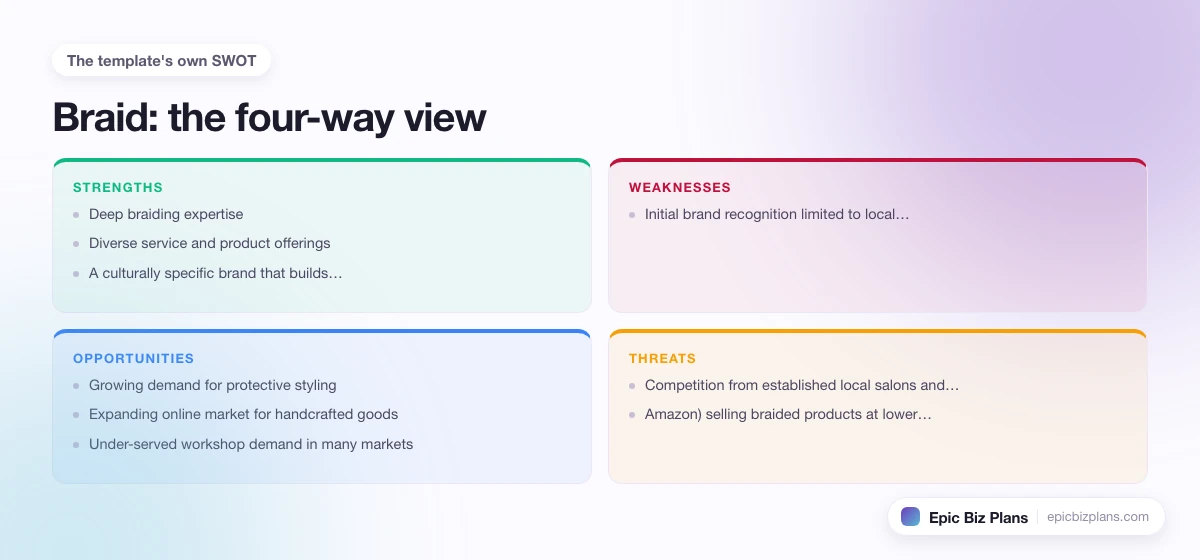
- Strengths: Deep braiding expertise, diverse service and product offerings, and a culturally specific brand that builds genuine loyalty.
- Weaknesses: Initial brand recognition limited to local market; service revenue is capped by available appointment hours.
- Opportunities: Growing demand for protective styling, expanding online market for handcrafted goods, and under-served workshop demand in many markets.
- Threats: Competition from established local salons and large e-commerce platforms (Etsy, Amazon) selling braided products at lower price points.
Braid Business Name Ideas
Website
Shopify works well for this business because it handles both appointment-adjacent product sales and digital workshop delivery. For service booking, integrate a booking app (Booksy, StyleSeat, or Square Appointments) directly linked from the website. The site should showcase a clear portfolio of braiding work - quality photos are the primary sales tool for a service this visual. A separate section for handcrafted products with clear shipping timelines and a workshop registration page complete the site structure. As a simpler alternative, Squarespace offers strong portfolio presentation for creatives who prefer a lighter setup.
Marketing Details
Hair braiding businesses grow primarily through visual social media content. Instagram and TikTok are the highest-ROI channels: before/after transformation videos, time-lapse braiding sessions, and client testimonial clips consistently generate bookings when posted consistently. Semrush will guide our local SEO strategy targeting queries like "box braids [your city]" and "protective style braider near me" - searches that convert directly to appointment bookings. HubSpot email campaigns will manage a client list for rebooking reminders (most clients return every 4-8 weeks) and new service announcements.
For the product side, TikTok ads targeting the handmade accessories audience perform well when the creative shows the braiding process. Paid retargeting on Instagram and Pinterest will support the e-commerce product catalog. Workshop marketing can use email to existing clients and Facebook Groups for natural hair communities in our target demographic.
Industry Trends
The protective styling market, which includes braiding as its largest segment, has grown significantly as more consumers adopt low-manipulation hair care routines. The CROWN Act movement and broader cultural recognition of natural hair styles have driven new demand for braiding services from customers who previously wore relaxed styles. Online education in hair braiding has expanded rapidly, with instructors generating substantial revenue through digital course sales and YouTube monetization. The handcrafted accessories market continues to grow as consumers seek alternatives to mass-produced goods, and braided jewelry occupies a premium niche within that market.
Competitor Information
Direct competitors are local hair braiding salons and independent braiders working from home or mobile setups. Indirect competition includes YouTube tutorials that teach clients to DIY (which we can partially counter with our own educational content that also drives workshop enrollment). Our differentiation is quality and consistency: we will deliver the same high standard on every appointment, maintain a clean and welcoming studio, and use high-quality hair extensions and materials that reduce client breakage and extend the life of each style. Referrals from satisfied clients are the most valuable competitive asset in this business.
Financial Information
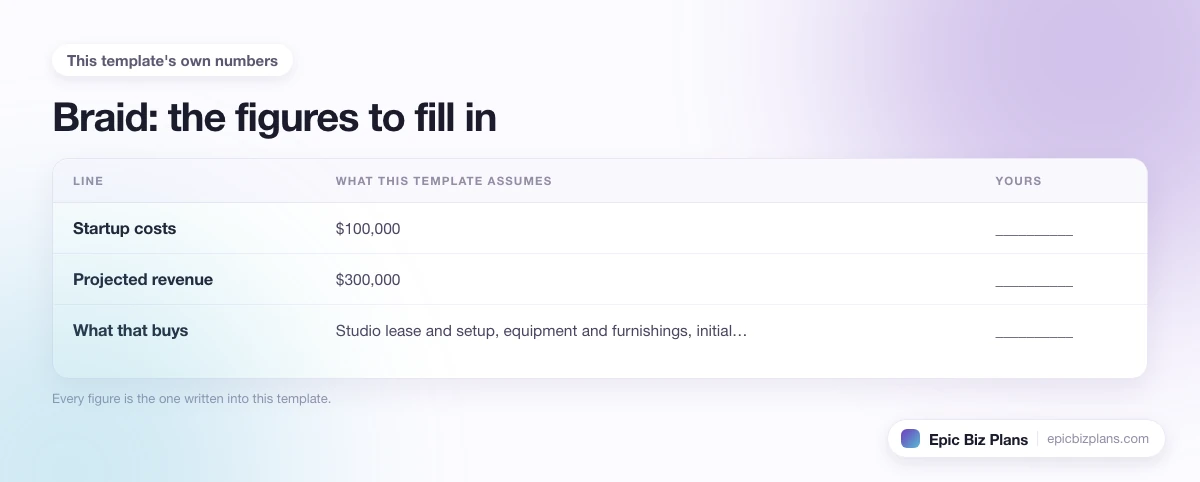
Startup costs are estimated at $100,000, covering studio lease and setup, equipment and furnishings, initial product inventory, website development, and the first two months of operating expenses. Year 1 revenue projection of $300,000 breaks down as: $200,000 from service appointments (averaging 3-4 clients per day at $80-$200 per service), $60,000 from handcrafted product sales, and $40,000 from workshops and digital courses. Ongoing annual expenses including rent, supplies, marketing, and software are estimated at $150,000, targeting 20%+ net margins by Year 2.
Legal and Compliance
Hair braiding licensing requirements vary significantly by state - some states require a full cosmetology license, others have a specific braiding exemption, and a growing number have no license requirement for natural hair braiding. We will verify our state's specific requirements before opening and obtain any required permits. General business registration, a DBA if operating under a business name, general liability insurance, and a professional liability policy are all required. If selling food or any product with skin contact claims, additional product regulations may apply.
Operational Plan
The studio will operate Tuesday through Saturday with appointment slots structured to allow 3-4 clients per day for a solo braider, scaling to 5-6 with a second braider added in Year 2. Check-in protocols, hair health consultations, and aftercare instructions will be standardized so every client experience is consistent. Product inventory for handcrafted items will be managed weekly, with production batches scheduled around the appointment calendar. Workshop cohorts will be capped at 8 participants per session to maintain instruction quality.
Contingency Planning
Key risks include appointment no-shows (which we will mitigate with a 24-hour cancellation policy and deposits for new clients), supply chain disruptions for hair extension products, and slower-than-expected e-commerce product sales. Emergency fund covering 3 months of operating expenses will be maintained from the outset. If service revenue grows faster than product revenue, we will shift resources toward adding a second braider rather than scaling the product line, since services have higher margins per hour of labor invested.
-
 SemrushSemrush is a platform with literally any online tool you will need to promote your business. Spy on your competitors, get search traffic, keyword research, social info, ad copies and much more. Used by most of the top online companies in the world. Besides all its tools, Semrush also has many available integrations possible with many other tools that will make your work even better.
 -
 Surfer SEOSurfer SEO is an incredibly smart AI tool that will give you exact explanations what to do in order to make your website rank better. They use hundreds of parameters, check your competitors and decide on the best course of action. Whether it be inner links, bold text, paragraphs, headers, images and much more. Surfer is a must-have in 2026.
Startup Cost Breakdown
Estimated costs for launching a braiding studio with product and workshop components:
- Studio lease deposit and first 2 months: $6,000-$12,000
- Studio setup, chairs, mirrors, lighting: $8,000-$15,000
- Initial hair extension inventory and supplies: $10,000-$20,000
- Braided product initial inventory (materials): $5,000-$10,000
- Website and booking system setup: $3,000-$6,000
- Branding and photography: $4,000-$8,000
- Legal and licensing fees: $2,000-$4,000
- Marketing (first 3 months): $8,000-$15,000
- Operating reserve: $15,000-$25,000
Total range: $61,000-$115,000. A home studio setup for a solo braider with a lean product line can launch for $30,000-$50,000.
Your Braid Business Awaits
Starting a braiding business means building something that matters to your clients in a tangible way. The right protective style isn't just an aesthetic choice - for many clients, it's a practical necessity for maintaining healthy hair. When you do that work well, clients return, refer their friends, and become long-term relationships rather than one-time transactions.
Types of Braid Businesses
The braiding niche includes storefront salons, mobile braiders who come to clients, online education businesses that scale without geographic limits, and product businesses focused entirely on braided accessories and decor. Hybrid models that combine services with products and workshops generate the most diversified revenue, which reduces vulnerability to any single slow period.
Future-Proof Your Plan
The hair care industry evolves quickly. New protective styles gain popularity, new extension materials enter the market, and client preferences shift. Stay current through professional networks, social media, and continuing education. Update your service menu and pricing annually to reflect market rates in your area - underpricing is the most common financial mistake in service businesses.
Practical Uses of Your Plan
This plan can help you secure a studio lease (some landlords require a business plan), apply for a small business loan, or structure a conversation with a potential business partner. The financial projections are the most scrutinized section in any funding conversation - make sure your service pricing and client volume assumptions are realistic and defensible.
This braid business plan template is free. Edit every section to reflect your specific services, market, and financial situation, and it becomes a genuinely useful planning tool.
